On Duties (eBook)
248 Seiten
Cornell University Press (Verlag)
978-1-5017-0652-3 (ISBN)
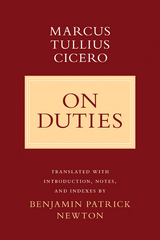
Benjamin Patrick Newton's translation of Cicero’s On Duties is the most complete edition of a text that has been considered a source of moral authority throughout classical, medieval, and modern times. It features an introduction, outline, footnotes, interpretative essay, glossary, and indexes, making Cicero’s thought accessible.
"This new translation of Cicero's De Officiis, which combines scrupulous faithfulness to the Latin text with smooth readability in English, is a welcome gift to students of manners, morals, ethics, and politics. Cicero’s classic book, somewhat neglected over the last century or so, is due for a revival of interest; this translation, together with its helpful aids to interpretation, should contribute to that end."â•James H. Nichols, Claremont McKenna Colleg
This new edition of On Duties aims to provide readers who cannot read Latin but wish to study the book with a literal yet elegant translation. It features an introduction, outline, footnotes, interpretative essay, glossary, and indexes, making Cicero’s thought accessible to a general audience.
Benjamin Patrick Newton’s translation of Cicero’s On Duties is the most complete edition of a text that has been considered a source of moral authority throughout classical, medieval, and modern times. Marcus Tullius Cicero was a preeminent Roman statesman, orator, and philosopher who introduced philosophy into Rome, and through Rome, into Christendom and the modern world. On Duties was championed by important thinkers including Thomas Aquinas, Montesquieu, and Voltaire, and it was one of the earliest books printed on the Gutenberg press.
The true significance of On Duties lies in its examination of several fundamental problems of political philosophy, the most important being the possible conflict between the honorable and the useful. The honorable encompasses the virtues of human beings, which include justice and concern for the common good. The useful refers to the needs of living beings, which includes certain necessities and concern for private good. Only by understanding the possible conflict between these two sides of human nature, Cicero declares, may we understand our duties to our community and to ourselves.
Benjamin Patrick Newton's translation of Cicero’s On Duties is the most complete edition of a text that has been considered a source of moral authority throughout classical, medieval, and modern times. Marcus Tullius Cicero was a preeminent Roman statesman, orator, and philosopher who introduced philosophy into Rome, and through Rome, into Christendom and the modern world. On Duties was championed by important thinkers including Thomas Aquinas, Montesquieu, and Voltaire, and it was one of the earliest books printed on the Gutenberg press.The true significance of On Duties lies in its examination of several fundamental problems of political philosophy, the most important being the possible conflict between the honorable and the useful. The honorable encompasses the virtues of human beings, which include justice and concern for the common good. The useful refers to the needs of living beings, which includes certain necessities and concern for private good. Only by understanding the possible conflict between these two sides of human nature, Cicero declares, may we understand our duties to our community and to ourselves. This new edition of On Duties aims to provide readers who cannot read Latin but wish to study the book with a literal yet elegant translation. It features an introduction, outline, footnotes, interpretative essay, glossary, and indexes, making Cicero’s thought accessible to a general audience.
Benjamin Patrick Newton is Assistant Professor of Political Science and Coordinator of the Legal Studies Program at Tarleton State University.
| Reihe/Serie | Agora Editions | Agora Editions |
|---|---|
| Übersetzer | Benjamin Patrick Newton |
| Verlagsort | Ithaca |
| Sprache | englisch |
| Maße | 150 x 150 mm |
| Themenwelt | Literatur ► Essays / Feuilleton |
| Sachbuch/Ratgeber ► Geschichte / Politik ► Vor- und Frühgeschichte / Antike | |
| Geschichte ► Allgemeine Geschichte ► Vor- und Frühgeschichte | |
| Geschichte ► Allgemeine Geschichte ► Altertum / Antike | |
| Geisteswissenschaften ► Philosophie ► Ethik | |
| Geisteswissenschaften ► Philosophie ► Philosophie Altertum / Antike | |
| Geisteswissenschaften ► Sprach- / Literaturwissenschaft ► Anglistik / Amerikanistik | |
| Geisteswissenschaften ► Sprach- / Literaturwissenschaft ► Literaturwissenschaft | |
| Sozialwissenschaften ► Politik / Verwaltung ► Politische Systeme | |
| Sozialwissenschaften ► Politik / Verwaltung ► Politische Theorie | |
| Schlagworte | Academic skepticism • Anarchism • ancient drama • Ancient Greek Literature • ancient literature • ancient literature, marcus tullius, cicero, ethics, Roman literature • ancient roman literature • Applied Ethics • appropriate action • Benjamin Patrick Newton • Benjamin Patrick Newton translation • Cicero • Cicero’s political theory • Cicero and Christianity • Cicero for students • Cicero influence on Enlightenment • Cicero moral thought • Cicero On Duties • cicero's social and political thought • Civic Duty • classical ethics • Classical literature • classical moral texts • Classical Political Thought • Classical Texts • De officiis • duties and virtue • duty and responsibility • Ethical decision-making • ethics • Historical Philosophy • History of Philosophy • history of political thought • how to be virtuous • how to be wise • Influential Philosophers • justice and common good • latin text • Latin translation • magnanmity • Marcus Cicero • Marcus Tullius • Marcus Tullius Cicero • modern ethics • Montesquieu • Moral Authority • moral obligations • Moral Philosophy • Philosophy in Rome • philosophy of ethics • philosophy of morality • Political Philosophy • Political Thinking • Political thought • political writings • propriety • Renaissance thought • Roman Literature • roman philosopher • Roman Philosophy • Roman Republic philosophy • Roman statesman • roman virtue • Stoic ethics • Stoicism • Thomas Aquinas • true search for truth and wisdom • virtue • Virtue and Utility • virtue of justice • virtue of wisdom • Voltaire • what is justice • what is magnanimity • what is propriety |
| ISBN-10 | 1-5017-0652-7 / 1501706527 |
| ISBN-13 | 978-1-5017-0652-3 / 9781501706523 |
| Informationen gemäß Produktsicherheitsverordnung (GPSR) | |
| Haben Sie eine Frage zum Produkt? |
 EPUB (Adobe DRM)
Kopierschutz: Adobe-DRM
Adobe-DRM ist ein Kopierschutz, der das eBook vor Mißbrauch schützen soll. Dabei wird das eBook bereits beim Download auf Ihre persönliche Adobe-ID autorisiert. Lesen können Sie das eBook dann nur auf den Geräten, welche ebenfalls auf Ihre Adobe-ID registriert sind.
Details zum Adobe-DRM
Dateiformat: EPUB (Electronic Publication)
EPUB ist ein offener Standard für eBooks und eignet sich besonders zur Darstellung von Belletristik und Sachbüchern. Der Fließtext wird dynamisch an die Display- und Schriftgröße angepasst. Auch für mobile Lesegeräte ist EPUB daher gut geeignet.
Systemvoraussetzungen:
PC/Mac: Mit einem PC oder Mac können Sie dieses eBook lesen. Sie benötigen eine
eReader: Dieses eBook kann mit (fast) allen eBook-Readern gelesen werden. Mit dem amazon-Kindle ist es aber nicht kompatibel.
Smartphone/Tablet: Egal ob Apple oder Android, dieses eBook können Sie lesen. Sie benötigen eine
Geräteliste und zusätzliche Hinweise
Buying eBooks from abroad
For tax law reasons we can sell eBooks just within Germany and Switzerland. Regrettably we cannot fulfill eBook-orders from other countries.
aus dem Bereich