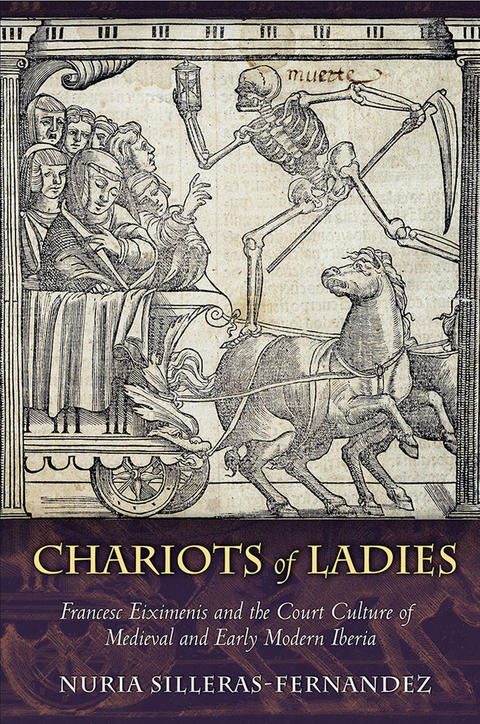
Chariots of Ladies (eBook)
328 Seiten
Cornell University Press (Verlag)
978-1-5017-0163-4 (ISBN)
In Chariots of Ladies, Núria Silleras-Fernández traces the development of devotion and female piety among the Iberian aristocracy from the late Middle Ages into the Golden Age, and from Catalonia to the rest of Iberia and Europe via the rise of the Franciscan Observant movement.
In Chariots of Ladies, Núria Silleras-Fernández traces the development of devotion and female piety among the Iberian aristocracy from the late Middle Ages into the Golden Age, and from Catalonia to the rest of Iberia and Europe via the rise of the Franciscan Observant movement. A program of piety and morality devised by Francesc Eiximenis, a Franciscan theologian, royal counselor, and writer in Catalonia in the 1390s, came to characterize the feminine ideal in the highest circles of the Iberian aristocracy in the era of the Empire. As Eiximenis's work was adapted and translated into Castilian over the century and a half that followed, it became a model of devotion and conduct for queens and princesses, including Isabel the Catholic and her descendants, who ruled over Portugal and the Spanish Empire of the Hapsburgs.Silleras-Fernández uses archival documentation, letters, manuscripts, incunabula, and a wide range of published material to clarify how Eiximenis's ideas on gender and devotion were read by Countess Sanxa Ximenis d'Arenós and Queen Maria de Luna of Aragon and how they were then changed by his adaptors and translators in Castile for new readers (including Isabel the Catholic and Juana the Mad), and in sixteenth-century Portugal for new patronesses (Juana's daughter, Catalina of Habsburg, and Catalina's daughter, Maria Manuela, first wife of Philip II). Chariots of Ladies casts light on a neglected dimension of encounter and exchange in Iberia from the late fourteenth to the mid-sixteenth centuries.
In Chariots of Ladies, Núria Silleras-Fernández traces the development of devotion and female piety among the Iberian aristocracy from the late Middle Ages into the Golden Age, and from Catalonia to the rest of Iberia and Europe via the rise of the Franciscan Observant movement. A program of piety and morality devised by Francesc Eiximenis, a Franciscan theologian, royal counselor, and writer in Catalonia in the 1390s, came to characterize the feminine ideal in the highest circles of the Iberian aristocracy in the era of the Empire. As Eiximenis's work was adapted and translated into Castilian over the century and a half that followed, it became a model of devotion and conduct for queens and princesses, including Isabel the Catholic and her descendants, who ruled over Portugal and the Spanish Empire of the Hapsburgs.
Silleras-Fernández uses archival documentation, letters, manuscripts, incunabula, and a wide range of published material to clarify how Eiximenis's ideas on gender and devotion were read by Countess Sanxa Ximenis d'Arenós and Queen Maria de Luna of Aragon and how they were then changed by his adaptors and translators in Castile for new readers (including Isabel the Catholic and Juana the Mad), and in sixteenth-century Portugal for new patronesses (Juana's daughter, Catalina of Habsburg, and Catalina's daughter, Maria Manuela, first wife of Philip II). Chariots of Ladies casts light on a neglected dimension of encounter and exchange in Iberia from the late fourteenth to the mid-sixteenth centuries.
Núria Silleras-Fernández is Assistant Professor of Spanish at the University of Colorado–Boulder. She is the author of Power, Piety, and Patronage in Late Medieval Queenship: Maria de Luna and coeditor of In and Of the Mediterranean: Medieval and Early Modern Iberian Studies.
Introduction: Eiximenis, His Patronesses, and Female Virtue in Late Medieval and Early Modern IberiaPart I. Genesis1. A Return to Piety: Eiximenis and the Culture of the Late Medieval Catalan Court (The Crown of Aragon, 1327–1409)2. Noble Inspiration: Sanxa Ximenis d'Arenós and the Book of Women (Valencia, c. 1380–96)3. Fit for a Queen: The Scala Dei, Franciscan Queenship, and Maria de Luna (Barcelona, c. 1396–1410)Part II. Afterlife4. Found in Translation: Isabel the Catholic Reads Eiximenis (Castile, c. 1490–1516)5. Eiximenis on the Atlantic: The Chariot of Ladies and Catalina of Habsburg (Portugal, c. 1525–78)Conclusion: Feminine Virtue, Female Agency, and the Legacy of EiximenisWorks Cited
Index
| Erscheint lt. Verlag | 25.11.2015 |
|---|---|
| Zusatzinfo | 6 halftones, 1 geneaological tree, 1 map |
| Verlagsort | Ithaca |
| Sprache | englisch |
| Maße | 160 x 160 mm |
| Themenwelt | Sachbuch/Ratgeber ► Geschichte / Politik ► Mittelalter |
| Geschichte ► Allgemeine Geschichte ► Mittelalter | |
| Geisteswissenschaften ► Geschichte ► Regional- / Ländergeschichte | |
| Geschichte ► Teilgebiete der Geschichte ► Religionsgeschichte | |
| Sozialwissenschaften ► Soziologie ► Gender Studies | |
| Schlagworte | Francesc Eiximenis, Iberian Peninsula, court culture, queenship, feminine conduct, noblewomen, female virtue, development of devotion and female piety, Iberian aristocracy, Iberian history, female empowerment |
| ISBN-10 | 1-5017-0163-0 / 1501701630 |
| ISBN-13 | 978-1-5017-0163-4 / 9781501701634 |
| Informationen gemäß Produktsicherheitsverordnung (GPSR) | |
| Haben Sie eine Frage zum Produkt? |
 EPUB (Adobe DRM)
Kopierschutz: Adobe-DRM
Adobe-DRM ist ein Kopierschutz, der das eBook vor Mißbrauch schützen soll. Dabei wird das eBook bereits beim Download auf Ihre persönliche Adobe-ID autorisiert. Lesen können Sie das eBook dann nur auf den Geräten, welche ebenfalls auf Ihre Adobe-ID registriert sind.
Details zum Adobe-DRM
Dateiformat: EPUB (Electronic Publication)
EPUB ist ein offener Standard für eBooks und eignet sich besonders zur Darstellung von Belletristik und Sachbüchern. Der Fließtext wird dynamisch an die Display- und Schriftgröße angepasst. Auch für mobile Lesegeräte ist EPUB daher gut geeignet.
Systemvoraussetzungen:
PC/Mac: Mit einem PC oder Mac können Sie dieses eBook lesen. Sie benötigen eine
eReader: Dieses eBook kann mit (fast) allen eBook-Readern gelesen werden. Mit dem amazon-Kindle ist es aber nicht kompatibel.
Smartphone/Tablet: Egal ob Apple oder Android, dieses eBook können Sie lesen. Sie benötigen eine
Geräteliste und zusätzliche Hinweise
Buying eBooks from abroad
For tax law reasons we can sell eBooks just within Germany and Switzerland. Regrettably we cannot fulfill eBook-orders from other countries.
aus dem Bereich