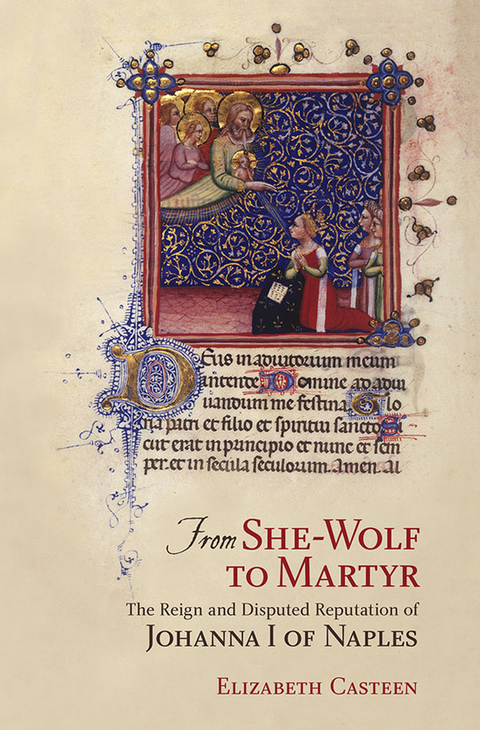
From She-Wolf to Martyr (eBook)
312 Seiten
Cornell University Press (Verlag)
978-1-5017-0099-6 (ISBN)
In From She-Wolf to Martyr, Elizabeth Casteen examines Johanna I of Naples's evolving, problematic reputation and uses it as a lens through which to analyze often-contradictory late-medieval conceptions of rulership, authority, and femininity.
In 1343 a seventeen-year-old girl named Johanna (1326-1382) ascended the Neapolitan throne, becoming the ruling monarch of one of medieval Europe's most important polities. For nearly forty years, she held her throne and the avid attention of her contemporaries. Their varied responses to her reign created a reputation that made Johanna the most notorious woman in Europe during her lifetime. In From She-Wolf to Martyr, Elizabeth Casteen examines Johanna's evolving, problematic reputation and uses it as a lens through which to analyze often-contradictory late-medieval conceptions of rulership, authority, and femininity. When Johanna inherited the Neapolitan throne from her grandfather, many questioned both her right to and her suitability for her throne. After the murder of her first husband, Johanna quickly became infamous as a she-wolf-a violent, predatory, sexually licentious woman. Yet, she also eventually gained fame as a wise, pious, and able queen. Contemporaries-including Francesco Petrarch, Giovanni Boccaccio, Birgitta of Sweden, and Catherine of Siena-were fascinated by Johanna. Drawing on a wide range of textual and visual sources, Casteen reconstructs the fourteenth-century conversation about Johanna and tracks the role she played in her time's cultural imaginary. She argues that despite Johanna's modern reputation for indolence and incompetence, she crafted a new model of female sovereignty that many of her contemporaries accepted and even lauded.
Elizabeth Casteen is Assistant Professor of History at Binghamton University–The State University of New York.
Introduction1. The Murder of Andrew of Hungary and the Making of a Neapolitan She-Wolf2. From She-Wolf to Radiant Queen: The Reign of Louis of Taranto and the Rehabilitation of Johanna of Naples3. A Most Loving Daughter: Filial Piety and the Apogee of Johanna's Reign4. An "Especially Good Friend" to Saints: Friendship, Politics, and the Performance of Sovereignty5. The Schism of the Western Church and the Division of Johanna of NaplesEpilogueConclusion
Bibliography
Index
| Erscheint lt. Verlag | 18.11.2015 |
|---|---|
| Zusatzinfo | 7 halftones, 2 genealogies, 2 maps |
| Verlagsort | Ithaca |
| Sprache | englisch |
| Maße | 160 x 160 mm |
| Gewicht | 28 g |
| Themenwelt | Literatur ► Biografien / Erfahrungsberichte |
| Literatur ► Romane / Erzählungen | |
| Sachbuch/Ratgeber ► Geschichte / Politik ► Mittelalter | |
| Geschichte ► Allgemeine Geschichte ► Mittelalter | |
| Geisteswissenschaften ► Geschichte ► Regional- / Ländergeschichte | |
| Schlagworte | Joanna I of Naples, queenship, rulership, authority, femininity, female sovereignty, Johanna's public image, southern Italy, medieval Europe, medieval preconceptions about femininity, Italian history |
| ISBN-10 | 1-5017-0099-5 / 1501700995 |
| ISBN-13 | 978-1-5017-0099-6 / 9781501700996 |
| Informationen gemäß Produktsicherheitsverordnung (GPSR) | |
| Haben Sie eine Frage zum Produkt? |
 EPUB (Adobe DRM)
Kopierschutz: Adobe-DRM
Adobe-DRM ist ein Kopierschutz, der das eBook vor Mißbrauch schützen soll. Dabei wird das eBook bereits beim Download auf Ihre persönliche Adobe-ID autorisiert. Lesen können Sie das eBook dann nur auf den Geräten, welche ebenfalls auf Ihre Adobe-ID registriert sind.
Details zum Adobe-DRM
Dateiformat: EPUB (Electronic Publication)
EPUB ist ein offener Standard für eBooks und eignet sich besonders zur Darstellung von Belletristik und Sachbüchern. Der Fließtext wird dynamisch an die Display- und Schriftgröße angepasst. Auch für mobile Lesegeräte ist EPUB daher gut geeignet.
Systemvoraussetzungen:
PC/Mac: Mit einem PC oder Mac können Sie dieses eBook lesen. Sie benötigen eine
eReader: Dieses eBook kann mit (fast) allen eBook-Readern gelesen werden. Mit dem amazon-Kindle ist es aber nicht kompatibel.
Smartphone/Tablet: Egal ob Apple oder Android, dieses eBook können Sie lesen. Sie benötigen eine
Geräteliste und zusätzliche Hinweise
Buying eBooks from abroad
For tax law reasons we can sell eBooks just within Germany and Switzerland. Regrettably we cannot fulfill eBook-orders from other countries.
aus dem Bereich