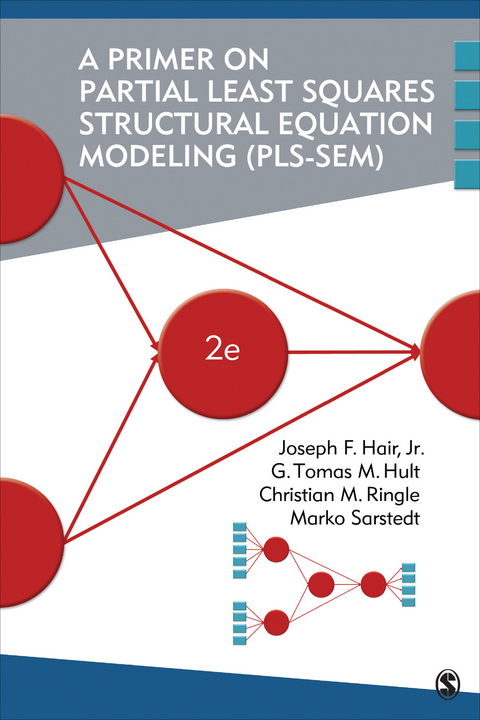
A Primer on Partial Least Squares Structural Equation Modeling (PLS-SEM) (eBook)
384 Seiten
Sage Publications, Inc (Verlag)
978-1-4833-7746-9 (ISBN)
Chapter 1: An Introduction to Structural Equation Modeling
What Is Structural Equation Modeling?
Considerations in Using Structural Equation Modeling
Structural Equation Modeling With Partial Least Squares Path Modeling
PLS-SEM, CB-SEM, and Regressions Based on Sum Scores
Organization of Remaining Chapters
Chapter 2: Specifying the Path Model and Examining Data
Stage 1: Specifying the Structural Model
Stage 2: Specifying the Measurement Models
Stage 3: Data Collection and Examination
Case Study Illustration: Specifying the PLS-SEM Model
Path Model Creation Using the SmartPLS Software
Chapter 3: Path Model Estimation
Stage 4: Model Estimation and the PLS-SEM Algorithm
Case Study Illustration: PLS Path Model Estimation (Stage 4)
Chapter 4: Assessing PLS-SEM Results Part I: Evaluation of Reflective Measurement Models
Overview of Stage 5: Evaluation of Measurement Models
Stage 5a: Assessing Results of Reflective Measurement Models
Case Study Illustration—Reflective Measurement Models
Running the PLS-SEM Algorithm
Reflective Measurement Model Evaluation
Chapter 5: Assessing PLS-SEM Results Part II: Evaluation of the Formative Measurement Models
Stage 5b: Assessing Results of Formative Measurement Models
Bootstrapping Procedure
Bootstrap Confidence Intervals
Case Study Illustration—Evaluation of Formative Measurement Models
Chapter 6: Assessing PLS-SEM Results Part III: Evaluation of the Structural Model
Stage 6: Assessing PLS-SEM Structural Model Results
Case Study Illustration—How Are PLS-SEM Structural Model Results Reported?
Chapter 7: Mediator and Moderator Analysis
Mediation
Moderation
Chapter 8: Outlook on Advanced Methods
Importance-Performance Map Analysis
Hierarchical Component Models
Confirmatory Tetrad Analysis
Dealing With Observed and Unobserved Heterogeneity
Consistent Partial Least Squares
| Erscheint lt. Verlag | 29.2.2016 |
|---|---|
| Verlagsort | Thousand Oaks |
| Sprache | englisch |
| Themenwelt | Sachbuch/Ratgeber ► Natur / Technik ► Natur / Ökologie |
| Mathematik / Informatik ► Mathematik ► Angewandte Mathematik | |
| Naturwissenschaften | |
| Sozialwissenschaften ► Soziologie ► Empirische Sozialforschung | |
| Schlagworte | Partial Least Squares • PLS-SEM • smartpls • Statistical Research • Structural Equation Modeling |
| ISBN-10 | 1-4833-7746-6 / 1483377466 |
| ISBN-13 | 978-1-4833-7746-9 / 9781483377469 |
| Informationen gemäß Produktsicherheitsverordnung (GPSR) | |
| Haben Sie eine Frage zum Produkt? |
 EPUB (Adobe DRM)
Kopierschutz: Adobe-DRM
Adobe-DRM ist ein Kopierschutz, der das eBook vor Mißbrauch schützen soll. Dabei wird das eBook bereits beim Download auf Ihre persönliche Adobe-ID autorisiert. Lesen können Sie das eBook dann nur auf den Geräten, welche ebenfalls auf Ihre Adobe-ID registriert sind.
Details zum Adobe-DRM
Dateiformat: EPUB (Electronic Publication)
EPUB ist ein offener Standard für eBooks und eignet sich besonders zur Darstellung von Belletristik und Sachbüchern. Der Fließtext wird dynamisch an die Display- und Schriftgröße angepasst. Auch für mobile Lesegeräte ist EPUB daher gut geeignet.
Systemvoraussetzungen:
PC/Mac: Mit einem PC oder Mac können Sie dieses eBook lesen. Sie benötigen eine
eReader: Dieses eBook kann mit (fast) allen eBook-Readern gelesen werden. Mit dem amazon-Kindle ist es aber nicht kompatibel.
Smartphone/Tablet: Egal ob Apple oder Android, dieses eBook können Sie lesen. Sie benötigen eine
Geräteliste und zusätzliche Hinweise
Buying eBooks from abroad
For tax law reasons we can sell eBooks just within Germany and Switzerland. Regrettably we cannot fulfill eBook-orders from other countries.
aus dem Bereich