


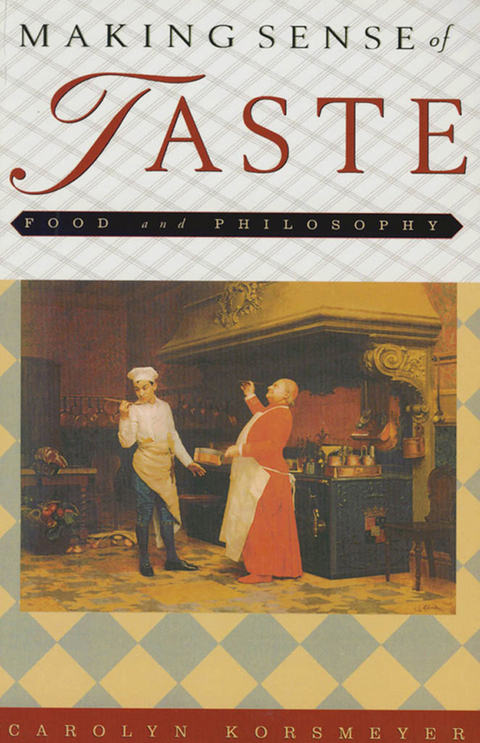
Making Sense of Taste (eBook)
256 Seiten
Cornell University Press (Verlag)
978-0-8014-7132-2 (ISBN)
Korsmeyer explains how taste came to occupy so low a place in the hierarchy of senses and why it is deserving of greater philosophical respect and attention.
Taste, perhaps the most intimate of the five senses, has traditionally been considered beneath the concern of philosophy, too bound to the body, too personal and idiosyncratic. Yet, in addition to providing physical pleasure, eating and drinking bear symbolic and aesthetic value in human experience, and they continually inspire writers and artists. Carolyn Korsmeyer explains how taste came to occupy so low a place in the hierarchy of senses and why it is deserving of greater philosophical respect and attention. Korsmeyer begins with the Greek thinkers who classified taste as an inferior, bodily sense; she then traces the parallels between notions of aesthetic and gustatory taste that were explored in the formation of modern aesthetic theories. She presents scientific views of how taste actually works and identifies multiple components of taste experiences. Turning to taste's objects-food and drink-she looks at the different meanings they convey in art and literature as well as in ordinary human life and proposes an approach to the aesthetic value of taste that recognizes the representational and expressive roles of food. Korsmeyer's consideration of art encompasses works that employ food in contexts sacred and profane, that seek to whet the appetite and to keep it at bay; her selection of literary vignettes ranges from narratives of macabre devouring to stories of communities forged by shared eating.
Carolyn Korsmeyer is the author or editor of several books in aesthetics and philosophy of art, feminist philosophy, and emotion theory, including Savoring Disgust: The Foul and the Fair in Aesthetics (2011) and Things: In Touch with the Past (2019).
Introduction
Chapter 1: The Hierarchy of the Senses
Chapter 2: Philosophies of Taste: Aesthetic and Nonasethetic Senses
Chapter 3: The Science of Taste
Chapter 4: The Meaning of Taste and the Taste of Meaning
Chapter 5: The Visual Appetite: Representing Taste and Food
Chapter 6: Narratives of Eating
Index
| Erscheint lt. Verlag | 4.1.2014 |
|---|---|
| Verlagsort | Ithaca |
| Sprache | englisch |
| Maße | 160 x 160 mm |
| Themenwelt | Sachbuch/Ratgeber ► Essen / Trinken ► Grundkochbücher |
| Geisteswissenschaften ► Geschichte | |
| Geisteswissenschaften ► Philosophie ► Philosophie der Neuzeit | |
| ISBN-10 | 0-8014-7132-X / 080147132X |
| ISBN-13 | 978-0-8014-7132-2 / 9780801471322 |
| Informationen gemäß Produktsicherheitsverordnung (GPSR) | |
| Haben Sie eine Frage zum Produkt? |
 EPUB (Adobe DRM)
Kopierschutz: Adobe-DRM
Adobe-DRM ist ein Kopierschutz, der das eBook vor Mißbrauch schützen soll. Dabei wird das eBook bereits beim Download auf Ihre persönliche Adobe-ID autorisiert. Lesen können Sie das eBook dann nur auf den Geräten, welche ebenfalls auf Ihre Adobe-ID registriert sind.
Details zum Adobe-DRM
Dateiformat: EPUB (Electronic Publication)
EPUB ist ein offener Standard für eBooks und eignet sich besonders zur Darstellung von Belletristik und Sachbüchern. Der Fließtext wird dynamisch an die Display- und Schriftgröße angepasst. Auch für mobile Lesegeräte ist EPUB daher gut geeignet.
Systemvoraussetzungen:
PC/Mac: Mit einem PC oder Mac können Sie dieses eBook lesen. Sie benötigen eine
eReader: Dieses eBook kann mit (fast) allen eBook-Readern gelesen werden. Mit dem amazon-Kindle ist es aber nicht kompatibel.
Smartphone/Tablet: Egal ob Apple oder Android, dieses eBook können Sie lesen. Sie benötigen eine
Geräteliste und zusätzliche Hinweise
Buying eBooks from abroad
For tax law reasons we can sell eBooks just within Germany and Switzerland. Regrettably we cannot fulfill eBook-orders from other countries.
aus dem Bereich


