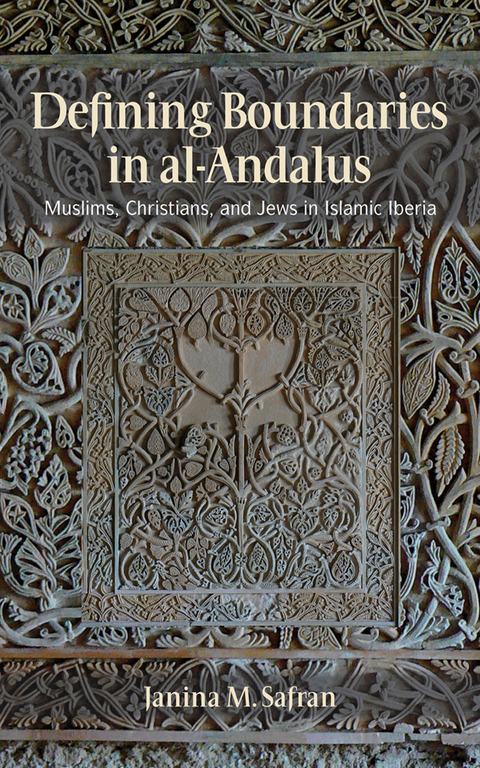
Defining Boundaries in al-Andalus (eBook)
264 Seiten
Cornell University Press (Verlag)
978-0-8014-6800-1 (ISBN)
Through an examination of the structure and practice of Muslim political and legal-religious authority, a rare look at intercommunal life in Iberia during the first three centuries of Islamic rule.
Al-Andalus, the Arabic name for the medieval Islamic state in Iberia, endured for over 750 years following the Arab and Berber conquest of Hispania in 711. While the popular perception of al-Andalus is that of a land of religious tolerance and cultural cooperation, the fact is that we know relatively little about how Muslims governed Christians and Jews in al-Andalus and about social relations among Muslims, Christians, and Jews. In Defining Boundaries in al-Andalus, Janina M. Safran takes a close look at the structure and practice of Muslim political and legal-religious authority and offers a rare look at intercommunal life in Iberia during the first three centuries of Islamic rule.
Safran makes creative use of a body of evidence that until now has gone largely untapped by historians—the writings and opinions of Andalusi and Maghribi jurists during the Umayyad dynasty. These sources enable her to bring to life a society undergoing dramatic transformation. Obvious differences between conquerors and conquered and Muslims and non-Muslims became blurred over time by transculturation, intermarriage, and conversion. Safran examines ample evidence of intimate contact between individuals of different religious communities and of legal-juridical accommodation to develop an argument about how legal-religious authorities interpreted the social contract between the Muslim regime and the Christian and Jewish populations. Providing a variety of examples of boundary-testing and negotiation and bringing judges, jurists, and their legal opinions and texts into the narrative of Andalusi history, Safran deepens our understanding of the politics of Umayyad rule, makes Islamic law tangibly social, and renders intercommunal relations vividly personal.
Al-Andalus, the Arabic name for the medieval Islamic state in Iberia, endured for over 750 years following the Arab and Berber conquest of Hispania in 711. While the popular perception of al-Andalus is that of a land of religious tolerance and cultural cooperation, the fact is that we know relatively little about how Muslims governed Christians and Jews in al-Andalus and about social relations among Muslims, Christians, and Jews. In Defining Boundaries in al-Andalus, Janina M. Safran takes a close look at the structure and practice of Muslim political and legal-religious authority and offers a rare look at intercommunal life in Iberia during the first three centuries of Islamic rule.Safran makes creative use of a body of evidence that until now has gone largely untapped by historians—the writings and opinions of Andalusi and Maghribi jurists during the Umayyad dynasty. These sources enable her to bring to life a society undergoing dramatic transformation. Obvious differences between conquerors and conquered and Muslims and non-Muslims became blurred over time by transculturation, intermarriage, and conversion. Safran examines ample evidence of intimate contact between individuals of different religious communities and of legal-juridical accommodation to develop an argument about how legal-religious authorities interpreted the social contract between the Muslim regime and the Christian and Jewish populations. Providing a variety of examples of boundary-testing and negotiation and bringing judges, jurists, and their legal opinions and texts into the narrative of Andalusi history, Safran deepens our understanding of the politics of Umayyad rule, makes Islamic law tangibly social, and renders intercommunal relations vividly personal.
Janina M. Safran is Associate Professor of History at Pennsylvania State University.
Introduction1. The Structuring of Umayyad Rule2. Society in Transition3. Between Enemies and Friends4. Borders and BoundariesConclusionBibliography
Index
| Verlagsort | Ithaca |
|---|---|
| Sprache | englisch |
| Maße | 160 x 160 mm |
| Gewicht | 28 g |
| Themenwelt | Sachbuch/Ratgeber ► Geschichte / Politik ► Mittelalter |
| Geschichte ► Allgemeine Geschichte ► Mittelalter | |
| Geisteswissenschaften ► Geschichte ► Regional- / Ländergeschichte | |
| Geschichte ► Teilgebiete der Geschichte ► Religionsgeschichte | |
| Sozialwissenschaften ► Ethnologie | |
| Sozialwissenschaften ► Soziologie | |
| Schlagworte | al-Andalus, medieval Islamic state, Iberia, Islamic rule, religious tolerance, cultural cooperation, legal-religious authority, transculturation, intermarriage, religious diversity, Muslim, Christian, Jew, politics of Umayyad rule |
| ISBN-10 | 0-8014-6800-0 / 0801468000 |
| ISBN-13 | 978-0-8014-6800-1 / 9780801468001 |
| Informationen gemäß Produktsicherheitsverordnung (GPSR) | |
| Haben Sie eine Frage zum Produkt? |
 EPUB (Adobe DRM)
Kopierschutz: Adobe-DRM
Adobe-DRM ist ein Kopierschutz, der das eBook vor Mißbrauch schützen soll. Dabei wird das eBook bereits beim Download auf Ihre persönliche Adobe-ID autorisiert. Lesen können Sie das eBook dann nur auf den Geräten, welche ebenfalls auf Ihre Adobe-ID registriert sind.
Details zum Adobe-DRM
Dateiformat: EPUB (Electronic Publication)
EPUB ist ein offener Standard für eBooks und eignet sich besonders zur Darstellung von Belletristik und Sachbüchern. Der Fließtext wird dynamisch an die Display- und Schriftgröße angepasst. Auch für mobile Lesegeräte ist EPUB daher gut geeignet.
Systemvoraussetzungen:
PC/Mac: Mit einem PC oder Mac können Sie dieses eBook lesen. Sie benötigen eine
eReader: Dieses eBook kann mit (fast) allen eBook-Readern gelesen werden. Mit dem amazon-Kindle ist es aber nicht kompatibel.
Smartphone/Tablet: Egal ob Apple oder Android, dieses eBook können Sie lesen. Sie benötigen eine
Geräteliste und zusätzliche Hinweise
Buying eBooks from abroad
For tax law reasons we can sell eBooks just within Germany and Switzerland. Regrettably we cannot fulfill eBook-orders from other countries.
aus dem Bereich