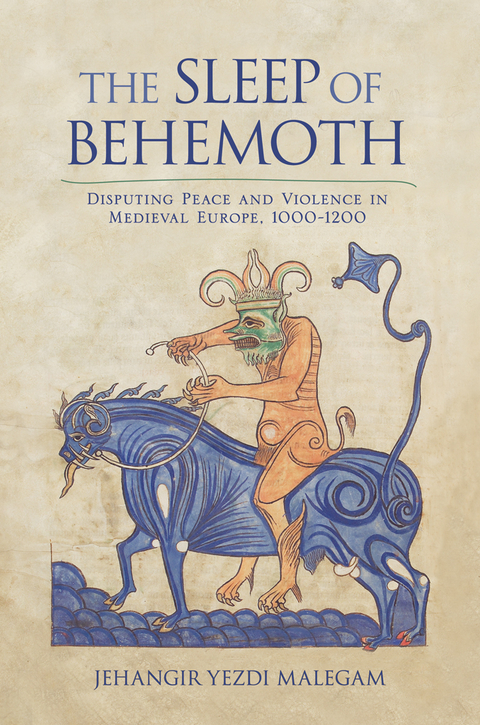
The Sleep of Behemoth (eBook)
352 Seiten
Cornell University Press (Verlag)
978-0-8014-6788-2 (ISBN)
Exploring the emergence of conflicting concepts of peace in western Europe during the High Middle Ages.
In The Sleep of Behemoth, Jehangir Yezdi Malegam explores the emergence of conflicting concepts of peace in western Europe during the High Middle Ages. Ever since the early Church, Christian thinkers had conceived of their peace separate from the peace of the world, guarded by the sacraments and shared only grudgingly with powers and principalities. To kingdoms and communities they had allowed attenuated versions of this peace, modes of accommodation and domination that had tranquility as the goal. After 1000, reformers in the papal curia and monks and canons in the intellectual circles of northern France began to reimagine the Church as an engine of true peace, whose task it was eventually to absorb all peoples through progressive acts of revolutionary peacemaking. Peace as they envisioned it became a mandate for reform through conflict, coercion, and insurrection. And the pursuit of mere tranquility appeared dangerous, and even diabolical.
As Malegam shows, within western Christendom's major centers of intellectual activity and political thought, the clergy competed over the meaning and monopolization of the term "peace," contrasting it with what one canon lawyer called the "sleep of Behemoth," a diabolical "false" peace of lassitude and complacency, one that produced unsuitable forms of community and friendship that must be overturned at all costs. Out of this contest over the meaning and ownership of true peace, Malegam concludes, medieval thinkers developed theologies that shaped secular political theory in the later Middle Ages. The Sleep of Behemoth traces this radical experiment in redefining the meaning of peace from the papal courts of Rome and the schools of Laon, Liege, and Paris to its gradual spread across the continent and its impact on such developments as the rise of papal monarchism; the growth of urban, communal self-government; and the emergence of secular and mystical scholasticism.
In The Sleep of Behemoth, Jehangir Yezdi Malegam explores the emergence of conflicting concepts of peace in western Europe during the High Middle Ages. Ever since the early Church, Christian thinkers had conceived of their peace separate from the peace of the world, guarded by the sacraments and shared only grudgingly with powers and principalities. To kingdoms and communities they had allowed attenuated versions of this peace, modes of accommodation and domination that had tranquility as the goal. After 1000, reformers in the papal curia and monks and canons in the intellectual circles of northern France began to reimagine the Church as an engine of true peace, whose task it was eventually to absorb all peoples through progressive acts of revolutionary peacemaking. Peace as they envisioned it became a mandate for reform through conflict, coercion, and insurrection. And the pursuit of mere tranquility appeared dangerous, and even diabolical.
As Malegam shows, within western Christendom's major centers of intellectual activity and political thought, the clergy competed over the meaning and monopolization of the term "peace," contrasting it with what one canon lawyer called the "sleep of Behemoth," a diabolical "false" peace of lassitude and complacency, one that produced unsuitable forms of community and friendship that must be overturned at all costs. Out of this contest over the meaning and ownership of true peace, Malegam concludes, medieval thinkers developed theologies that shaped secular political theory in the later Middle Ages. The Sleep of Behemoth traces this radical experiment in redefining the meaning of peace from the papal courts of Rome and the schools of Laon, Liège, and Paris to its gradual spread across the continent and its impact on such developments as the rise of papal monarchism; the growth of urban, communal self-government; and the emergence of secular and mystical scholasticism.
Jehangir Yezdi Malegam is Andrew W. Mellon Assistant Professor of History at Duke University.
Introduction1. Revising Peace: Reform and the Millennium2. The Papal Reform: Peace Espoused and Repudiated3. False Sacraments: Violence, Captivity, and Insurrection4. Dueling Sacraments: The Communion of Judas Iscariot5. Inner Peace: Discord, Discretion, and Discipline6. Exporting Peace: Ecclesiology and Evangelism7. Communes: Inversions of Peace8. Disciplining Behemoth: Provisions for Secular PeaceEpilogueBibliography
Index
| Erscheint lt. Verlag | 15.3.2013 |
|---|---|
| Verlagsort | Ithaca |
| Sprache | englisch |
| Maße | 160 x 160 mm |
| Themenwelt | Sachbuch/Ratgeber ► Geschichte / Politik ► Mittelalter |
| Geschichte ► Allgemeine Geschichte ► Mittelalter | |
| Geisteswissenschaften ► Geschichte ► Regional- / Ländergeschichte | |
| Schlagworte | western europe and peace, high middle ages violence, history of peace, christian peace, revolutionary peacemaking, peace and complacency, peace of god, investiture conflict, history of violence |
| ISBN-10 | 0-8014-6788-8 / 0801467888 |
| ISBN-13 | 978-0-8014-6788-2 / 9780801467882 |
| Informationen gemäß Produktsicherheitsverordnung (GPSR) | |
| Haben Sie eine Frage zum Produkt? |
 EPUB (Adobe DRM)
Kopierschutz: Adobe-DRM
Adobe-DRM ist ein Kopierschutz, der das eBook vor Mißbrauch schützen soll. Dabei wird das eBook bereits beim Download auf Ihre persönliche Adobe-ID autorisiert. Lesen können Sie das eBook dann nur auf den Geräten, welche ebenfalls auf Ihre Adobe-ID registriert sind.
Details zum Adobe-DRM
Dateiformat: EPUB (Electronic Publication)
EPUB ist ein offener Standard für eBooks und eignet sich besonders zur Darstellung von Belletristik und Sachbüchern. Der Fließtext wird dynamisch an die Display- und Schriftgröße angepasst. Auch für mobile Lesegeräte ist EPUB daher gut geeignet.
Systemvoraussetzungen:
PC/Mac: Mit einem PC oder Mac können Sie dieses eBook lesen. Sie benötigen eine
eReader: Dieses eBook kann mit (fast) allen eBook-Readern gelesen werden. Mit dem amazon-Kindle ist es aber nicht kompatibel.
Smartphone/Tablet: Egal ob Apple oder Android, dieses eBook können Sie lesen. Sie benötigen eine
Geräteliste und zusätzliche Hinweise
Buying eBooks from abroad
For tax law reasons we can sell eBooks just within Germany and Switzerland. Regrettably we cannot fulfill eBook-orders from other countries.
aus dem Bereich