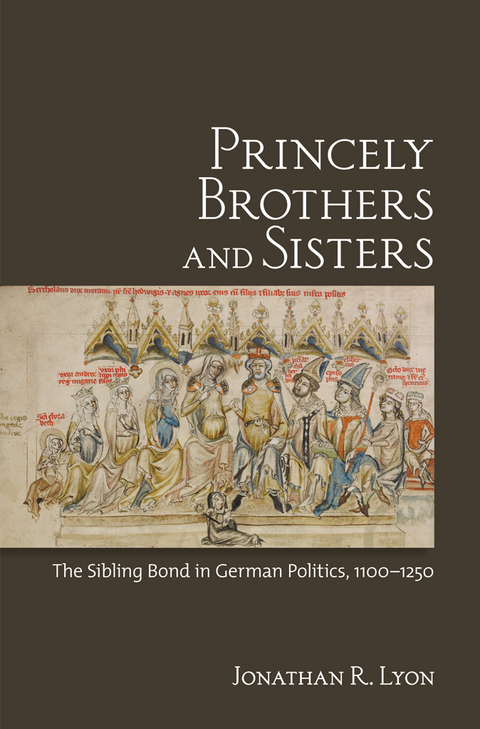
Princely Brothers and Sisters (eBook)
312 Seiten
Cornell University Press (Verlag)
978-0-8014-6784-4 (ISBN)
Offering a fresh look at sibling networks and the role they played in shaping the practice of politics in the Middle Ages.
In Princely Brothers and Sisters, Jonathan R. Lyon takes a fresh look at sibling networks and the role they played in shaping the practice of politics in the Middle Ages. Focusing on nine of the most prominent aristocratic families in the German kingdom during the Staufen period (1138–1250), Lyon finds that noblemen—and to a lesser extent, noblewomen—relied on the cooperation and support of their siblings as they sought to maintain or expand their power and influence within a competitive political environment. Consequently, sibling relationships proved crucial at key moments in shaping the political and territorial interests of many lords of the kingdom.Family historians have largely overlooked brothers and sisters in the political life of medieval societies. As Lyon points out, however, siblings are the contemporaries whose lives normally overlap the longest. More so than parents and children, husbands and wives, or lords and vassals, brothers and sisters have the potential to develop relationships that span entire lifetimes. The longevity of some sibling bonds therefore created opportunities for noble brothers and sisters to collaborate in especially potent ways. As Lyon shows, cohesive networks of brothers and sisters proved remarkably effective at counterbalancing the authority of the Staufen kings and emperors. Well written and impeccably researched, Princely Brothers and Sisters is an important book not only for medieval German historians but also for the field of family history.
In Princely Brothers and Sisters, Jonathan R. Lyon takes a fresh look at sibling networks and the role they played in shaping the practice of politics in the Middle Ages. Focusing on nine of the most prominent aristocratic families in the German kingdom during the Staufen period (1138–1250), Lyon finds that noblemen—and to a lesser extent, noblewomen—relied on the cooperation and support of their siblings as they sought to maintain or expand their power and influence within a competitive political environment. Consequently, sibling relationships proved crucial at key moments in shaping the political and territorial interests of many lords of the kingdom.
Family historians have largely overlooked brothers and sisters in the political life of medieval societies. As Lyon points out, however, siblings are the contemporaries whose lives normally overlap the longest. More so than parents and children, husbands and wives, or lords and vassals, brothers and sisters have the potential to develop relationships that span entire lifetimes. The longevity of some sibling bonds therefore created opportunities for noble brothers and sisters to collaborate in especially potent ways. As Lyon shows, cohesive networks of brothers and sisters proved remarkably effective at counterbalancing the authority of the Staufen kings and emperors. Well written and impeccably researched, Princely Brothers and Sisters is an important book not only for medieval German historians but also for the field of family history.
Jonathan R. Lyon is Assistant Professor of History at the University of Chicago.
Introduction1. The Origins of Twelfth-Century Princely Lineages2. Forging the Bonds between Siblings: Succession, Inheritance, and Church Careers3. Baby Boomers: The First Generation of the Staufen Upper Aristocracy4. Frederick Barbarossa and Henry the Lion: Cousins in an Age of Brothers5. Cooperation, Conflict, and the Rise of a New Generation, ca. 1180–12106. From Bamberg to Budapest: Four Brothers and Four Sisters in the Early Thirteenth Century7. The Uncertain Future of Lineages: Siblings during the Reign of Frederick IIConclusionAppendix: Genealogical Charts
The Andechs lineage
The Ascanian lineage
The Babenberg lineage
The Ludowing lineage
The Staufen lineage
The Welf lineage
The Wettin lineage (part 1)
The Wettin lineage (part 2)
The Wittelsbach lineage
The Zähringen lineageWorks Cited
Index
| Erscheint lt. Verlag | 15.1.2013 |
|---|---|
| Zusatzinfo | 11 charts, 4 maps |
| Verlagsort | Ithaca |
| Sprache | englisch |
| Maße | 160 x 160 mm |
| Themenwelt | Sachbuch/Ratgeber ► Geschichte / Politik ► Mittelalter |
| Geschichte ► Allgemeine Geschichte ► Mittelalter | |
| Geisteswissenschaften ► Geschichte ► Regional- / Ländergeschichte | |
| Schlagworte | medieval politics, medieval families, european political history, aristocratic family structure, german family structure, sibling networks, staufen period, family history |
| ISBN-10 | 0-8014-6784-5 / 0801467845 |
| ISBN-13 | 978-0-8014-6784-4 / 9780801467844 |
| Informationen gemäß Produktsicherheitsverordnung (GPSR) | |
| Haben Sie eine Frage zum Produkt? |
 EPUB (Adobe DRM)
Kopierschutz: Adobe-DRM
Adobe-DRM ist ein Kopierschutz, der das eBook vor Mißbrauch schützen soll. Dabei wird das eBook bereits beim Download auf Ihre persönliche Adobe-ID autorisiert. Lesen können Sie das eBook dann nur auf den Geräten, welche ebenfalls auf Ihre Adobe-ID registriert sind.
Details zum Adobe-DRM
Dateiformat: EPUB (Electronic Publication)
EPUB ist ein offener Standard für eBooks und eignet sich besonders zur Darstellung von Belletristik und Sachbüchern. Der Fließtext wird dynamisch an die Display- und Schriftgröße angepasst. Auch für mobile Lesegeräte ist EPUB daher gut geeignet.
Systemvoraussetzungen:
PC/Mac: Mit einem PC oder Mac können Sie dieses eBook lesen. Sie benötigen eine
eReader: Dieses eBook kann mit (fast) allen eBook-Readern gelesen werden. Mit dem amazon-Kindle ist es aber nicht kompatibel.
Smartphone/Tablet: Egal ob Apple oder Android, dieses eBook können Sie lesen. Sie benötigen eine
Geräteliste und zusätzliche Hinweise
Buying eBooks from abroad
For tax law reasons we can sell eBooks just within Germany and Switzerland. Regrettably we cannot fulfill eBook-orders from other countries.
aus dem Bereich