Neotropical Birds of Prey (eBook)
432 Seiten
Comstock Publishing Associates (Verlag)
978-0-8014-6611-3 (ISBN)
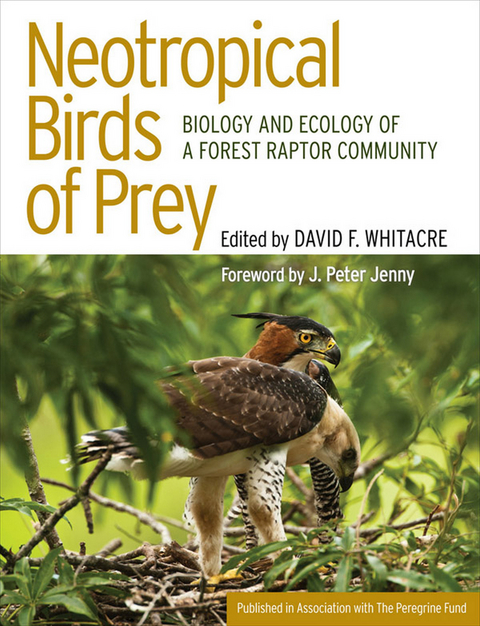
Beautifully illustrated with photographs of previously little-known species, this book is the most important single source for information on the lowland tropical forest raptor species found in Central America.
Until recently, surprisingly little has been known about the biology and behavior of tropical forest raptors, including such basic aspects as diets, breeding biology, habitat requirements, and population ecology, information critical to the development of conservation efforts. The Peregrine Fund conducted a significant eight-year-long research program on the raptor species, including owls, in Tikal National Park in Guatemala to learn more about Neotropical birds of prey. Impressive and unprecedented in scale, this pioneering research also involved the development of new methods for detecting, enumerating, and studying these magnificent but often elusive birds in their forest home. Beautifully illustrated with photographs of previously little-known species, the resulting book is the most important single source for information on the lowland tropical forest raptor species found in Central America.Neotropical Birds of Prey covers twenty specific species in depth, including the Ornate Hawk-Eagle, the Barred Forest-Falcon, the Bat Falcon, and the Mexican Wood Owl, offering thorough synopses of all current knowledge regarding breeding biology and behavior, diet, habitat use, and spatial needs. Contributors to this landmark work also show how the populations fit together as a community with overlapping habitat and prey needs that can put them in competition with reptiles and mammalian carnivores as well, yet differ from one another in their nesting or feeding behaviors and population dynamics. The work's substantive original data offer interesting comparisons between tropical and temperate zone species, and provide a basis for establishing conservation measures based on firsthand research. Making available for the first time new data on the biology, ecology, behavior, and conservation of the majestic owls and raptors of the New World tropics, this book will appeal to a wide ornithological readership, especially the many raptor enthusiasts around the world.
Until recently, surprisingly little has been known about the biology and behavior of tropical forest raptors, including such basic aspects as diets, breeding biology, habitat requirements, and population ecology, information critical to the development of conservation efforts. The Peregrine Fund conducted a significant eight-year-long research program on the raptor species, including owls, in Tikal National Park in Guatemala to learn more about Neotropical birds of prey. Impressive and unprecedented in scale, this pioneering research also involved the development of new methods for detecting, enumerating, and studying these magnificent but often elusive birds in their forest home. Beautifully illustrated with photographs of previously little-known species, the resulting book is the most important single source for information on the lowland tropical forest raptor species found in Central America.
Neotropical Birds of Prey covers twenty specific species in depth, including the Ornate Hawk-Eagle, the Barred Forest-Falcon, the Bat Falcon, and the Mexican Wood Owl, offering thorough synopses of all current knowledge regarding breeding biology and behavior, diet, habitat use, and spatial needs. Contributors to this landmark work also show how the populations fit together as a community with overlapping habitat and prey needs that can put them in competition with reptiles and mammalian carnivores as well, yet differ from one another in their nesting or feeding behaviors and population dynamics. The work's substantive original data offer interesting comparisons between tropical and temperate zone species, and provide a basis for establishing conservation measures based on firsthand research. Making available for the first time new data on the biology, ecology, behavior, and conservation of the majestic owls and raptors of the New World tropics, this book will appeal to a wide ornithological readership, especially the many raptor enthusiasts around the world.
David F. Whitacre is a former Research Scientist at The Peregrine Fund. J. Peter Jenny is President and CEO of The Peregrine Fund.
Foreword by J. Peter JennyAcknowledgments
About the Authors1. The Maya Project
David F. Whitacre and William A. Burnham2. The Maya Forest
David F. Whitacre and Mark D. Schulze3. Gray-headed Kite
Russell K. Thorstrom, David F. Whitacre, Juventino López, and Gregorio López4. Hook-billed Kite
David F. Whitacre and Miguel A. Vásquez5. Swallow-tailed Kite
Richard P. Gerhardt, Dawn M. Gerhardt, and Miguel A. Vásquez6. Double-toothed Kite
Mark D. Schulze, José L. Córdova, Nathaniel E. Seavy, and David F. Whitacre7. Plumbeous Kite
Nathaniel E. Seavy, Mark D. Schulze, David F. Whitacre, and Miguel A. Vásquez8. Bicolored Hawk
Russell K. Thorstrom9. Crane Hawk
Jason Sutter10. White Hawk
Gregory S. Draheim, David F. Whitacre, Angel M. Enamorado, Oscar A. Aguirre, and Aquiles E. Hernández11. Great Black Hawk
Richard P. Gerhardt, Nathaniel E. Seavy, and Ricardo A. Madrid12. Roadside Hawk
Theresa Panasci13. Crested Eagle
David F. Whitacre, Juventino López, and Gregorio López14. Black Hawk-eagle
David F. Whitacre, Juventino López, Gregorio López, Sixto H. Funes, Craig J. Flatten, and Julio A. Madrid15. Ornate Hawk-eagle
David F. Whitacre, Julio A. Madrid, Héctor D. Madrid, Rodolfo Cruz, Craig J. Flatten, and Sixto H. Funes16. Barred Forest Falcon
Russell K. Thorstrom17. Collared Forest Falcon
Russell K. Thorstrom18. Laughing Falcon
Margaret N. Parker, Angel M. Enamorado, and Mario Lima19. Bat Falcon
Margaret N. Parker and David F. Whitacre20. Orange-breasted Falcon
Aaron J. Baker, David F. Whitacre, and Oscar A. Aguirre21. Mexican Wood Owl
Richard P. Gerhardt and Dawn M. Gerhardt22. Black-and-white Owl
Richard P. Gerhardt, Dawn M. Gerhardt, Normandy Bonilla, and Craig J. Flatten23. Ecology and Conservation of Tikal's Raptor Fauna
David F. Whitacre and William A. BurnhamAppendix 1: Body Mass and Sexual Size Dimorphism Data for Maya Forest Raptor SpeciesAppendix 2: Linear Measurements and Sexual Size Dimorphism for Maya Forest Raptor SpeciesLiterature CitedIndex
| Erscheint lt. Verlag | 15.5.2013 |
|---|---|
| Vorwort | J. Peter Jenny |
| Zusatzinfo | 24-page color insert, 5 line drawings, 17 maps, 84 tables, 59 charts/graphs |
| Verlagsort | Ithaca |
| Sprache | englisch |
| Maße | 220 x 220 mm |
| Themenwelt | Sachbuch/Ratgeber ► Natur / Technik ► Naturführer |
| Naturwissenschaften ► Biologie ► Zoologie | |
| Schlagworte | tropical forest raptor behavior, forest raptor breeding, population ecology, bird conservation, the peregrine fund, central american biodiversity, ornate hawk eagle, barred forest falcon, bat falcon, mexican wood owl, breeding biology, bird behavior |
| ISBN-10 | 0-8014-6611-3 / 0801466113 |
| ISBN-13 | 978-0-8014-6611-3 / 9780801466113 |
| Informationen gemäß Produktsicherheitsverordnung (GPSR) | |
| Haben Sie eine Frage zum Produkt? |
 EPUB (Adobe DRM)
Kopierschutz: Adobe-DRM
Adobe-DRM ist ein Kopierschutz, der das eBook vor Mißbrauch schützen soll. Dabei wird das eBook bereits beim Download auf Ihre persönliche Adobe-ID autorisiert. Lesen können Sie das eBook dann nur auf den Geräten, welche ebenfalls auf Ihre Adobe-ID registriert sind.
Details zum Adobe-DRM
Dateiformat: EPUB (Electronic Publication)
EPUB ist ein offener Standard für eBooks und eignet sich besonders zur Darstellung von Belletristik und Sachbüchern. Der Fließtext wird dynamisch an die Display- und Schriftgröße angepasst. Auch für mobile Lesegeräte ist EPUB daher gut geeignet.
Systemvoraussetzungen:
PC/Mac: Mit einem PC oder Mac können Sie dieses eBook lesen. Sie benötigen eine
eReader: Dieses eBook kann mit (fast) allen eBook-Readern gelesen werden. Mit dem amazon-Kindle ist es aber nicht kompatibel.
Smartphone/Tablet: Egal ob Apple oder Android, dieses eBook können Sie lesen. Sie benötigen eine
Geräteliste und zusätzliche Hinweise
Buying eBooks from abroad
For tax law reasons we can sell eBooks just within Germany and Switzerland. Regrettably we cannot fulfill eBook-orders from other countries.
aus dem Bereich