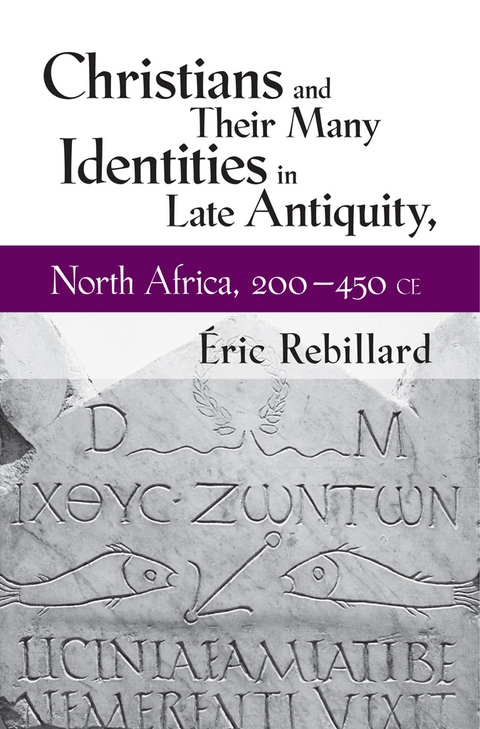
Christians and Their Many Identities in Late Antiquity, North Africa, 200-450 CE (eBook)
144 Seiten
Cornell University Press (Verlag)
978-0-8014-6555-0 (ISBN)
Rebillard explores how Christians in North Africa between the age of Tertullian and the age of Augustine were selective in identifying as Christian, giving salience to their religious identity only intermittently.
For too long, the study of religious life in Late Antiquity has relied on the premise that Jews, pagans, and Christians were largely discrete groups divided by clear markers of belief, ritual, and social practice. More recently, however, a growing body of scholarship is revealing the degree to which identities in the late Roman world were fluid, blurred by ethnic, social, and gender differences. Christianness, for example, was only one of a plurality of identities available to Christians in this period.
In Christians and Their Many Identities in Late Antiquity, North Africa, 200–450 CE, Éric Rebillard explores how Christians in North Africa between the age of Tertullian and the age of Augustine were selective in identifying as Christian, giving salience to their religious identity only intermittently. By shifting the focus from groups to individuals, Rebillard more broadly questions the existence of bounded, stable, and homogeneous groups based on Christianness. In emphasizing that the intermittency of Christianness is structurally consistent in the everyday life of Christians from the end of the second to the middle of the fifth century, this book opens a whole range of new questions for the understanding of a crucial period in the history of Christianity.
For too long, the study of religious life in Late Antiquity has relied on the premise that Jews, pagans, and Christians were largely discrete groups divided by clear markers of belief, ritual, and social practice. More recently, however, a growing body of scholarship is revealing the degree to which identities in the late Roman world were fluid, blurred by ethnic, social, and gender differences. Christianness, for example, was only one of a plurality of identities available to Christians in this period.
In Christians and Their Many Identities in Late Antiquity, North Africa, 200–450 CE, Éric Rebillard explores how Christians in North Africa between the age of Tertullian and the age of Augustine were selective in identifying as Christian, giving salience to their religious identity only intermittently. By shifting the focus from groups to individuals, Rebillard more broadly questions the existence of bounded, stable, and homogeneous groups based on Christianness. In emphasizing that the intermittency of Christianness is structurally consistent in the everyday life of Christians from the end of the second to the middle of the fifth century, this book opens a whole range of new questions for the understanding of a crucial period in the history of Christianity.
Éric Rebillard is Professor of Classics and History at Cornell University. He is the author of The Care of the Dead in Late Antiquity, also from Cornell.
Introduction1. Setting the Stage: Carthage at the End of the Second Century2. Persecution and the Limits of Religious Allegiance3. Being Christian in the Age of AugustineConclusionNotes
Bibliography
Index
| Verlagsort | Ithaca |
|---|---|
| Sprache | englisch |
| Maße | 150 x 150 mm |
| Gewicht | 28 g |
| Themenwelt | Sachbuch/Ratgeber ► Geschichte / Politik ► Vor- und Frühgeschichte / Antike |
| Geschichte ► Allgemeine Geschichte ► Vor- und Frühgeschichte | |
| Geschichte ► Allgemeine Geschichte ► Altertum / Antike | |
| Geisteswissenschaften ► Geschichte ► Regional- / Ländergeschichte | |
| Geschichte ► Teilgebiete der Geschichte ► Religionsgeschichte | |
| Religion / Theologie ► Christentum ► Kirchengeschichte | |
| Schlagworte | late Roman Africa, Christianity, Christianness, Christian identity, religious identity studies, history of Christianity |
| ISBN-10 | 0-8014-6555-9 / 0801465559 |
| ISBN-13 | 978-0-8014-6555-0 / 9780801465550 |
| Informationen gemäß Produktsicherheitsverordnung (GPSR) | |
| Haben Sie eine Frage zum Produkt? |
 EPUB (Adobe DRM)
Kopierschutz: Adobe-DRM
Adobe-DRM ist ein Kopierschutz, der das eBook vor Mißbrauch schützen soll. Dabei wird das eBook bereits beim Download auf Ihre persönliche Adobe-ID autorisiert. Lesen können Sie das eBook dann nur auf den Geräten, welche ebenfalls auf Ihre Adobe-ID registriert sind.
Details zum Adobe-DRM
Dateiformat: EPUB (Electronic Publication)
EPUB ist ein offener Standard für eBooks und eignet sich besonders zur Darstellung von Belletristik und Sachbüchern. Der Fließtext wird dynamisch an die Display- und Schriftgröße angepasst. Auch für mobile Lesegeräte ist EPUB daher gut geeignet.
Systemvoraussetzungen:
PC/Mac: Mit einem PC oder Mac können Sie dieses eBook lesen. Sie benötigen eine
eReader: Dieses eBook kann mit (fast) allen eBook-Readern gelesen werden. Mit dem amazon-Kindle ist es aber nicht kompatibel.
Smartphone/Tablet: Egal ob Apple oder Android, dieses eBook können Sie lesen. Sie benötigen eine
Geräteliste und zusätzliche Hinweise
Buying eBooks from abroad
For tax law reasons we can sell eBooks just within Germany and Switzerland. Regrettably we cannot fulfill eBook-orders from other countries.
aus dem Bereich