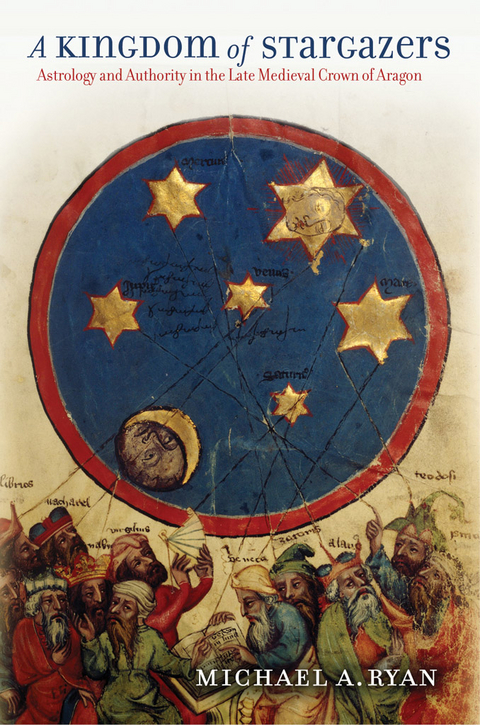
A Kingdom of Stargazers (eBook)
232 Seiten
Cornell University Press (Verlag)
978-0-8014-6316-7 (ISBN)
In A Kingdom of Stargazers, Michael A. Ryan examines the interest in astrology in the Iberian kingdom of Aragon, where ideas about magic and the occult were deeply intertwined with notions of power, authority, and providence.
Astrology in the Middle Ages was considered a branch of the magical arts, one informed by Jewish and Muslim scientific knowledge in Muslim Spain. As such it was deeply troubling to some Church authorities. Using the stars and planets to divine the future ran counter to the orthodox Christian notion that human beings have free will, and some clerical authorities argued that it almost certainly entailed the summoning of spiritual forces considered diabolical. We know that occult beliefs and practices became widespread in the later Middle Ages, but there is much about the phenomenon that we do not understand. For instance, how deeply did occult beliefs penetrate courtly culture and what exactly did those in positions of power hope to gain by interacting with the occult? In A Kingdom of Stargazers, Michael A. Ryan examines the interest in astrology in the Iberian kingdom of Aragon, where ideas about magic and the occult were deeply intertwined with notions of power, authority, and providence.
Ryan focuses on the reigns of Pere III (1336–1387) and his sons Joan I (1387–1395) and Martí I (1395–1410). Pere and Joan spent lavish amounts of money on astrological writings, and astrologers held great sway within their courts. When Martí I took the throne, however, he was determined to purge Joan's courtiers and return to religious orthodoxy. As Ryan shows, the appeal of astrology to those in power was clear: predicting the future through divination was a valuable tool for addressing the extraordinary problems—political, religious, demographic—plaguing Europe in the fourteenth century. Meanwhile, the kings' contemporaries within the noble, ecclesiastical, and mercantile elite had their own reasons for wanting to know what the future held, but their engagement with the occult was directly related to the amount of power and authority the monarch exhibited and applied. A Kingdom of Stargazers joins a growing body of scholarship that explores the mixing of religious and magical ideas in the late Middle Ages.
Astrology in the Middle Ages was considered a branch of the magical arts, one informed by Jewish and Muslim scientific knowledge in Muslim Spain. As such it was deeply troubling to some Church authorities. Using the stars and planets to divine the future ran counter to the orthodox Christian notion that human beings have free will, and some clerical authorities argued that it almost certainly entailed the summoning of spiritual forces considered diabolical. We know that occult beliefs and practices became widespread in the later Middle Ages, but there is much about the phenomenon that we do not understand. For instance, how deeply did occult beliefs penetrate courtly culture and what exactly did those in positions of power hope to gain by interacting with the occult? In A Kingdom of Stargazers, Michael A. Ryan examines the interest in astrology in the Iberian kingdom of Aragon, where ideas about magic and the occult were deeply intertwined with notions of power, authority, and providence.
Ryan focuses on the reigns of Pere III (1336–1387) and his sons Joan I (1387–1395) and Martí I (1395–1410). Pere and Joan spent lavish amounts of money on astrological writings, and astrologers held great sway within their courts. When Martí I took the throne, however, he was determined to purge Joan's courtiers and return to religious orthodoxy. As Ryan shows, the appeal of astrology to those in power was clear: predicting the future through divination was a valuable tool for addressing the extraordinary problems—political, religious, demographic—plaguing Europe in the fourteenth century. Meanwhile, the kings' contemporaries within the noble, ecclesiastical, and mercantile elite had their own reasons for wanting to know what the future held, but their engagement with the occult was directly related to the amount of power and authority the monarch exhibited and applied. A Kingdom of Stargazers joins a growing body of scholarship that explores the mixing of religious and magical ideas in the late Middle Ages.
Michael A. Ryan is Associate Professor of History at the University of New Mexico. He is the editor of A Companion to the Premodern Apocalypse and coeditor of End of Days: Essays on the Apocalypse from Antiquity to Modernity.
Introduction: Traveling SouthPart I. Positioning the Stars, Divining the Future1. Prophecy, Knowledge, and Authority: Divining the Future and Expecting the End of Days2. For Youths and Simpletons: The Folly of Elite Astrology3. The Iberian Peninsula: Land of Astral MagicPart II. A Kingdom of Stargazers4. Kings and Their Heavens: The Ceremonious and the Negligent5. To Condemn a King: The Inquisitor and the Notary6. A Return to Orthodoxy: The Ascension of Martí I and the End of an EraEpilogue: An Unfortunate Claimant: Jaume el Dissortat, the Rise of the Trastámaras, and beyond the Closing of the EcumeneBibliography
Index
| Erscheint lt. Verlag | 27.3.2012 |
|---|---|
| Verlagsort | Ithaca |
| Sprache | englisch |
| Maße | 150 x 150 mm |
| Gewicht | 28 g |
| Themenwelt | Sachbuch/Ratgeber ► Geschichte / Politik ► Mittelalter |
| Sachbuch/Ratgeber ► Gesundheit / Leben / Psychologie ► Astrologie | |
| Sachbuch/Ratgeber ► Gesundheit / Leben / Psychologie ► Esoterik / Spiritualität | |
| Geisteswissenschaften ► Archäologie | |
| Geschichte ► Allgemeine Geschichte ► Mittelalter | |
| Geisteswissenschaften ► Geschichte ► Regional- / Ländergeschichte | |
| Religion / Theologie ► Christentum ► Kirchengeschichte | |
| Schlagworte | astrology, astrology in the Middle Ages, history of astrological studies, history of science, Iberian kingdom of Aragon, court of Aragon, magic, alchemy, political power, authority, providence • history of astrological studies, history of science, Iberian kingdom of Aragon, court of Aragon, magic, alchemy, political power, authority, providence, divination |
| ISBN-10 | 0-8014-6316-5 / 0801463165 |
| ISBN-13 | 978-0-8014-6316-7 / 9780801463167 |
| Informationen gemäß Produktsicherheitsverordnung (GPSR) | |
| Haben Sie eine Frage zum Produkt? |
 EPUB (Adobe DRM)
Kopierschutz: Adobe-DRM
Adobe-DRM ist ein Kopierschutz, der das eBook vor Mißbrauch schützen soll. Dabei wird das eBook bereits beim Download auf Ihre persönliche Adobe-ID autorisiert. Lesen können Sie das eBook dann nur auf den Geräten, welche ebenfalls auf Ihre Adobe-ID registriert sind.
Details zum Adobe-DRM
Dateiformat: EPUB (Electronic Publication)
EPUB ist ein offener Standard für eBooks und eignet sich besonders zur Darstellung von Belletristik und Sachbüchern. Der Fließtext wird dynamisch an die Display- und Schriftgröße angepasst. Auch für mobile Lesegeräte ist EPUB daher gut geeignet.
Systemvoraussetzungen:
PC/Mac: Mit einem PC oder Mac können Sie dieses eBook lesen. Sie benötigen eine
eReader: Dieses eBook kann mit (fast) allen eBook-Readern gelesen werden. Mit dem amazon-Kindle ist es aber nicht kompatibel.
Smartphone/Tablet: Egal ob Apple oder Android, dieses eBook können Sie lesen. Sie benötigen eine
Geräteliste und zusätzliche Hinweise
Buying eBooks from abroad
For tax law reasons we can sell eBooks just within Germany and Switzerland. Regrettably we cannot fulfill eBook-orders from other countries.
aus dem Bereich