Corruption as a Last Resort (eBook)
200 Seiten
Cornell University Press (Verlag)
978-0-8014-5490-5 (ISBN)
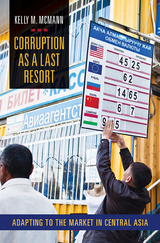
Using evidence from her long-term research in Kazakhstan and Kyrgyzstan, Kelly M. McMann traces the situations that drive individuals to illicitly seek employment and loans from government officials.
Why do ordinary people engage in corruption? Kelly M. McMann contends that bureaucrats, poverty, and culture do not force individuals in Central Asia to pay bribes, use connections, or sell political support. Rather, corruption is a last resort when relatives, groups in society, the market, and formal government programs cannot provide essential goods and services. Using evidence from her long-term research in Kazakhstan and Kyrgyzstan, McMann shows that Islamic institutions, secular charities, entrepreneurs, and banks cannot provide the jobs and credit people need. This drives individuals to illicitly seek employment and loans from government officials.A leading cause of this resource scarcity is market reform, as demonstrated by McMann's analysis of these countries as well as of Uzbekistan and global data. Market reform without supporting institutions, such as credit registries and antimonopoly measures, limits the resources available from the market and societal groups. McMann finds that in these circumstances only those individuals who have affluent relatives have an alternative to corruption.By focusing on ordinary people, McMann offers a new understanding of corruption. Previously, our knowledge was largely restricted to government officials' role in illicit exchanges. From her novel approach comes a useful policy insight: supplying ordinary people with alternatives to corruption is a fundamental and important anticorruption strategy.
Why do ordinary people engage in corruption? In Corruption as a Last Resort, Kelly M. McMann contends that bureaucrats, poverty, and culture do not force individuals in Central Asia to pay bribes, use connections, or sell political support. Rather, corruption is a last resort when relatives, groups in society, the market, and formal government programs cannot provide essential goods and services. Using evidence from her long-term research in Kazakhstan and Kyrgyzstan, McMann shows that Islamic institutions, secular charities, entrepreneurs, and banks cannot provide the jobs and credit people need. This drives individuals to illicitly seek employment and loans from government officials.
A leading cause of this resource scarcity is market reform, as demonstrated by McMann's analysis of these countries as well as of Uzbekistan and global data. Market reform without supporting institutions, such as credit registries and antimonopoly measures, limits the resources available from the market and societal groups. McMann finds that in these circumstances only those individuals who have affluent relatives have an alternative to corruption. By focusing on ordinary people, McMann offers a new understanding of corruption. Previously, our knowledge was largely restricted to government officials' role in illicit exchanges. From her novel approach comes a useful policy insight: supplying ordinary people with alternatives to corruption is a fundamental and important anticorruption strategy.
Kelly M. McMann is Associate Professor of Political Science at Case Western Reserve University.
1. An Absence of Alternatives: A New Framework for Understanding Corruption2. Alternatives to Corruption and the Effect of Market Reform: The Arguments and Their Theoretical Implications3. Bribery, Favoritism, and Clientelism: Evidence from Kazakhstan and Kyrgyzstan4. Market Actors as an Unrealized Alternative: The Effect of Market Reforms5. Islamic Institutions and Secular Charities: Obstacles to Providing Substitute Resources6. Families: The Uneven Effect of Market Reforms7. Reducing Corruption: Policy RecommendationsAppendix: Statistical Analysis
Index
| Erscheint lt. Verlag | 6.2.2015 |
|---|---|
| Zusatzinfo | 32 tables, 1 map |
| Verlagsort | Ithaca |
| Sprache | englisch |
| Maße | 160 x 160 mm |
| Gewicht | 28 g |
| Themenwelt | Sachbuch/Ratgeber ► Beruf / Finanzen / Recht / Wirtschaft ► Wirtschaft |
| Recht / Steuern ► Strafrecht ► Kriminologie | |
| Sozialwissenschaften ► Politik / Verwaltung ► Vergleichende Politikwissenschaften | |
| Wirtschaft ► Volkswirtschaftslehre ► Wirtschaftspolitik | |
| Schlagworte | kazakhstan market reform, kyrgyzstan market reform, uzbekistan economy, illegal government loans, political corruption in central asia, antimonopoly regulations, anticorruption strategy |
| ISBN-10 | 0-8014-5490-5 / 0801454905 |
| ISBN-13 | 978-0-8014-5490-5 / 9780801454905 |
| Informationen gemäß Produktsicherheitsverordnung (GPSR) | |
| Haben Sie eine Frage zum Produkt? |
 EPUB (Adobe DRM)
Kopierschutz: Adobe-DRM
Adobe-DRM ist ein Kopierschutz, der das eBook vor Mißbrauch schützen soll. Dabei wird das eBook bereits beim Download auf Ihre persönliche Adobe-ID autorisiert. Lesen können Sie das eBook dann nur auf den Geräten, welche ebenfalls auf Ihre Adobe-ID registriert sind.
Details zum Adobe-DRM
Dateiformat: EPUB (Electronic Publication)
EPUB ist ein offener Standard für eBooks und eignet sich besonders zur Darstellung von Belletristik und Sachbüchern. Der Fließtext wird dynamisch an die Display- und Schriftgröße angepasst. Auch für mobile Lesegeräte ist EPUB daher gut geeignet.
Systemvoraussetzungen:
PC/Mac: Mit einem PC oder Mac können Sie dieses eBook lesen. Sie benötigen eine
eReader: Dieses eBook kann mit (fast) allen eBook-Readern gelesen werden. Mit dem amazon-Kindle ist es aber nicht kompatibel.
Smartphone/Tablet: Egal ob Apple oder Android, dieses eBook können Sie lesen. Sie benötigen eine
Geräteliste und zusätzliche Hinweise
Buying eBooks from abroad
For tax law reasons we can sell eBooks just within Germany and Switzerland. Regrettably we cannot fulfill eBook-orders from other countries.
aus dem Bereich