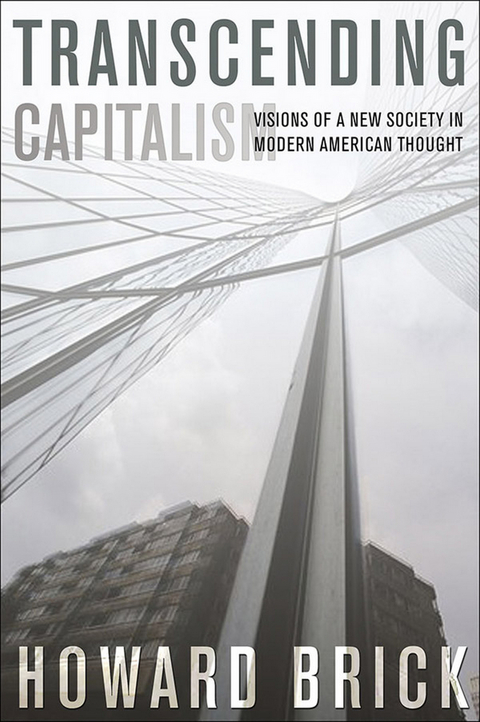
Transcending Capitalism (eBook)
304 Seiten
Cornell University Press (Verlag)
978-0-8014-5428-8 (ISBN)
Understanding why a generation of social theorists imagined the future of advanced societies would not be defined by capitalism but rather as being postcapitalist or postindustrial.
Transcending Capitalism explains why many influential midcentury American social theorists came to believe it was no longer meaningful to describe modern Western society as "capitalist," but instead preferred alternative terms such as "postcapitalist," "postindustrial," or "technological." Considering the discussion today of capitalism and its global triumph, it is important to understand why a prior generation of social theorists imagined the future of advanced societies not in a fixed capitalist form but in some course of development leading beyond capitalism.Howard Brick locates this postcapitalist vision within a long history of social theory and ideology. He challenges the common view that American thought and culture utterly succumbed in the 1940s to a conservative cold war consensus that put aside the reform ideology and social theory of the early twentieth century. Rather, expectations of the shift to a new social economy persisted and cannot be disregarded as one of the elements contributing to the revival of dissenting thought and practice in the 1960s.Rooted in a politics of social liberalism, this vision held influence for roughly a half century, from its interwar origins until the right turn in American political culture during the 1970s and 1980s. In offering a historically based understanding of American postcapitalist thought, Brick also presents some current possibilities for reinvigorating critical social thought that explores transitional developments beyond capitalism.
In Transcending Capitalism, Howard Brick explains why many influential midcentury American social theorists came to believe it was no longer meaningful to describe modern Western society as "capitalist," but instead preferred alternative terms such as "postcapitalist," "postindustrial," or "technological." Considering the discussion today of capitalism and its global triumph, it is important to understand why a prior generation of social theorists imagined the future of advanced societies not in a fixed capitalist form but in some course of development leading beyond capitalism.
Brick locates this postcapitalist vision within a long history of social theory and ideology. He challenges the common view that American thought and culture utterly succumbed in the 1940s to a conservative cold war consensus that put aside the reform ideology and social theory of the early twentieth century. Rather, expectations of the shift to a new social economy persisted and cannot be disregarded as one of the elements contributing to the revival of dissenting thought and practice in the 1960s.
Rooted in a politics of social liberalism, this vision held influence for roughly a half century, from its interwar origins until the right turn in American political culture during the 1970s and 1980s. In offering a historically based understanding of American postcapitalist thought, Brick also presents some current possibilities for reinvigorating critical social thought that explores transitional developments beyond capitalism.
Howard Brick is Professor of History and Louis Evans Chair in U.S. History at the University of Michigan at Ann Arbor. He is the author of Age of Contradiction: American Thought and Culture in the 1960s, also from Cornell, and Daniel Bell and the Decline of Intellectual Radicalism: Social Theory and Political Reconciliation in the 1940s.
Introduction. To Name a New Society in the Making1. Capitalism and Its Future on the Eve of World War I2. The American Theory of Organized Capitalism3. The Interwar Critique of Competitive Individualism4. Talcott Parsons and the Evanescence of Capitalism5. The Displacement of Economy in an Age of Plenty6. The Heyday of Dynamic Sociology7. The Great ReversalConclusion. On Transitional Developments beyond CapitalismNotes
Index
| Erscheint lt. Verlag | 25.9.2015 |
|---|---|
| Verlagsort | Ithaca |
| Sprache | englisch |
| Maße | 160 x 160 mm |
| Gewicht | 28 g |
| Themenwelt | Sachbuch/Ratgeber ► Geschichte / Politik ► 20. Jahrhundert bis 1945 |
| Geschichte ► Allgemeine Geschichte ► Neuzeit (bis 1918) | |
| Geisteswissenschaften ► Geschichte ► Regional- / Ländergeschichte | |
| Sozialwissenschaften ► Soziologie ► Allgemeines / Lexika | |
| Wirtschaft ► Allgemeines / Lexika | |
| Wirtschaft ► Volkswirtschaftslehre | |
| Schlagworte | Social theory, postcapitalist society, modern Western society, postindustrial, American thought and culture, Cold War, reform ideology |
| ISBN-10 | 0-8014-5428-X / 080145428X |
| ISBN-13 | 978-0-8014-5428-8 / 9780801454288 |
| Informationen gemäß Produktsicherheitsverordnung (GPSR) | |
| Haben Sie eine Frage zum Produkt? |
 EPUB (Adobe DRM)
Kopierschutz: Adobe-DRM
Adobe-DRM ist ein Kopierschutz, der das eBook vor Mißbrauch schützen soll. Dabei wird das eBook bereits beim Download auf Ihre persönliche Adobe-ID autorisiert. Lesen können Sie das eBook dann nur auf den Geräten, welche ebenfalls auf Ihre Adobe-ID registriert sind.
Details zum Adobe-DRM
Dateiformat: EPUB (Electronic Publication)
EPUB ist ein offener Standard für eBooks und eignet sich besonders zur Darstellung von Belletristik und Sachbüchern. Der Fließtext wird dynamisch an die Display- und Schriftgröße angepasst. Auch für mobile Lesegeräte ist EPUB daher gut geeignet.
Systemvoraussetzungen:
PC/Mac: Mit einem PC oder Mac können Sie dieses eBook lesen. Sie benötigen eine
eReader: Dieses eBook kann mit (fast) allen eBook-Readern gelesen werden. Mit dem amazon-Kindle ist es aber nicht kompatibel.
Smartphone/Tablet: Egal ob Apple oder Android, dieses eBook können Sie lesen. Sie benötigen eine
Geräteliste und zusätzliche Hinweise
Buying eBooks from abroad
For tax law reasons we can sell eBooks just within Germany and Switzerland. Regrettably we cannot fulfill eBook-orders from other countries.
aus dem Bereich