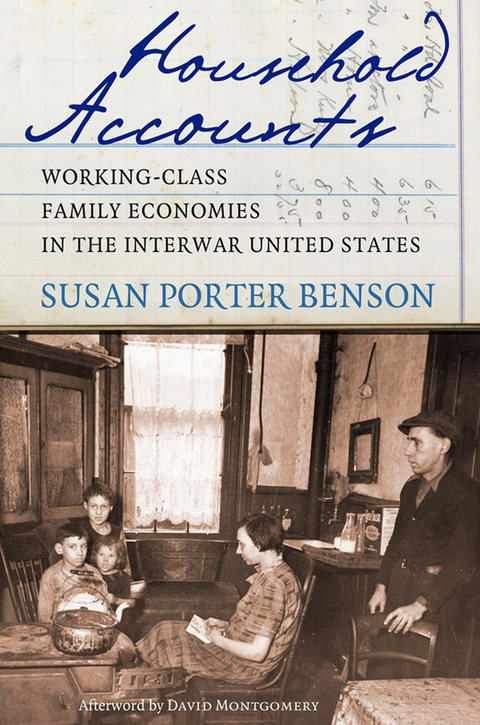
Household Accounts (eBook)
256 Seiten
Cornell University Press (Verlag)
978-0-8014-5426-4 (ISBN)
Susan Porter Benson takes readers into the budgets and the lives of working-class families in the United States between the two world wars.
With unprecedented subtlety, compassion and richness of detail, Susan Porter Benson takes readers into the budgets and the lives of working-class families in the United States between the two world wars. Focusing on families from regions across America and of differing races and ethnicities, she argues that working-class families of the time were not on the verge of entering the middle class and embracing mass culture. Rather, she contends that during the interwar period such families lived in a context of scarcity and limited resources, not plenty. Their consumption, Benson argues, revolved around hard choices about basic needs and provided therapeutic satisfactions only secondarily, if at all.Household Accounts is rich with details Benson gathered from previously untapped sources, particularly interviews with women wage earners conducted by field agents of the Women's Bureau of the Department of Labor. She provides a vivid picture of a working-class culture of family consumption: how working-class families negotiated funds; how they made qualitative decisions about what they wanted; how they determined financial strategies and individual goals; and how, in short, families made ends meet during this period. Topics usually central to the histories of consumption—he development of mass consumer culture, the hegemony of middle-class versions of consumption, and the expanded offerings of the marketplace—contributed to but did not control the lives of working-class people. Ultimately, Household Accounts seriously calls into question the usual narrative of a rising and inclusive tide of twentieth-century consumption.
With unprecedented subtlety, compassion and richness of detail, Susan Porter Benson takes readers into the budgets and the lives of working-class families in the United States between the two world wars. Focusing on families from regions across America and of differing races and ethnicities, she argues that working-class families of the time were not on the verge of entering the middle class and embracing mass culture. Rather, she contends that during the interwar period such families lived in a context of scarcity and limited resources, not plenty. Their consumption, Benson argues, revolved around hard choices about basic needs and provided therapeutic satisfactions only secondarily, if at all.
Household Accounts is rich with details Benson gathered from previously untapped sources, particularly interviews with women wage earners conducted by field agents of the Women's Bureau of the Department of Labor. She provides a vivid picture of a working-class culture of family consumption: how working-class families negotiated funds; how they made qualitative decisions about what they wanted; how they determined financial strategies and individual goals; and how, in short, families made ends meet during this period. Topics usually central to the histories of consumption—he development of mass consumer culture, the hegemony of middle-class versions of consumption, and the expanded offerings of the marketplace—contributed to but did not control the lives of working-class people. Ultimately, Household Accounts seriously calls into question the usual narrative of a rising and inclusive tide of twentieth-century consumption.
The late Susan Porter Benson was Director of Women's Studies at the University of Connecticut and the author of Counter Cultures: Saleswoman, Managers, and Customers in American Department Stores, 1890-1940. The late David Montgomery was Farnam Professor of History Emeritus at Yale University and the author of several books, including The Fall of the House of Labor: The Workplace, the State, and American Labor Activism, 1865-1925.
A Note on Household Accounts and Its Preparation
AcknowledgmentsIntroduction1. "Living on the Margin": Working-Class Marriages and Family Survival Strategies2. "Cooperative Conflict": Gender, Generation, and Consumption in Working-Class Families3. The Mutuality of Shared Spaces4. What Goes 'Round, Comes ’Round:Working-Class Reciprocity5. The Family Economy in the MarketplaceClass, Gender, and Reciprocity: An Afterword
by David MontgomeryNotes
Index
| Erscheint lt. Verlag | 25.9.2015 |
|---|---|
| Nachwort | David Montgomery |
| Verlagsort | Ithaca |
| Sprache | englisch |
| Maße | 150 x 150 mm |
| Gewicht | 28 g |
| Themenwelt | Sachbuch/Ratgeber ► Geschichte / Politik ► 20. Jahrhundert bis 1945 |
| Geschichte ► Allgemeine Geschichte ► Neuzeit (bis 1918) | |
| Geisteswissenschaften ► Geschichte ► Regional- / Ländergeschichte | |
| Geschichte ► Teilgebiete der Geschichte ► Wirtschaftsgeschichte | |
| Sozialwissenschaften ► Pädagogik ► Sozialpädagogik | |
| Sozialwissenschaften ► Soziologie ► Makrosoziologie | |
| Sozialwissenschaften ► Soziologie ► Mikrosoziologie | |
| Wirtschaft ► Volkswirtschaftslehre ► Mikroökonomie | |
| Schlagworte | American life, sociopolitical relations, class solidarity, class struggle, interwar class relations, postwar class relations |
| ISBN-10 | 0-8014-5426-3 / 0801454263 |
| ISBN-13 | 978-0-8014-5426-4 / 9780801454264 |
| Informationen gemäß Produktsicherheitsverordnung (GPSR) | |
| Haben Sie eine Frage zum Produkt? |
 EPUB (Adobe DRM)
Kopierschutz: Adobe-DRM
Adobe-DRM ist ein Kopierschutz, der das eBook vor Mißbrauch schützen soll. Dabei wird das eBook bereits beim Download auf Ihre persönliche Adobe-ID autorisiert. Lesen können Sie das eBook dann nur auf den Geräten, welche ebenfalls auf Ihre Adobe-ID registriert sind.
Details zum Adobe-DRM
Dateiformat: EPUB (Electronic Publication)
EPUB ist ein offener Standard für eBooks und eignet sich besonders zur Darstellung von Belletristik und Sachbüchern. Der Fließtext wird dynamisch an die Display- und Schriftgröße angepasst. Auch für mobile Lesegeräte ist EPUB daher gut geeignet.
Systemvoraussetzungen:
PC/Mac: Mit einem PC oder Mac können Sie dieses eBook lesen. Sie benötigen eine
eReader: Dieses eBook kann mit (fast) allen eBook-Readern gelesen werden. Mit dem amazon-Kindle ist es aber nicht kompatibel.
Smartphone/Tablet: Egal ob Apple oder Android, dieses eBook können Sie lesen. Sie benötigen eine
Geräteliste und zusätzliche Hinweise
Buying eBooks from abroad
For tax law reasons we can sell eBooks just within Germany and Switzerland. Regrettably we cannot fulfill eBook-orders from other countries.
aus dem Bereich