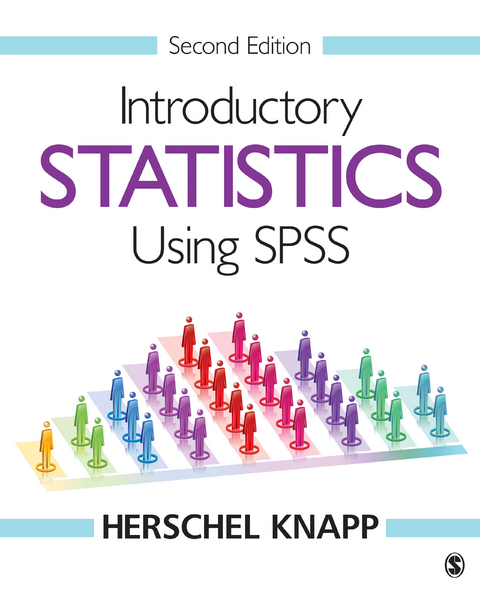
Introductory Statistics Using SPSS (eBook)
312 Seiten
Sage Publications, Inc (Verlag)
978-1-5063-5869-7 (ISBN)
Preface
Acknowledgments
About the Author
PART I: STATISTICAL PRINCIPLES
1. Research Principles
Learning Objectives
Overview—Research Principles
Rationale for Statistics
Research Questions
Treatment and Control Groups
Rationale for Random Assignment
Hypothesis Formulation
Reading Statistical Outcomes
Accept or Reject Hypotheses
Variable Types and Levels of Measure
Continuous
Interval
Ratio
Categorical
Nominal
Ordinal
Good Common Sense
Key Concepts
Practice Exercises
2. Sampling
Learning Objectives
Overview—Sampling
Rationale for Sampling
Time
Cost
Feasibility
Extrapolation
Sampling Terminology
Population
Sample Frame
Sample
Representative Sample
Probability Sampling
Simple Random Sampling
Stratified Sampling
Proportionate and Disproportionate Sampling
Systematic Sampling
Area Sampling
Nonprobability Sampling
Convenience Sampling
Purposive Sampling
Quota Sampling
Snowball Sampling
Sampling Bias
Optimal Sample Size
Good Common Sense
Key Concepts
Practice Exercises
3. Working in SPSS
Learning Objectives
Video
Overview—SPSS
Two Views: Variable View and Data View
Variable View
Name
Type
Width
Decimals
Label
Values
Missing
Columns
Align
Measure
Role
Data View
Value Labels Icon
Codebook
Saving Data Files
Good Common Sense
Key Concepts
Practice Exercises
PART II: STATISTICAL PROCESSES
4. Descriptive Statistics
Learning Objectives
Videos
Overview—Descriptive Statistics
Descriptive Statistics
Number (n)
Mean (µ)
Median
Mode
Standard Deviation (SD)
Variance
Minimum
Maximum
Range
SPSS—Loading an SPSS Data File
Run SPSS
Data Set
Test Run
SPSS—Descriptive Statistics: Continuous Variables (age)
Statistics Tables
Histogram With Normal Curve
Skewed Distribution
SPSS—Descriptive Statistics: Categorical Variables (gender)
Statistics Tables
Bar Chart
SPSS—Descriptive Statistics: Continuous Variable (age) Select by Categorical Variable (gender)—Female or Male Only
SPSS—(Re)Selecting All Variables
Good Common Sense
Key Concepts
Practice Exercises
5. t Test and Mann-Whitney U Test
Learning Objectives
Videos
Overview—t Test
Example
Research Question
Groups
Procedure
Hypotheses
Data Set
Pretest Checklist
Pretest Checklist Criterion 1—Normality
Pretest Checklist Criterion 2—n Quota
Pretest Checklist Criterion 3—Homogeneity of Variance
Test Run
Results
Pretest Checklist Criterion 2—n Quota
Pretest Checklist Criterion 3—Homogeneity of Variance
p Value
Hypothesis Resolution
a Level
Documenting Results
Type I and Type II Errors
Type I Error
Type II Error
Overview—Mann-Whitney U Test
Test Run
Results
Good Common Sense
Key Concepts
Practice Exercises
6. ANOVA and Kruskal-Wallis Test
Learning Objectives
Videos
Layered Learning
Overview—ANOVA
Example
Research Question
Groups
Procedure
Hypotheses
Data Set
Pretest Checklist
Pretest Checklist Criterion 1—Normality
Pretest Checklist Criterion 2—n Quota
Pretest Checklist Criterion 3—Homogeneity of Variance
Test Run
Results
Pretest Checklist Criterion 2—n Quota
Pretest Checklist Criterion 3—Homogeneity of Variance
Comparison 1—Text : Text With Illustrations
Comparison 2—Text : Video
Comparison 3—Text With Illustrations : Video
Hypothesis Resolution
Documenting Results
Overview—Kruskal-Wallis Test
Test Run
Results
Good Common Sense
Key Concepts
Practice Exercises
7. Paired t Test and Wilcoxon Test
Learning Objectives
Videos
Overview—Paired t Test
Pretest/Posttest Design
Step 1: Pretest
Step 2: Treatment
Step 3: Posttest
Example
Research Question
Groups
Procedure
Step 1: Pretest
Step 2: Treatment
Step 3: Posttest
Hypotheses
Data Set
Pretest Checklist
Pretest Checklist Criterion 1—Normality of Difference
Test Run
Results
Hypothesis Resolution
Documenting Results
?% Formula
Overview—Wilcoxon Test
Test Run
Results
Good Common Sense
Key Concepts
Practice Exercises
8. Correlation and Regression—Pearson and Spearman
Learning Objectives
Videos
Overview—Pearson Correlation
Example 1—Pearson Regression
Research Question
Groups
Procedure
Hypotheses
Data Set
Pretest Checklist
Pretest Checklist Criterion 1—Normality
Test Run
Correlation
Regression (Scatterplot With Regression Line)
Results
Scatterplot Points
Scatterplot Regression Line
Pretest Checklist Criterion 2—Linearity
Pretest Checklist Criterion 3—Homoscedasticity
Correlation
Hypothesis Resolution
Documenting Results
Negative Correlation
No Correlation
Overview—Spearman Correlation
Example 2—Spearman Correlation
Research Question
Groups
Procedure
Hypotheses
Data Set
Pretest Checklist
Test Run
Results
Hypothesis Resolution
Documenting Results
Alternative Use for Spearman Correlation
Correlation Versus Causation
Overview—Other Types of Statistical Regression: Multiple Regression and Logistic Regression
Multiple Regression (R2)
Logistic Regression
Good Common Sense
Key Concepts
Practice Exercises
9. Chi-Square
Learning Objectives
Video
Overview—Chi-Square
Example
Research Question
Groups
Procedure
Hypotheses
Data Set
Pretest Checklist
Pretest Checklist Criterion 1—n = 5 per Cell
Test Run
Results
Pretest Checklist Criterion 1—n = 5 per Cell
Hypothesis Resolution
Documenting Results
Good Common Sense
Key Concepts
Practice Exercises
PART III: DATA HANDLING
10. Supplemental SPSS Operations
Learning Objectives
Data Sets
Overview—Supplemental SPSS Operations
Generating Random Numbers
Sort Cases
Data Set
Select Cases
Data Set
Recoding
Data Set
Importing Data
Importing Excel Data
Data Set
Importing ASCII Data (Generic Text File)
Data Set
SPSS Syntax
Data Set
Data Sets
Good Common Sense
Key Concepts
Practice Exercises
Glossary
Index
| Verlagsort | Thousand Oaks |
|---|---|
| Sprache | englisch |
| Themenwelt | Sachbuch/Ratgeber ► Natur / Technik ► Natur / Ökologie |
| Naturwissenschaften | |
| Sozialwissenschaften ► Soziologie ► Empirische Sozialforschung | |
| Schlagworte | Introductory Statistics • Intro Stats • SPSS • Statistics |
| ISBN-10 | 1-5063-5869-1 / 1506358691 |
| ISBN-13 | 978-1-5063-5869-7 / 9781506358697 |
| Informationen gemäß Produktsicherheitsverordnung (GPSR) | |
| Haben Sie eine Frage zum Produkt? |
 EPUB (Adobe DRM)
Kopierschutz: Adobe-DRM
Adobe-DRM ist ein Kopierschutz, der das eBook vor Mißbrauch schützen soll. Dabei wird das eBook bereits beim Download auf Ihre persönliche Adobe-ID autorisiert. Lesen können Sie das eBook dann nur auf den Geräten, welche ebenfalls auf Ihre Adobe-ID registriert sind.
Details zum Adobe-DRM
Dateiformat: EPUB (Electronic Publication)
EPUB ist ein offener Standard für eBooks und eignet sich besonders zur Darstellung von Belletristik und Sachbüchern. Der Fließtext wird dynamisch an die Display- und Schriftgröße angepasst. Auch für mobile Lesegeräte ist EPUB daher gut geeignet.
Systemvoraussetzungen:
PC/Mac: Mit einem PC oder Mac können Sie dieses eBook lesen. Sie benötigen eine
eReader: Dieses eBook kann mit (fast) allen eBook-Readern gelesen werden. Mit dem amazon-Kindle ist es aber nicht kompatibel.
Smartphone/Tablet: Egal ob Apple oder Android, dieses eBook können Sie lesen. Sie benötigen eine
Geräteliste und zusätzliche Hinweise
Buying eBooks from abroad
For tax law reasons we can sell eBooks just within Germany and Switzerland. Regrettably we cannot fulfill eBook-orders from other countries.
aus dem Bereich