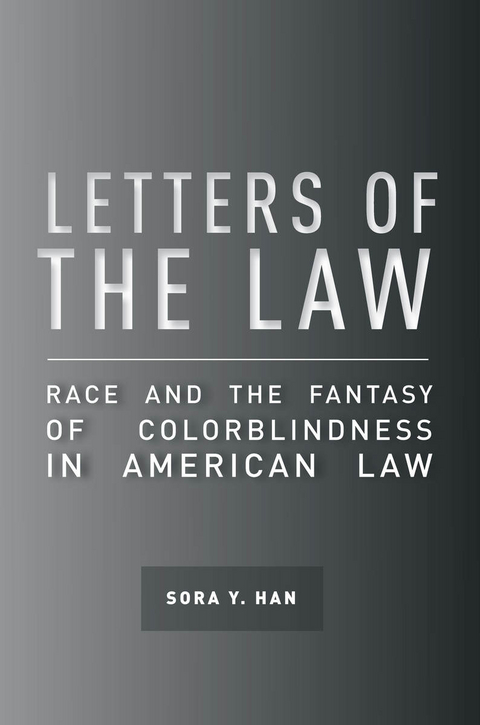
Letters of the Law (eBook)
184 Seiten
Stanford University Press (Verlag)
978-0-8047-9501-2 (ISBN)
One of the hallmark features of the post-civil rights United States is the reign of colorblindness over national conversations about race and law. But how, precisely, should we understand this notion of colorblindness in the face of enduring racial hierarchy in American society? In Letters of the Law, Sora Y. Han argues that colorblindness is a foundational fantasy of law that not only informs individual and collective ideas of race, but also structures the imaginative capacities of American legal interpretation. Han develops a critique of colorblindness by deconstructing the law's central doctrines on due process, citizenship, equality, punishment and individual liberty, in order to expose how racial slavery and the ongoing struggle for abolition continue to haunt the law's reliance on the fantasy of colorblindness.Letters of the Law provides highly original readings of iconic Supreme Court cases on racial inequality spanning Japanese internment to affirmative action, policing to prisoner rights, Jim Crow segregation to sexual freedom. Han's analysis provides readers with new perspectives on many urgent social issues of our time, including mass incarceration, educational segregation, state intrusions on privacy, and neoliberal investments in citizenship. But more importantly, Han compels readers to reconsider how the diverse legacies of civil rights reform archived in American law might be rewritten as a heterogeneous practice of black freedom struggle.
Sora Y. Han is Assistant Professor of Criminology, Law and Society at the University of California, Irvine.
Contents and AbstractsIntroduction: Letters of the Law chapter abstractDrawing on concepts from critical race theory, feminist psychoanalysis and deconstruction, the Introduction exposits and explains the importance of developing a protocol of reading the law's language of race anew. "Letters of the Law" is the conceptual term designating this protocol of reading beyond the law's functional effects in or formal divisions from social reality, and toward the law's language of race on its own terms. The fantasy of colorblindness serves as the entry point into the law's language, and is further exposited through case law and critical scholarship on race and law. In the course of this exposition, the Introduction also revises the central theoretical assumptions dominating the study of race and law so that they can better reflect the centrality of fantasy, unconscious desire, and rhetoric and writing to the practice and politics of legal reform and black freedom struggle.1Decompositional Rights chapter abstractThis chapter revisits and restages U.S. Supreme Court cases on affirmative action and the critique of "reverse discrimination" claims within a broader set of jurisprudential and philosophical questions about black citizenship and civil rights. Through a close reading of how the fantasy of colorblindness is articulated in affirmative action law through a multiracial national citizenship constituted against the historical limit of slavery, this chapter argues that the figure of black citizenship occupies a type of legal standing that promises only a constant cancellation of civil rights. The black claim to civil rights not only fails to achieve the status of an affirmative recognition of a citizen subject, but also, its force as a right decomposes the philosophical interdependence between citizenship and civil rights in the broader arena of Equal Protection anti-discrimination jurisprudence.2Colorblind Judgment chapter abstractThis chapter examines and explores the formal structure of judicial review in U.S. Supreme Court cases establishing the negative right prohibiting state-enforced racial discrimination codified in the Fourteenth Amendment Equal Protection clause. The fantasy of colorblindness in this doctrinal context is an admission of the limits of the justificatory logic of universal legal reason. Expanding on the abyssal form this limit takes, this chapter argues that colorblind judgment, like classic topographical conceptions of blindness in philosophic knowledge and aesthetic experience, both guards against and contains the excesses of desire, specifically "racial animus", in law. The chapter further explores how the materiality of desire in legal judgment is also where a poetics of the plea takes the form of an enduring echo in constitutional law.3Racial Profiling chapter abstractThis chapter examines the problem of legal interpretation in constitutional protections of privacy, including the Fourteenth Amendment rights to equal protection and due process, and the Fourth Amendment right requiring probable cause during police searches and seizures of persons and property. It argues that legal interpretations of these privacy rights and the policing such rights delimit both rely on the fantasmatic pursuit of an escaping image, the racial profile, to enforce the universal democratic value of personal sovereignty. The fantasy of colorblindness appears in this doctrinal context as a constitutional gaze that both creates and obscures the racial profile in the imaginative domain of producing legal meaning.4The Purloined Prisoner chapter abstractThis chapter examines letter writing as a formal, internally produced limit to the erosion of prisoners' First Amendment right to expression. It details how mass incarceration and its administration of various types of civil death, runs up against an epistolary expressivity that is neither extinguished nor sheltered by law, but is the material ground of desire at work in reading the law both to the letter and for its letters. The chapter argues that the fantasy of colorblindness in this context is a territorializing practice of reducing these plural forms of the letter in the law to a mass scene of writing. The chapter concludes with a reading of the agency of a prisoner's letter in Cheryl Dunye's film, Stranger Inside.
| Erscheint lt. Verlag | 5.5.2015 |
|---|---|
| Reihe/Serie | The Cultural Lives of Law | The Cultural Lives of Law |
| Zusatzinfo | 2 illustrations |
| Sprache | englisch |
| Themenwelt | Sachbuch/Ratgeber ► Beruf / Finanzen / Recht / Wirtschaft |
| Recht / Steuern ► Allgemeines / Lexika | |
| Recht / Steuern ► EU / Internationales Recht | |
| Recht / Steuern ► Öffentliches Recht ► Verfassungsrecht | |
| Schlagworte | Black Radical Tradition • Citizenship • Civil rights law • Colorblindness • Critical Legal Studies • critical race theory • Deconstruction • Legal Interpretation • racial profiling • Slavery |
| ISBN-10 | 0-8047-9501-0 / 0804795010 |
| ISBN-13 | 978-0-8047-9501-2 / 9780804795012 |
| Informationen gemäß Produktsicherheitsverordnung (GPSR) | |
| Haben Sie eine Frage zum Produkt? |
 EPUB (Adobe DRM)
Kopierschutz: Adobe-DRM
Adobe-DRM ist ein Kopierschutz, der das eBook vor Mißbrauch schützen soll. Dabei wird das eBook bereits beim Download auf Ihre persönliche Adobe-ID autorisiert. Lesen können Sie das eBook dann nur auf den Geräten, welche ebenfalls auf Ihre Adobe-ID registriert sind.
Details zum Adobe-DRM
Dateiformat: EPUB (Electronic Publication)
EPUB ist ein offener Standard für eBooks und eignet sich besonders zur Darstellung von Belletristik und Sachbüchern. Der Fließtext wird dynamisch an die Display- und Schriftgröße angepasst. Auch für mobile Lesegeräte ist EPUB daher gut geeignet.
Systemvoraussetzungen:
PC/Mac: Mit einem PC oder Mac können Sie dieses eBook lesen. Sie benötigen eine
eReader: Dieses eBook kann mit (fast) allen eBook-Readern gelesen werden. Mit dem amazon-Kindle ist es aber nicht kompatibel.
Smartphone/Tablet: Egal ob Apple oder Android, dieses eBook können Sie lesen. Sie benötigen eine
Geräteliste und zusätzliche Hinweise
Buying eBooks from abroad
For tax law reasons we can sell eBooks just within Germany and Switzerland. Regrettably we cannot fulfill eBook-orders from other countries.
aus dem Bereich