


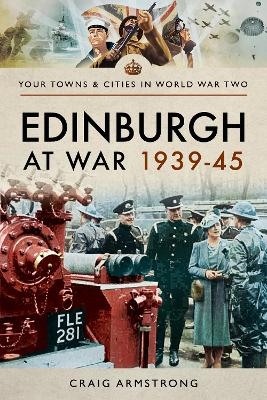
Edinburgh at War 1939 - 1945
Seiten
2018
Pen & Sword Military (Verlag)
978-1-4738-7963-8 (ISBN)
Pen & Sword Military (Verlag)
978-1-4738-7963-8 (ISBN)
A close look at the worry and hardships the people of Edinburgh were faced with during the Second World War.
Scotland was of grave strategic importance during the war because of its geographical position and its capital was the location of a significant number of important military and civil organisations. Edinburgh Castle became the HQ of the Scottish Home Forces whilst the Forth was a vitally important port and was heavily protected even before the start of the war. Its importance was marked by its attracting the first air raid of the war on mainland Britain when a force of German bombers was sent to attack naval shipping in the Forth on 16th October 1939/. The raid was intercepted by the RAF which shot down at least two bombers and the entire action was witnessed by many civilians on the ground. The raid also caused the first civilian casualties when two women were injured in Edinburgh and two men machine-gunned in Portobello. Thousands lined the streets days later for the funeral of two of the Luftwaffe airmen.
No member of the population of Edinburgh escaped the war, whether it was the huge numbers of men and women from the area who came forward for service in the military or in roles such as the Home Guard, ARP services, nursing, working in vital war industries, struggling to maintain a household under strict rationing and the stresses of wartime life, or children evacuated from the city to the rural areas of Scotland to escape the expected bombing campaign (even though the Archbishop of Edinburgh called for their return if there was insufficient provision of religious instruction in reception areas). Edinburgh was also home to a sizable Italian community which was badly affected by internment and the subsequent tight restrictions on movement and civil rights. The Italian community was also subjected to violent attacks when rioting mobs attacked Italian owned business throughout the city (although one family business was spared because one of the sons was known as a fanatical supporter of Hibs). _Edinburgh at War 1939-1945_ poignantly commemorates the efforts and achievements of Edinburgh: workers, fighters, families divided, all surviving astounding tests.
Scotland was of grave strategic importance during the war because of its geographical position and its capital was the location of a significant number of important military and civil organisations. Edinburgh Castle became the HQ of the Scottish Home Forces whilst the Forth was a vitally important port and was heavily protected even before the start of the war. Its importance was marked by its attracting the first air raid of the war on mainland Britain when a force of German bombers was sent to attack naval shipping in the Forth on 16th October 1939/. The raid was intercepted by the RAF which shot down at least two bombers and the entire action was witnessed by many civilians on the ground. The raid also caused the first civilian casualties when two women were injured in Edinburgh and two men machine-gunned in Portobello. Thousands lined the streets days later for the funeral of two of the Luftwaffe airmen.
No member of the population of Edinburgh escaped the war, whether it was the huge numbers of men and women from the area who came forward for service in the military or in roles such as the Home Guard, ARP services, nursing, working in vital war industries, struggling to maintain a household under strict rationing and the stresses of wartime life, or children evacuated from the city to the rural areas of Scotland to escape the expected bombing campaign (even though the Archbishop of Edinburgh called for their return if there was insufficient provision of religious instruction in reception areas). Edinburgh was also home to a sizable Italian community which was badly affected by internment and the subsequent tight restrictions on movement and civil rights. The Italian community was also subjected to violent attacks when rioting mobs attacked Italian owned business throughout the city (although one family business was spared because one of the sons was known as a fanatical supporter of Hibs). _Edinburgh at War 1939-1945_ poignantly commemorates the efforts and achievements of Edinburgh: workers, fighters, families divided, all surviving astounding tests.
Born and bred in Northumberland, Dr Craig Armstrong is an experienced historian, with a special interest in the history of the North East of England and Scotland. He has expertise in nineteenth and twentieth-century history, with a particular focus on social and military history. Dr Armstrong currently splits his time between working as a freelance author and researcher on all things North Eastern and Scottish and teaching part-time at Newcastle University.
| Erscheinungsdatum | 10.10.2018 |
|---|---|
| Zusatzinfo | 50 illustrations |
| Verlagsort | South Yorkshire |
| Sprache | englisch |
| Maße | 156 x 234 mm |
| Themenwelt | Sachbuch/Ratgeber ► Geschichte / Politik ► Regional- / Landesgeschichte |
| Geschichte ► Allgemeine Geschichte ► 1918 bis 1945 | |
| Geschichte ► Teilgebiete der Geschichte ► Militärgeschichte | |
| ISBN-10 | 1-4738-7963-9 / 1473879639 |
| ISBN-13 | 978-1-4738-7963-8 / 9781473879638 |
| Zustand | Neuware |
| Informationen gemäß Produktsicherheitsverordnung (GPSR) | |
| Haben Sie eine Frage zum Produkt? |
Mehr entdecken
aus dem Bereich

aus dem Bereich
Deutschland 1933 bis 1945
Buch | Hardcover (2025)
S. Fischer (Verlag)
CHF 47,60
ein Psychologe erlebt das Konzentrationslager
Buch | Hardcover (2024)
Kösel (Verlag)
CHF 30,80


