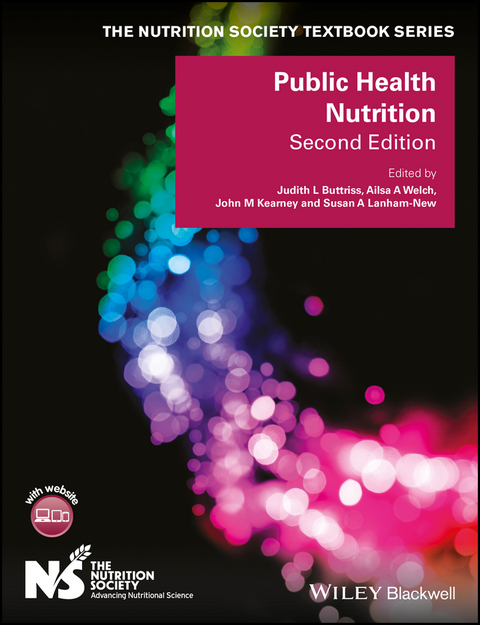
Public Health Nutrition (eBook)
John Wiley & Sons (Verlag)
978-1-118-66096-6 (ISBN)
In this second edition of the bestselling title from the acclaimed Nutrition Society Textbook series, Public Health Nutrition has been extensively revised to ensure that it reflects the latest evidence-based knowledge and research. Ground-breaking and comprehensive in both its scope and approach, Public Health Nutrition has been fully updated by an expert editorial team to cover the most recent changes in the field. It now offers a structured overview of the subject's core concepts and considers public health nutrition tools and the application of intervention strategies.
Divided into five key sections, Public Health Nutrition contains a wealth of information, including:
- Public health nutrition concepts and assessment tools, and their application in light of the latest evidence.
- Case studies to illustrate how best to apply the theory and evidence to policy and practice.
- An examination of nutrition throughout the lifecycle, and the relationship between diet and disease, including in relation to obesity, diabetes, cancer, as well as mental health.
- The impact of environmental factors on public health.
- Public health strategies, policies and approaches.
With a clear and concise structure, Public Health Nutrition is an essential purchase for students of nutrition, dietetics and other healthcare areas, as well as an invaluable practical guide for health professionals working within public health.
A supporting companion website featuring multiple-choice, short answer, and essay style questions is available at www.wiley.com/go/buttriss/publichealth
Professor Judith L Buttriss, Director General, British Nutrition Foundation, UK.
Dr Ailsa A Welch, Reader in Nutritional Epidemiology, University of East Anglia, UK.
Dr John M Kearney, Lecturer, Epidemiology, Dublin Institute of Technology, Republic of Ireland.
Professor Susan A Lanham-New, Head of the Department of Nutritional Sciences, University of Surrey, UK.
In this second edition of the bestselling title from the acclaimed Nutrition Society Textbook series, Public Health Nutrition has been extensively revised to ensure that it reflects the latest evidence-based knowledge and research. Ground-breaking and comprehensive in both its scope and approach, Public Health Nutrition has been fully updated by an expert editorial team to cover the most recent changes in the field. It now offers a structured overview of the subject s core concepts and considers public health nutrition tools and the application of intervention strategies. Divided into five key sections, Public Health Nutrition contains a wealth of information, including: Public health nutrition concepts and assessment tools, and their application in light of the latest evidence. Case studies to illustrate how best to apply the theory and evidence to policy and practice. An examination of nutrition throughout the lifecycle, and the relationship between diet and disease, including in relation to obesity, diabetes, cancer, as well as mental health. The impact of environmental factors on public health. Public health strategies, policies and approaches. With a clear and concise structure, Public Health Nutrition is an essential purchase for students of nutrition, dietetics and other healthcare areas, as well as an invaluable practical guide for health professionals working within public health. A supporting companion website featuring multiple-choice, short answer, and essay style questions is available at www.wiley.com/go/buttriss/publichealth
Professor Judith L Buttriss, Director General, British Nutrition Foundation, UK. Dr Ailsa A Welch, Reader in Nutritional Epidemiology, University of East Anglia, UK. Dr John M Kearney, Lecturer, Epidemiology, Dublin Institute of Technology, Republic of Ireland. Professor Susan A Lanham-New, Head of the Department of Nutritional Sciences, University of Surrey, UK.
Contributors viii
Series Foreword x
Preface xi
Introduction xiii
About the companion website xiv
Part One Public Health Nutrition Tools 1
1 Introduction to Public Health Nutrition 3
Martin Wiseman
2 Concepts and Definitions Used in Public Health Nutrition 9
Eric J Brunner and Ailsa A Welch
3 Assessment of Dietary Habits 18
Marga Ocke and Emma Foster
4 Assessment of Nutritional Status in Public Health Nutrition Settings 29
H David McCarthy
5 Food Composition 36
Mark Roe, Jenny Plumb, U Ruth Charrondierre and Paul Finglas
6 Dietary Reference Values 47
Peter J Aggett
7 Assessment of Physical Activity 56
Bjørge H Hansen and Ulf Ekelund
Part Two Current State of Evidence 69
8 Poor Dietary Patterns 71
Judith L Buttriss and Anne P Nugent
9 Minerals and Vitamins of Current Concern 88
Iron 88
Peter J Aggett
Iodine 96
Margaret P Rayman and Sarah C Bath
Vitamin A 102
Elizabeth J Johnson and Emily Mohn
10 Nutrition Pre-conception and during Pregnancy 111
Sara Stanner
11 Nutrition and Infant/Child Development 137
Alison M Lennox
12 Nutrition and Teenagers/Young Adults 159
Elisabeth Weichselbaum
13 Nutrition in Older Adults 175
Ashley T LaBrier, Clare A Corish, and Johanna T Dwyer
Part Three Diet and Disease 193
14 Obesity: Maternal 195
Debbie M Smith, Tracey A Mills, and Christine Furber
15 Obesity: Childhood 205
Laura Stewart, Jenny Gillespie, and Taryn Young
16 Cardiovascular Diseases: Sodium and Blood Pressure 214
Linda M Oude Griep and Paul Elliott
17 Carbohydrates and Metabolic Health 221
Judith L Buttriss
18 Cardiovascular Disease: Dietary Fat Quality 236
Tom Sanders
19 Diet and Cancer 243
Farah Naja and Lara Nasreddine
20 Bone Health 284
Louise R Wilson, Andrea L Darling, and Susan A Lanham-New
21 Dental Health 298
Anja Heilmann and Richard G Watt
22 Mental Health and Cognitive Function 310
Iron 310
Paul A Sharp
Caffeine 313
Peter J Rogers
B Vitamins 317
Helene McNulty
Physical Activity 320
Kenneth R Fox
Part Four Environmental Factors 325
23 Obesogenic Neighbourhood Food Environments 327
Amelia A Lake, Tim G Townshend, and Thomas Burgoine
24 The Wider Environment and its Effect on Dietary Behaviour 339
Bridget Benelam and Judith L Buttriss
Part Five Public Health Nutrition Strategies and Approaches 357
25 Global and National Public Health Nutrition Approaches 359
Francesco Branca and Cassandra H Ellis
26 Developing Strategies in the Community 373
Janet E Cade, Charlotte EL Evans, and Jayne Hutchinson
27 Dietary Change and Evidence on How to Achieve This 386
Janice L Thompson
28 Evaluation of Public Health Nutrition Interventions and Policies 398
Ailsa A Welch and Richard PG Hayhoe
29 Considerations for Evaluation of Public Health Nutrition Interventions in Diverse Communities 405
Basma Ellahi
Appendix 411
Index 417
1
Introduction to Public Health Nutrition
Martin Wiseman
Key Messages
- Nutrition is fundamental for life and health. The term ‘nutrition’ encompasses both biological and sociological aspects of how cells, tissues and organisms access the substrates and cofactors that are necessary for normal conception, growth, development and ageing.
- Public health nutrition refers to nutritional aspects of public health, which is the science and art of promoting and protecting health and well-being, preventing ill health and prolonging life through the organised efforts of society.
- The historical focus of public health nutrition has been on undernutrition, which is still a major problem across all levels of development. In less economically developed countries, it most commonly manifest as deficiencies of micronutrients as well as wasting and stunting (acute and chronic malnutrition) in childhood. In economically developed countries undernutrition is a common feature of ageing, though nutrition-related chronic non-communicable diseases such as obesity, type 2 diabetes, cardiovascular disease and several common cancers predominate. Increasingly, as less economically developed countries undergo nutritional transition, they are experiencing a rising burden of these diseases, so that these are now the major nutrition-related disease burden globally.
- The characterisation of human nutrient requirements is a fundamental activity for public health nutrition, and their application in clinical or public health settings requires training and experience that marks professional nutritional practice.
- Effective public health nutrition requires three discrete functions
- the acquisition, synthesis and dissemination of knowledge relating nutrition to health and disease;
- surveillance programmes to detect potential nutritional problems across the life course among the population, and to monitor change;
- evidence-informed policy development, implementation and evaluation.
- Public health nutrition policy relies on ensuring that people have the necessary information to make healthy choices around food and physical activity, as well as on ensuring that the environment in which they live is conducive to making those healthy choices. Policy makers need to balance the evidence for health need against economic and other socio-political factors in determining what action to take.
1.1 Public Health and Nutrition
Nutrition lies at the heart of health. Human life – from conception or even before, through fetal and childhood growth, development and maturation, to adult life and old age – creates a demand for energy and nutrients, and relies on their adequate provision, and on the body's metabolic capability to transform these substrates and cofactors into the multitude of chemicals needed by cells for normal structure and function, driven by their genetic endowment. Nutrition is the process by which cells, tissues, organs, people and populations achieve this. Poor nutrition leads to poor health; and poor health also often leads to poor nutrition.
Public health refers to those aspects of health that affect the population as a whole, their study and the services that aim to deliver it. Public health nutrition is where these two concerns – population health and nutrition – interact or overlap.
Public health is defined as ‘The science and art of promoting and protecting health and well-being, preventing ill health and prolonging life through the organised efforts of society’.
It is worth elaborating on that concise definition, first to note the implicit recognition that the evidence (science) underpinning actions to promote or protect health may often be incomplete, and that professional judgement (art) is needed to interpret and apply it. This is no different in concept from the application of science in clinical care, where the demand for evidence-based practice exposes gaps in knowledge of how to manage the very variable presentations of individual patients, but does not paralyse clinical action. Second, it is important that prolongation of life is linked with the promotion of health and prevention of ill health, in order to avoid prolonged disability with ageing. The aim is to shorten the period of ill health (compression of morbidity) before death in old age. Third, public health needs to be organised. It is not a default, as can be seen in the many parts of the world where effective public health structures and systems do not exist, and where infant and maternal mortality are high, expectation of life is low, and infectious and increasingly non-communicable diseases are common, as was the case in now economically developed countries in the past. Finally, the responsibility to make efforts falls not only to the small group of people who are professionals in public health, but to society as a whole. This recognises that the determinants of health in populations have little to do with the health care system (which deals with the problems of failed health), and are mostly related to the wider environmental conditions in which people are conceived, born, grow, live, work and age. Public health is about creating environments that are conducive to health, and public health nutrition is about creating environments that are conducive to healthy nutrition.
1.2 History of Nutrition in Public Health
The ancients regarded food and medicine as related aspects, and since the demonstration in the 18th century by James Lind that lime juice was effective in curing and preventing scurvy (even though the finding was initially ignored and later had to be rediscovered), it has been clear that the provision of appropriate quality and quantity of food is essential in securing people's health.
The importance of food for growth, development and health was apparent despite lack of knowledge of the biological processes involved. This ignorance of the detail of the body's nutritional demands and how different foods and diets can meet them meant that it was difficult to derive rational nutrition policies.
The UK offers a good illustration. In the UK during the First World War, disruption to food imports from abroad had a major impact on the food supply (see Table 1.1), but there was insufficient understanding of the nutritional consequences for a coherent political response to be mounted.
Table 1.1 When food imports were seriously disrupted in the First World War (WW1), limited nutrition knowledge meant that a coherent food policy was not possible and the food supply was adversely affected. In contrast, despite similar disruption to food imports in the Second World War (WW2), the application of the new nutritional science into effective policy ensured that the food supply was maintained and equitably distributed to secure the health of the population.
Source: Magee (1946). Reproduced with permission of BMJ Publishing Ltd.
| WW1 | WW2 |
| Milk | −26% | +28% |
| Eggs | −40% | −6% |
| Meat | −27% | −21% |
| Vegetables | −9% | +34% |
Subsequently, the British population experienced food shortages, and malnutrition was a major problem. After the establishment of the Ministry of Health in 1919, food and nutrition were early targets for a more systematic approach to policy. In 1921 the Ministry published a report on ‘Diet in Relation to Normal Nutrition’ that identified the importance of so-called ‘protective foods’ – green leafy vegetables, milk and eggs – for healthy growth in children. This period coincided with the explosion of nutrition research into the accessory food factors (vitamins, minerals and trace elements) and the biological mechanisms for their effects – a discipline which spawned the new word ‘biochemistry’. By the time of the Second World War, when there was a similar disruption as in the first war to the food imports on which the British food supply depended, nutritional science had progressed sufficiently for the Government to base its food policy on sound science. This policy, which involved public education with enhanced local food production and controls on the equitable distribution of food, led to quite different effects on the food supply (see Table 1.1), and its success to the British Ministries of Food and Health later receiving the prestigious Lasker Award for public health.
This period set the foundations for the essential elements of food and nutrition policy into the future. The key aspects are
- a transparent mechanism for the provision of scientific nutrition advice to government;
- reliable means for monitoring diet and nutrition status among the population;
- effective means of developing and evaluating policies to assure the quality and quantity of the food supply, and the nutritional health of the population.
The most prominent aspect of nutritional advice was the establishment by groups of experts of so-called recommended daily (or dietary) allowances. These set the amounts of essential nutrients needed to be consumed by populations to minimise risk of deficiencies, based on the growing science. These reports, published in the UK in the same series as the 1921 report for the Ministry of Health, have now been supplanted in most...
| Erscheint lt. Verlag | 5.4.2017 |
|---|---|
| Reihe/Serie | The Nutrition Society Textbook |
| The Nutrition Society Textbook | The Nutrition Society Textbook |
| Sprache | englisch |
| Themenwelt | Sachbuch/Ratgeber ► Gesundheit / Leben / Psychologie |
| Medizin / Pharmazie ► Gesundheitsfachberufe ► Diätassistenz / Ernährungsberatung | |
| Schlagworte | Ernährungslehre • Ernährungslehre • Gesundheit • Gesundheit, Ernährung u. Diät • Gesundheit, Ernährung u. Diät • Gesundheits- u. Sozialwesen • Health & Social Care • Health, Diet & Nutrition • International Public Health • Nutrition • Nutrition, dietetics, public, health, intervention, assessment, theory, practice, obesity, diabetes, cancer, mental health, environment, environmental • Public Health • Public Health / International |
| ISBN-10 | 1-118-66096-X / 111866096X |
| ISBN-13 | 978-1-118-66096-6 / 9781118660966 |
| Informationen gemäß Produktsicherheitsverordnung (GPSR) | |
| Haben Sie eine Frage zum Produkt? |
 EPUB (Adobe DRM)
Kopierschutz: Adobe-DRM
Adobe-DRM ist ein Kopierschutz, der das eBook vor Mißbrauch schützen soll. Dabei wird das eBook bereits beim Download auf Ihre persönliche Adobe-ID autorisiert. Lesen können Sie das eBook dann nur auf den Geräten, welche ebenfalls auf Ihre Adobe-ID registriert sind.
Details zum Adobe-DRM
Dateiformat: EPUB (Electronic Publication)
EPUB ist ein offener Standard für eBooks und eignet sich besonders zur Darstellung von Belletristik und Sachbüchern. Der Fließtext wird dynamisch an die Display- und Schriftgröße angepasst. Auch für mobile Lesegeräte ist EPUB daher gut geeignet.
Systemvoraussetzungen:
PC/Mac: Mit einem PC oder Mac können Sie dieses eBook lesen. Sie benötigen eine
eReader: Dieses eBook kann mit (fast) allen eBook-Readern gelesen werden. Mit dem amazon-Kindle ist es aber nicht kompatibel.
Smartphone/Tablet: Egal ob Apple oder Android, dieses eBook können Sie lesen. Sie benötigen eine
Geräteliste und zusätzliche Hinweise
Buying eBooks from abroad
For tax law reasons we can sell eBooks just within Germany and Switzerland. Regrettably we cannot fulfill eBook-orders from other countries.
aus dem Bereich