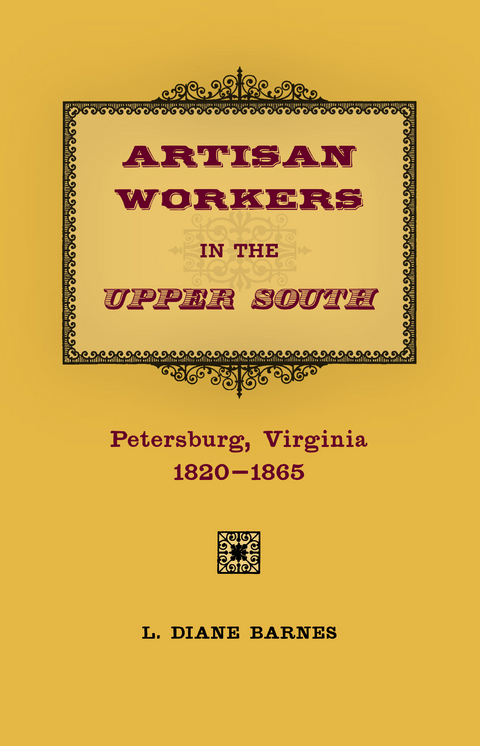
Though deeply entrenched in antebellum life, the artisans who lived and worked in Petersburg, Virginia, in the 1800s -- including carpenters, blacksmiths, coach makers, bakers, and other skilled craftsmen -- helped transform their planter-centered agricultural community into one of the most industrialized cities in the Upper South. These mechanics, as the artisans called themselves, successfully lobbied for new railroad lines and other amenities they needed to open their factories and shops, and turned a town whose livelihood once depended almost entirely on tobacco exports into a bustling modern city. In Artisan Workers in the Upper South, L. Diane Barnes closely examines the relationships between Petersburg's skilled white, free black, and slave mechanics and the roles they played in southern Virginia's emerging market economy. Barnes demonstrates that, despite studies that emphasize the backwardness of southern development, modern industry and the institution of slavery proved quite compatible in the Upper South.Petersburg joined the industrialized world in part because of the town's proximity to northern cities and resources, but it succeeded because its citizens capitalized on their uniquely southern resource: slaves. Petersburg artisans realized quickly that owning slaves could increase the profitability of their businesses, and these artisans -- including some free African Americans -- entered the master class when they could. Slave-owning mechanics, both white and black, gained wealth and status in society, and they soon joined an emerging middle class. Not all mechanics could afford slaves, however, and those who could not struggled to survive in the new economy. Forced to work as journeymen and face the unpleasant reality of permanent wage labor, the poorer mechanics often resented their inability to prosper like their fellow artisans. These differing levels of success, Barnes shows, created a sharp class divide that rivaled the racial divide in the artisan community.Unlike their northern counterparts, who united as a political force and organized strikes to effect change, artisans in the Upper South did not rise up in protest against the prevailing social order. Skilled white mechanics championed free manual labor -- a common refrain of northern artisans -- but they carefully limited the term "e;free"e; to whites and simultaneously sought alliances with slaveholding planters. Even those artisans who didn't own slaves, Barnes explains, rarely criticized the wealthy planters, who not only employed and traded with artisans, but also controlled both state and local politics. Planters, too, guarded against disparaging free labor too loudly, and their silence, together with that of the mechanics, helped maintain the precariously balanced social structure.Artisan Workers in the Upper South rejects the notion of the antebellum South as a semifeudal planter-centered political economy and provides abundant evidence that some areas of the South embraced industrial capitalism and economic modernity as readily as communities in the North.
lt;p>L. Diane Barnes is an associate professor of history at Youngstown State University.
 EPUB (Adobe DRM)
Kopierschutz: Adobe-DRM
Adobe-DRM ist ein Kopierschutz, der das eBook vor Mißbrauch schützen soll. Dabei wird das eBook bereits beim Download auf Ihre persönliche Adobe-ID autorisiert. Lesen können Sie das eBook dann nur auf den Geräten, welche ebenfalls auf Ihre Adobe-ID registriert sind.
Details zum Adobe-DRM
Dateiformat: EPUB (Electronic Publication)
EPUB ist ein offener Standard für eBooks und eignet sich besonders zur Darstellung von Belletristik und Sachbüchern. Der Fließtext wird dynamisch an die Display- und Schriftgröße angepasst. Auch für mobile Lesegeräte ist EPUB daher gut geeignet.
Systemvoraussetzungen:
PC/Mac: Mit einem PC oder Mac können Sie dieses eBook lesen. Sie benötigen eine Adobe-ID und die Software Adobe Digital Editions (kostenlos). Von der Benutzung der OverDrive Media Console raten wir Ihnen ab. Erfahrungsgemäß treten hier gehäuft Probleme mit dem Adobe DRM auf.
eReader: Dieses eBook kann mit (fast) allen eBook-Readern gelesen werden. Mit dem amazon-Kindle ist es aber nicht kompatibel.
Smartphone/Tablet: Egal ob Apple oder Android, dieses eBook können Sie lesen. Sie benötigen eine Adobe-ID sowie eine kostenlose App.
Geräteliste und zusätzliche Hinweise
Buying eBooks from abroad
For tax law reasons we can sell eBooks just within Germany and Switzerland. Regrettably we cannot fulfill eBook-orders from other countries.