


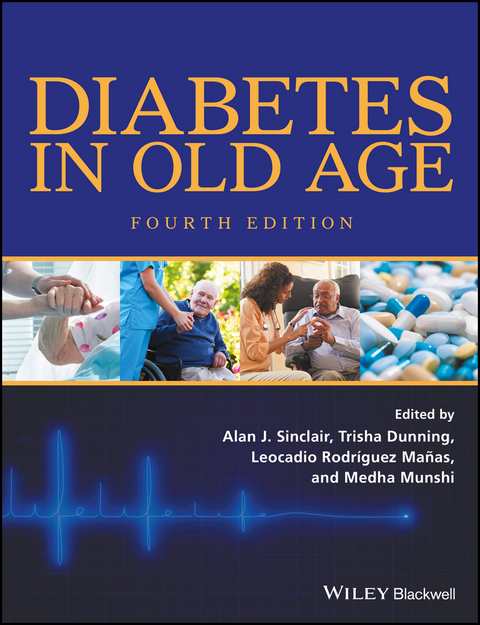
Diabetes in Old Age (eBook)
John Wiley & Sons (Verlag)
978-1-118-95460-7 (ISBN)
This new edition of the popular and market-leading Diabetes in Old Age features up-to-date and comprehensive information about the key aspects of managing older people with diabetes, predominantly type 2 diabetes.
With a strong evidence-based focus throughout, the entire range of issues surrounding diabetes and its many complications are covered, each with a clear focus on how they relate directly to the older patient. Varying approaches to optimizing diabetes care in the community, primary care and secondary care health care arenas are presented, and the importance of comprehensive functional assessment is emphasized. Coverage of areas unique to an ageing population of older people with diabetes such as falls management, frailty and sarcopenia, and cognitive dysfunction form a key cornerstone of the book. In every chapter, best practice points and key learning outcomes are provided, as well as published evidence bases for each major conclusion.
Diabetes in Old Age, 4th edition is essential reading for diabetologists and endocrinologists, diabetes specialist nurses, primary care physicians, general physicians and geriatricians, podiatrists and dieticians with an interest in diabetes, as well as all health professionals engaged in the delivery of diabetes care to older people.
Edited by
Alan J. Sinclair, Foundation for Diabetes Research in Older People, Diabetes Frail Ltd and University of Aston, UK
Trisha Dunning, Centre for Nursing and Allied Health Research, Deakin University and Barwon Health, Geelong, Australia
Leocadio Rodríguez Mañas, Servicio de Geriatría, Hospital Universitario de Getafe and Universidad Europea de Madrid, Spain
Medha Munshi, Joslin Geriatric Diabetes Programs, Beth Israel Deaconess Medical Center and Harvard Medical School, Boston, USA
This new edition of the popular and market-leading Diabetes in Old Age features up-to-date and comprehensive information about the key aspects of managing older people with diabetes, predominantly type 2 diabetes. With a strong evidence-based focus throughout, the entire range of issues surrounding diabetes and its many complications are covered, each with a clear focus on how they relate directly to the older patient. Varying approaches to optimizing diabetes care in the community, primary care and secondary care health care arenas are presented, and the importance of comprehensive functional assessment is emphasized. Coverage of areas unique to an ageing population of older people with diabetes such as falls management, frailty and sarcopenia, and cognitive dysfunction form a key cornerstone of the book. In every chapter, best practice points and key learning outcomes are provided, as well as published evidence bases for each major conclusion. Diabetes in Old Age, 4th edition is essential reading for diabetologists and endocrinologists, diabetes specialist nurses, primary care physicians, general physicians and geriatricians, podiatrists and dieticians with an interest in diabetes, as well as all health professionals engaged in the delivery of diabetes care to older people.
Edited by Alan J. Sinclair, Foundation for Diabetes Research in Older People, Diabetes Frail Ltd and University of Aston, UK Trisha Dunning, Centre for Nursing and Allied Health Research, Deakin University and Barwon Health, Geelong, Australia Leocadio Rodríguez Mañas, Servicio de Geriatría, Hospital Universitario de Getafe and Universidad Europea de Madrid, Spain Medha Munshi, Joslin Geriatric Diabetes Programs, Beth Israel Deaconess Medical Center and Harvard Medical School, Boston, USA
Title Page 5
Copyright Page 6
Contents 7
Preface 9
Foreword 10
List of contributors 13
Section A Pathophysiology, screening and diagnosis 17
Chapter 1 Pathophysiology of diabetes in older people 19
1.1 Introduction 19
1.2 Diet and diabetes in the elderly 20
1.3 Other factors 21
1.4 Metabolic alterations 21
1.5 Molecular biology studies 24
1.6 Glucose counter-regulation 24
1.7 Conclusions 25
Acknowledgments 25
References 25
Chapter 2 Type 1 diabetes in older age 29
2.1 Introduction 29
2.2 Goals in the management of type 1 diabetes in older adults 29
2.3 Complications and co-morbidities 30
2.4 Hypoglycemia 32
2.5 Multidisciplinary team approach 33
2.6 Long-term care 33
2.7 Conclusion 33
References 34
Chapter 3 Preventative strategies 36
3.1 Introduction 36
3.2 Diabetes and cardiovascular disease 37
3.3 Trials to prevent or delay progression from impaired glucose tolerance to diabetes 37
3.4 Diabetes prevention trials using lifestyle modification programs 38
3.5 The Da Qing study 39
3.6 The Finnish Diabetes Prevention Study 40
3.7 The Diabetes Prevention Program/Diabetes Prevention Program Outcomes Study 40
3.8 Translation of clinical trial results into clinical practice 42
References 43
Chapter 4 Diagnosis and screening 45
4.1 Introduction 45
4.2 Definition of being old 46
4.3 Definition of diabetes 46
4.4 Why investigate diabetes? Diagnostic objectives 47
4.5 How to recognize diabetes mellitus: Diagnostic tools 48
4.6 Diagnostic criteria 50
4.7 Diagnostic approach 52
4.8 Screening 52
References 55
Chapter 5 Assessment procedures including comprehensive geriatric assessment 59
5.1 Diabetes in the aging population 59
5.2 Geriatric syndromes in an aging population 60
5.3 CGA and the geriatrics approach to diabetes 60
5.4 Conclusion 66
References 67
Section B Vascular risk factors and complications 71
Chapter 6 Peripheral arterial disease 73
6.1 Introduction 73
6.2 Epidemiology of PAD 73
6.3 Pathophysiology 74
6.4 Clinical presentation 77
6.5 Diagnostic methods 78
6.6 Treatment 80
6.7 Conclusions 81
References 81
Chapter 7 Coronary heart disease 83
7.1 Introduction 83
7.2 Effect of aging and diabetes on the cardiovascular system 83
7.3 Epidemiology of CHD 85
7.4 Cardiovascular risk 86
7.5 Prevention and management of CHD 87
7.6 Conclusion 95
References 95
Chapter 8 Chronic kidney disease related to diabetes in older patients 100
8.1 Introduction 100
8.2 Relevant epidemiological information and forms of presentation 101
8.3 Pathophysiological mechanisms involved in diabetic kidney disease 103
8.4 Metabolic alterations, particularly hyperglycemia 103
8.5 Conclusion 114
References 115
Chapter 9 Visual loss in people with diabetes in old age 122
9.1 Introductions and background 122
9.2 Causes of visual impairment 123
9.3 Conclusions 126
References 127
Chapter 10 Diabetes foot disease 129
10.1 Introduction 129
10.2 Foot disease in older people 130
10.3 Risk factors for foot disease 130
10.4 Diabetic neuropathy 130
10.5 Charcot’s neuropathy 130
10.6 Peripheral arterial disease 131
10.7 PAD and foot ulcer healing 131
10.8 Other risk factors 131
10.9 Classification of diabetic foot ulcers 132
10.10 Assessment of foot at risk 132
10.11 Principles of management 134
10.12 Treatment of diabetic foot ulcers 134
10.13 Control of infection 134
10.14 Improvement in wound condition 135
10.15 Surgery 137
10.16 Conclusion 138
References 138
Chapter 11 Diabetes, neuropathy, and old age 141
11.1 Introduction 141
11.2 Frequency of neuropathy development 141
11.3 Types of diabetic peripheral neuropathy 142
11.4 Diagnosis and evaluation 146
11.5 Management 148
11.6 Summary 150
References 150
Chapter 12 Sensory disabilities in people with diabetes 153
12.1 Introduction 153
12.2 The five senses 153
12.3 Prevent sensory disability 153
12.4 Seeing 154
12.5 Hearing 155
12.6 Smelling and tasting (olfaction and gustation) 157
12.7 Impaired bodily sensation 159
12.8 Medication and sensory impairment 161
12.9 Sensory assessment 161
12.10 Conclusions 161
References 162
Chapter 13 Sexual health and wellbeing 164
13.1 Why is sexuality important in older age? 164
13.2 What sexual problems do we see associated with diabetes in aging? 164
13.3 Impact of aging in men and women 166
13.4 Hormones and aging in men 167
13.5 Diabetes and sexuality in women 172
13.6 Cardiovascular drugs and sexual function in men and women 174
13.7 Osteoporosis, frailty, recurrent falls, and muscle strength 175
13.8 Cognitive function 176
13.9 Mood and depression 176
13.10 Testosterone and Alzheimer’s disease 176
13.11 Testosterone and quality of life 176
13.12 Long-term safety of testosterone therapy 177
13.13 Effects of androgen ablation therapy 177
13.14 Conclusions 177
References 177
Chapter 14 eHealth and diabetes: Designing a novel system for remotely monitoring older adults with type 2 diabetes 183
14.1 Introduction 183
14.2 An overview of ICT solutions for managing chronic conditions 184
14.3 Diabetes management apps: strengths and weaknesses 185
14.4 Diabetes and older people: looking for a novel approach 186
14.5 Conclusion 190
References 190
Section C Treatment and care issues 193
Chapter 15 Insulin resistance and the metabolic syndrome 195
15.1 Introduction 195
15.2 Insulin physiology and metabolic regulation 196
15.3 Insulin action: Relation to aging 196
15.4 Implications of insulin resistance for cardiometabolic disease 197
15.5 Clinical research methods for assessing insulin action 198
15.6 Studies of insulin action in older people 198
15.7 Insulin resistance in clinical practice 199
15.8 Metabolic syndrome: clinical definitions 200
15.9 Utility of the metabolic syndrome in clinical practice 201
15.10 Prevalence of the metabolic syndrome 202
15.11 Pathogenesis of the metabolic syndrome 202
15.12 Overweight and obesity 202
15.13 Role of insulin resistance 205
15.14 Emerging role of insulin resistance and the metabolic syndrome in age-related disorders 208
15.15 Controversies in prevention and therapy of the metabolic syndrome 210
References 215
Chapter 16 Diabetes and functional limitation: The emergence of frailty and disability 229
16.1 Introduction 229
16.2 Functional limitation and diabetes: early background studies 230
16.3 Diabetes and frailty 231
16.4 Diabetes and disability 234
16.5 Functional assessment in varying clinical sectors 235
16.6 Conclusions 238
References 238
Chapter 17 Metabolic decompensation in older people 241
17.1 Introduction 241
17.2 Hypoglycemia 242
17.3 Diabetic ketoacidosis and hyperosmolar hyperglycemic state in the elderly 244
17.4 Pathogenesis of DKA and HHS 245
17.5 Diagnosis of DKA and HHS 247
17.6 Conclusion 252
References 252
Chapter 18 Nutrition management 256
18.1 Introduction 256
18.2 Basis of nutrition support 257
18.3 Nutrition and normal aging 257
18.4 Under- and malnutrition in older people 258
18.5 Over-nutrition and obesity in older people 261
18.6 Nutrition assessment 262
18.7 Brief review of nutritional guidelines 265
18.8 Current dietary recommendations: Applications to older people with diabetes 266
18.9 Energy intake: Carbohydrates and fats 266
18.10 Activity and exercise 267
18.11 Protein 268
18.12 Fiber 268
18.13 Sodium 268
18.14 Alcohol 269
18.15 Vitamins and minerals 269
18.16 Specific mineral and vitamin deficiencies 269
18.17 Other vitamins and minerals 271
18.18 Oral nutrition supplements 272
18.19 Prebiotics and probiotics 272
18.20 Artificial nutrition 273
18.21 Is artificial nutritional support necessary? 273
18.22 Delivery routes for artificial nutritional 274
18.23 Enteral tube feeding 274
18.24 Composition of specialist feeds to manage hyperglycemia 275
18.25 Administering medicines with enteral feeding 276
18.26 Complications of enteral nutrition 276
18.27 Parenteral nutrition 277
18.28 Ethical issues 277
18.29 Oral health, swallowing, and dysphagia 278
18.30 Pressure ulcers and the diabetic foot 278
18.31 Summary 278
Acknowledgments 279
References 279
Chapter 19 Physical exercise management 283
19.1 Introduction 283
19.2 The effects of exercise interventions on glycemic control in older people 284
19.3 The effects of endurance training 284
19.4 The effects of resistance training 284
19.5 The effects of combined resistance and endurance training 287
19.6 Functional capacity in older diabetic patients 287
19.7 Resistance training improves muscle strength, power, and functional capacity in older people with diabetes 288
19.8 High-velocity resistance training in older patients with diabetes 288
19.9 Endurance training and cardiovascular function in older patients with diabetes 289
19.10 Diabetes, cognitive impairment, and exercise 289
19.11 Conclusions: Special considerations when prescribing exercise in older type 2 diabetic patients 289
References 290
Chapter 20 Medicines, pharmacovigilance, and the importance of undertaking comprehensive assessments and regular medicine reviews 293
20.1 Introduction 293
20.2 Medicine-related vulnerability and older people 295
20.3 Polypharmacy 296
20.4 Pharmacovigilance 298
20.5 Common medicine-related issues in older people 300
20.6 Medicine adherence 302
20.12 Antipsychotic, antihypertensive, and lipid- and glucose-lowering medicines 303
20.13 Infrequent blood glucose testing 303
20.14 Frailty and cognitive changes 303
20.15 Falls risk 303
20.16 Health professionals, people with diabetes, and/or family medicine-related beliefs and attitudes 304
20.17 Strategies that can help reduce medicine-related adverse events 304
20.18 The five rights of administering medicines 304
20.19 Medicine reviews and risk assessments 305
20.20 Medicine dose aids 308
20.21 Technology and apps 308
20.22 Medicine environment 309
20.23 Summary 309
References 310
Chapter 21 Glucose-lowering drugs 314
21.1 Introduction 315
21.2 Insulin-sensitizing drugs 316
21.3 Insulin secretagogues 321
21.4 Other oral glucose-lowering drug options 329
21.5 Oral glucose-lowering drugs in development 330
21.6 Conclusions 331
References 331
Chapter 22 Insulin therapy 339
22.1 Introduction 339
22.2 Indications for insulin therapy 339
22.3 Advantages and disadvantages of insulin therapy 340
22.4 Barriers to insulin therapy 341
22.5 Goals of insulin therapy 342
22.6 Initiation of insulin therapy 342
22.7 Physiologic insulin secretion 343
22.8 Insulin regimens 343
22.9 Insulin therapy in care homes 346
22.10 Insulin therapy in diabetic patients with dementia 348
22.11 Insulin therapy in tube feeding 348
22.12 Special considerations 349
22.13 Conclusion 351
References 351
Chapter 23 Hypertension in older diabetic patients 354
23.1 Introduction and background 354
23.2 Prevalence and impact 355
23.3 Normal blood pressure and the definition of hypertension 355
23.4 Hypertension in diabetic older persons 356
23.5 Measurement of blood pressure 356
23.6 Goals of management 356
23.7 Initiation of therapy 357
23.8 Non-pharmacological management 358
23.9 Pharmacological management 360
23.10 Compliance with treatment and monitoring 361
23.11 Special situations of hypertension in diabetes 361
References 363
Chapter 24 Hypoglycemia 366
24.1 Introduction 366
24.2 Epidemiology and risks of hypoglycemia 367
24.3 Altered physiological response to hypoglycemia with aging 367
24.4 Hypoglycemic unawareness 368
24.5 Risk factors for hypoglycemia in aging 369
24.6 Clinical implications of hypoglycemia 370
24.7 Glycemic control and hypoglycemia in aging 371
24.8 HbA1c and hypoglycemia in aging 372
24.9 Role of treatment modalities 372
24.10 Conclusions 373
Referencess 373
Chapter 25 Diabetes in care homes 376
25.1 Introduction 376
25.2 The UK as a model of care home reform 377
25.3 Epidemiology 377
25.4 Complications and co?morbidity 379
25.5 Common management problems 380
25.6 Organization of diabetes care in residential settings 381
25.7 Improving care 384
25.8 Nutrition in older residents with diabetes 384
25.9 Responsibility of physicians 385
25.10 Multidisciplinary diabetes care 385
25.11 Nursing care 385
25.12 Foot care 386
25.13 Eye care 386
25.14 Assessing the efficacy and efficiency of diabetes care 387
25.15 What care homes need to provide 387
25.16 What needs to be provided in near-patient healthcare settings 388
25.17 Conclusion 388
Acknowledgments 389
References 389
Chapter 26 Primary and community care of diabetes in older people 392
26.1 Introduction 392
26.2 Definition of primary care 393
26.3 The shift of diabetes care from the hospital to the community 393
26.4 The primary care diabetes team 394
26.5 Individualizing management 395
26.6 Glycemic targets 396
26.7 Lifestyle modification 397
26.8 Pharmacotherapy 397
26.9 Screening for microvascular complications 397
26.10 Smoking cessation 398
26.11 Treatment of hypertension 398
26.12 Treatment of dyslipidemia 399
26.13 Aspirin therapy 399
26.14 Co-morbidities and special circumstances 399
26.15 Falls 400
26.16 Frailty 401
26.17 Urinary incontinence 402
26.18 Concordance with recommended treatment 402
26.19 Loneliness and social isolation 403
26.20 Nursing home patients 403
26.21 Preventive health care in older people: another perspective 404
26.22 Conclusions 404
Acknowledgments 404
References 404
Chapter 27 Inpatient diabetes care and admissions avoidance in older people with diabetes 411
27.1 Introduction 411
27.2 Diabetes admissions from the care home population 413
27.3 Reducing diabetes admissions: A whole-system approach 413
27.4 Diabetes medication 414
27.5 Hyperglycemia 414
27.6 Conclusions 422
References 422
Section D Management of associated complications 427
Chapter 28 Diabetes and co-morbidities 429
28.1 Introduction 429
28.2 Obstructive sleep apnea 431
28.3 Fatty liver disease 432
28.4 Cancer 435
28.5 Fractures 436
28.6 Type 2 diabetes and the lower urinary tract 437
28.7 Hearing impairment 439
28.8 Periodontal disease 439
28.9 Conclusion 440
References 440
Chapter 29 Diabetes and cognitive dysfunction 442
29.1 Introduction 442
29.2 Background evidence of association between diabetes and cognitive dysfunction 443
29.3 Background evidence of the relationship between cognitive dysfunction and glycemic control 445
29.4 The importance of detecting cognitive dysfunction 445
29.5 Methods of detection 446
29.6 Influence on diabetes self-care 447
29.7 The importance of excluding depression 448
29.8 Further investigations 449
29.9 Recent developments 449
29.10 Conclusions 450
Acknowledgement 450
Chapter 30 Mood disorders 453
30.1 Introduction 453
30.2 Depression 453
30.3 Anxiety 459
30.4 Distress 460
30.5 Conclusion 460
Key points 460
References 461
Chapter 31 Falls and diabetes 464
31.1 Introduction 464
31.2 Falls: A major public health problem 464
31.3 Diabetes: An independent risk factor for falls 465
31.4 Other risk factors for falls in older adults with diabetes 466
31.5 Assessment of falls in outpatient diabetes clinics 467
References 470
Chapter 32 Managing pain 472
32.1 Introduction 472
32.2 What is pain? 473
32.3 Categories of pain 474
32.4 Prevalence of pain in older people 475
32.5 Barriers to pain management 476
32.6 Common types of pain in older people 477
32.7 Some diabetes-specific types of pain 477
32.8 Painful diabetic neuropathy 478
32.9 Pressure ulcers and wound pain 478
32.10 Managing pain 478
32.11 Pain tools 479
32.12 Observation 480
32.13 Pharmaceutical treatment 481
32.14 Non-medicine options 481
32.15 Involving the older person in pain management 482
32.16 Communicating the pain management plan 482
32.17 Pain management in aged-care homes 482
32.18 Summary 483
References 483
Chapter 33 Palliative and end-of-life care 486
33.1 Introduction 486
33.2 Making decisions about end-of-life care: clinical and ethical dilemmas 489
33.3 Key management strategies 491
33.4 Pain management 492
33.5 Glycemic targets 492
33.6 Monitoring blood glucose 492
33.7 Hyperglycemia 493
33.8 Hypoglycemia 493
33.9 Medicine management 495
33.10 Type 1 diabetes 495
33.11 Type 2 diabetes 495
33.12 Complementary and alternative therapies 497
33.13 Nutrition and hydration 498
33.14 Diabetogenic medicines 498
33.15 Managing corticosteroid-induced diabetes in palliative and end-of-life care 499
33.16 Supporting family/carers 499
33.17 Advanced care plans and withdrawing treatment 500
33.18 Diabetes education 500
33.19 Spiritual needs 501
33.20 Summary 501
References 501
Section E Optimizing diabetes care in older people 505
Chapter 34 Diabetes education and the older adult 507
34.1 Introduction 507
34.2 Phases of living with diabetes 507
34.3 Educational assessment of factors associated with diabetes self-care 509
34.4 Diabetes educational and behavioral support interventions 514
34.5 Summary 517
References 517
Chapter 35 Supporting the family and informal carers 521
35.1 Introduction 521
35.2 Who are carers? 522
35.3 What do carers do? 523
35.4 What effect can caring have on the carer? 525
35.5 What do carers want? 526
35.6 What are the benefits for carers? 528
Acknowledgments 529
References 529
Chapter 36 Public health issues and community impact 532
36.1 Introduction 532
36.2 Diabetes as a public health priority 532
36.3 Heterogeneity of diabetes in the old 533
36.4 Epidemiology 533
36.5 Prevention 536
36.6 Putting it into practice: An agenda for action 538
36.7 Summary 539
References 539
Chapter 37 Providing cost-effective diabetes care 541
37.1 Introduction 541
37.2 Current and future costs of diabetes 542
37.3 Prevalence of pre-diabetes and diabetes prevention 542
37.4 Principles of cost-effectiveness analysis 542
37.5 Cost-effectiveness of diabetes prevention 543
37.6 Cost-effectiveness of specific components of diabetes care 544
37.7 Cost-effectiveness of new approaches to care management and coordination of care 546
References 547
Chapter 38 Clinical trials in older people 549
38.1 Overview of clinical trials 549
38.2 Clinical trials for older subjects 550
38.3 Differential aspects of clinical trials in elderly subjects 551
Further reading 557
Index 559
EULA 573
| Erscheint lt. Verlag | 13.2.2017 |
|---|---|
| Sprache | englisch |
| Themenwelt | Sachbuch/Ratgeber ► Gesundheit / Leben / Psychologie |
| Medizin / Pharmazie ► Medizinische Fachgebiete ► Geriatrie | |
| Medizinische Fachgebiete ► Innere Medizin ► Diabetologie | |
| Medizinische Fachgebiete ► Innere Medizin ► Endokrinologie | |
| Studium ► 1. Studienabschnitt (Vorklinik) ► Biochemie / Molekularbiologie | |
| Schlagworte | APPROACHES • Care • clear • Community • complications • Diabetes • directly • Edition • endocrinology • Endokrinologie • entire • evidencebased • focus • geriatric medicine • Geriatrie • Information • Issues • Key • many • marketleading • Medical Science • Medizin • New • Old age • older • Patient • Popular • Range • relate • strong • surrounding • throughout |
| ISBN-10 | 1-118-95460-2 / 1118954602 |
| ISBN-13 | 978-1-118-95460-7 / 9781118954607 |
| Informationen gemäß Produktsicherheitsverordnung (GPSR) | |
| Haben Sie eine Frage zum Produkt? |
 PDF (Adobe DRM)
Kopierschutz: Adobe-DRM
Adobe-DRM ist ein Kopierschutz, der das eBook vor Mißbrauch schützen soll. Dabei wird das eBook bereits beim Download auf Ihre persönliche Adobe-ID autorisiert. Lesen können Sie das eBook dann nur auf den Geräten, welche ebenfalls auf Ihre Adobe-ID registriert sind.
Details zum Adobe-DRM
Dateiformat: PDF (Portable Document Format)
Mit einem festen Seitenlayout eignet sich die PDF besonders für Fachbücher mit Spalten, Tabellen und Abbildungen. Eine PDF kann auf fast allen Geräten angezeigt werden, ist aber für kleine Displays (Smartphone, eReader) nur eingeschränkt geeignet.
Systemvoraussetzungen:
PC/Mac: Mit einem PC oder Mac können Sie dieses eBook lesen. Sie benötigen eine
eReader: Dieses eBook kann mit (fast) allen eBook-Readern gelesen werden. Mit dem amazon-Kindle ist es aber nicht kompatibel.
Smartphone/Tablet: Egal ob Apple oder Android, dieses eBook können Sie lesen. Sie benötigen eine
Geräteliste und zusätzliche Hinweise
Buying eBooks from abroad
For tax law reasons we can sell eBooks just within Germany and Switzerland. Regrettably we cannot fulfill eBook-orders from other countries.
aus dem Bereich


