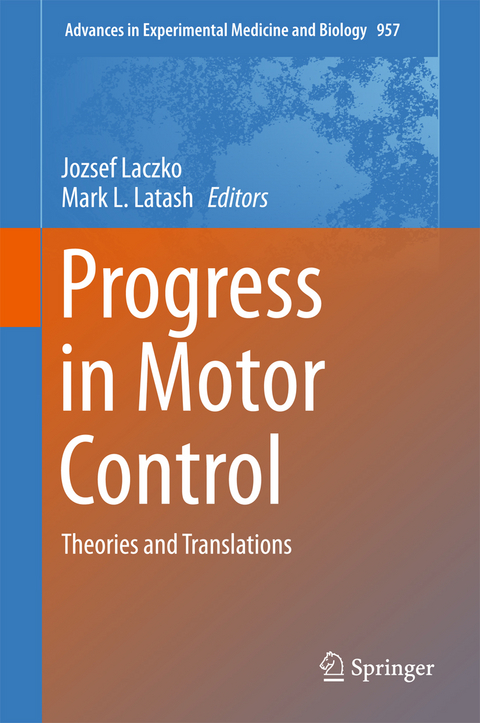
Progress in Motor Control (eBook)
XX, 388 Seiten
Springer International Publishing (Verlag)
978-3-319-47313-0 (ISBN)
Jozsef Laczko is head of Department of Information Technology and Biorobotics at University of Pecs in Hungary. He also holds positions in the Wigner Research Centre for Physics in Budapest and an adjunct assignment at the Northwestern University in Chicago. Dr. Laczko earned his Ph.D. in mathematics at the Eotvos Lorand University in Budapest, Hungary. He is experienced in computational approaches for motor control. He has published over 40 papers in refereed journals and proceedings, four book chapters and has presented over 50 professional talks. He was the chair of the 'Progress in Motor Control X' conference of the Society for Motor Control. His chief research interest is on the area of biomechanics, and in the last decade, he became engaged in the control of Functional Electrical Stimulation driven limb movements for spinal cord injured individuals.
Jozsef Laczko is head of Department of Information Technology and Biorobotics at University of Pecs in Hungary. He also holds positions in the Wigner Research Centre for Physics in Budapest and an adjunct assignment at the Northwestern University in Chicago. Dr. Laczko earned his Ph.D. in mathematics at the Eotvos Lorand University in Budapest, Hungary. He is experienced in computational approaches for motor control. He has published over 40 papers in refereed journals and proceedings, four book chapters and has presented over 50 professional talks. He was the chair of the “Progress in Motor Control X” conference of the Society for Motor Control. His chief research interest is on the area of biomechanics, and in the last decade, he became engaged in the control of Functional Electrical Stimulation driven limb movements for spinal cord injured individuals.Mark L. Latash is a Distinguished Professor of Kinesiology and Director of the Motor Control Laboratory at the Pennsylvania State University. He studied Physics, Physics of Living Systems, and Physiology in Moscow and Chicago. His research is focused on the control and coordination of human voluntary movements and movement disorders. He is the author of numerous books including, Control of Human Movement, The Neurophysiological Basis of Movement, Synergy, Fundamentals of Motor Control, and Biomechanics and Motor Control: Defining Central Concepts (with Vladimir Zatsiorsky). In addition, he edited nine books and published over 350 papers in refereed journals. Dr. Latash was the Founding Editor of the journal “Motor Control” and as President of the International Society of Motor Control. He continues to serve as Director of the annual Motor Control Summer School series. He is a recipient of the Bernstein Prize in motor control.
There will be six sections in the book: I. Theoretical Motor Control (d’Avella, Kornysheva, Piovesan, Smeets, Sternad) II. Neurophysiological Mechanisms of Motor Control (Carson, Hermsdorfer, Mayr, Perez) III. Fifty Years of the Equilibrium-Point Hypothesis (Feldman, Latash, Levin, McIntyre) IV. Learning of Skilled Behavior (Altenmüller, Scheidt, Torres) V. Impaired Motor Control and Rehabilitation (Laczko, Gordon, Mushahwar, Rothwell) VI. Human–Machine Interface (Ajiboye, Georgopoulos, Miller, Mussa-Ivaldi, van der Smagt) PRIMARY Authors of the Chapters: A. Bolu Ajiboye Cleveland Clinic Foundation, OH Eckart Altenmüller Univ. Hannover, Germany eckart.altenmueller@hmtm-hannover.deRichard Carson Queen’s Univ. Belfast, UK richard.carson@tcd.ieAndrea D’Avella Santa Lucia Foundation, Italy; andrea.davella@unime.itAnatol Feldman Univ. of Montreal, Canada anatol.g.feldman@umontreal.caApostolos Georgopoulos Univ. of Minnesota, MN omega@umn.eduAndrew Gordon Columbia Univ., NY agordona@tc.columbia.eduJoachim Hermsdörfer Tech. Univ. München, Germany joachim.hermsdoerfer@tum.deKatya Kornysheva Univ. College of London, UK ; k.kornysheva@ucl.ac.ukJozsef Laczko Univ. of Pecs, Hungary laczkoj@gamma.ttk.pte.huMark Latash Penn State Univ., PA mll11@psu.eduMindy Levin McGill Univ., Canada mindy.levin@mcgill.caJoseph McIntyre Tecnalia Health Res Inst., Spain joseph.mcintyre@tecnalia.comWinfried Mayr Med. Univ. Vienna, Austria winfried.mayr@meduniwien.ac.atLee Miller Nothwestern Univ., Chicago, IL lm@northwestern.eduVivian Mushahwar Univ. of Alberta, Canada vmushahw@ualberta.caSandro Mussa-Ivaldi Northwestern Univ., Chicago, IL; sandro@northwestern.eduMonica Perez Univ, of Miami, FL perezmo@pitt.eduDavide Piovesan Gannon Univ., PA piovesan001@gannon.eduJohn Rothwell Univ. College of London, UK j.rothwell@ucl.ac.ukRobert Scheidt Marquette Univ., WI robert.scheidt@marquette.eduJeroen Smeets Free Univ., The Netherlands j.b.j.smeets@vu.nlDagmar Sternad Northeastern Univ., Boston, MA dagmar@neu.eduElizabeth Torres Rutgers Univ., NJ torreselizabeth248@gmail.com Patrick van der Smagt Technical Univ., Munich, Germany smagt@brml.org
| Erscheint lt. Verlag | 30.12.2016 |
|---|---|
| Reihe/Serie | Advances in Experimental Medicine and Biology | Advances in Experimental Medicine and Biology |
| Zusatzinfo | XX, 388 p. 94 illus., 48 illus. in color. |
| Verlagsort | Cham |
| Sprache | englisch |
| Themenwelt | Sachbuch/Ratgeber ► Sport |
| Medizin / Pharmazie ► Studium | |
| Schlagworte | equilibrium-point hypothesis • Human-Machine Interface • Motor Cortex • Motor impairment • Motor Learning • motor recovery • neurophysiological • Rehabilitation • spinal cord |
| ISBN-10 | 3-319-47313-1 / 3319473131 |
| ISBN-13 | 978-3-319-47313-0 / 9783319473130 |
| Informationen gemäß Produktsicherheitsverordnung (GPSR) | |
| Haben Sie eine Frage zum Produkt? |
 PDF (Wasserzeichen)
DRM: Digitales Wasserzeichen
Dieses eBook enthält ein digitales Wasserzeichen und ist damit für Sie personalisiert. Bei einer missbräuchlichen Weitergabe des eBooks an Dritte ist eine Rückverfolgung an die Quelle möglich.
Dateiformat: PDF (Portable Document Format)
Mit einem festen Seitenlayout eignet sich die PDF besonders für Fachbücher mit Spalten, Tabellen und Abbildungen. Eine PDF kann auf fast allen Geräten angezeigt werden, ist aber für kleine Displays (Smartphone, eReader) nur eingeschränkt geeignet.
Systemvoraussetzungen:
PC/Mac: Mit einem PC oder Mac können Sie dieses eBook lesen. Sie benötigen dafür einen PDF-Viewer - z.B. den Adobe Reader oder Adobe Digital Editions.
eReader: Dieses eBook kann mit (fast) allen eBook-Readern gelesen werden. Mit dem amazon-Kindle ist es aber nicht kompatibel.
Smartphone/Tablet: Egal ob Apple oder Android, dieses eBook können Sie lesen. Sie benötigen dafür einen PDF-Viewer - z.B. die kostenlose Adobe Digital Editions-App.
Buying eBooks from abroad
For tax law reasons we can sell eBooks just within Germany and Switzerland. Regrettably we cannot fulfill eBook-orders from other countries.
aus dem Bereich