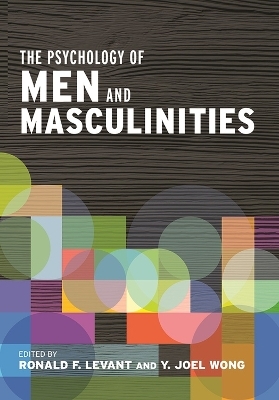
The Psychology of Men and Masculinities
American Psychological Association (Verlag)
978-1-4338-2690-0 (ISBN)
Decades ago, the emergence of feminist psychology upended the old order by redefining sex and gender. Soon thereafter, scholars such as Ron Levant recognized the importance of doing a similar critical analysis of men. Now, years later, the psychology of men and masculinities is a thriving, growing field illuminating the impact of sex and gender on the lives of men.
This highly anticipated volume shows how far the field has advanced and what directions it is taking. It explains and evaluates major theories, research, and applications, with an emphasis on the gender role strain paradigm, which is an empirical, feminist, and social constructionist approach that is based primarily in psychology and that relies largely on quantitative research. The chapters also synthesize research on men amp rsquo s mental and physical health, including depression, help-seeking, stigma, body image, and the physical health effects of masculinity. Special attention is given to ethnic, racial, and sexual minority men. Finally, the book surveys the growing body of work on therapeutic and preventive interventions for men, as well as programs aimed at men amp rsquo s violence, substance use, and lack of self-care. With such broad and inclusive coverage, this volume will be a standard reference for researchers and practitioners in this field and an essential part of university courses on men and masculinities.
Ronald F. Levant, EdD, ABPP, earned his doctorate in clinical psychology and public practice from Harvard University. He served on the faculties of Boston University, Rutgers University, Harvard Medical School at The Cambridge Hospital, and (as both Dean and Professor) the Center for Psychological Studies at Nova Southeastern University. He is currently Professor of Psychology at the University of Akron, where he served for 4 years as Dean of the College of Arts and Sciences. Dr. Levant has authored, co-authored, edited, or co-edited books and over 2 peer-refereed journal articles and book chapters in gender and family psychology and in advancing professional psychology. Dr. Levant developed a leadership role in the American Psychological Association (APA). He served as President of APA Division 43 (Family Psychology), as Editor of the Journal of Family Psychology, and as Associate Editor for Professional Psychology: Research and Practice. He also chaired the APA Committee for the Advancement of Professional Practice for two terms and served two 3-year terms on the APA Council of Representatives. Following that, he served 2 years on the APA Board of Directors, as an at-large member for one term, two terms as APA Recording Secretary, and as the 2 5 APA President. Dr. Levant has been one of the leading pioneers of the new field of the psychology of men and masculinities. He played a key role in the late 98 amp rsquo s and early 99 amp rsquo s in envisioning and developing this new field, serving as the co-founder, co-chair, and the first President of the Society for the Psychological Study of Men and Masculinity (APA Division 5 ). He co-edited A New Psychology of Men (Basic Books, 995), which has been cited as amp ldquo the most salient publication amp rdquo in the new psychology of men. He served as Editor of Psychology of Men and Masculinity for over half of its 5 years of existence, which had an Impact Factor of 2.947 in the final year of his editorship (2 5). Finally, he has developed theory and conducted research on fathering, gender role strain, masculinity ideologies, and normative male alexithymia. Dr. Levant amp rsquo s work in the psychology of men and masculinities was recognized in 2 , when he was awarded the APA Award for Distinguished Professional Contributions to Applied Research. Y. Joel Wong, PhD, is Associate Professor in the APA-accredited Counseling Psychology Program at Indiana University. Dr. Wong obtained his PhD in counseling psychology from the University Texas at Austin and completed his APA-accredited internship at the University of Texas' Counseling and Mental Health Center. He is a fellow of APA (Divisions 7, 45 and 5 ) and of the Asian American Psychological Association. Dr. Wong has published more than 9 peer-reviewed articles and book chapters. He also co-edited the 34-chapter, 799-page APA Handbook of Men and Masculinities. His research interests are in the psychology of men and masculinities, Asian American mental health, and positive psychology. With regard to the psychology of men and masculinities, he has studied the intersection of race and gender and its implications for men of color as well as men amp rsquo s emotional lives. Dr. Wong amp rsquo s current research interests in masculinities address basic theoretical conceptualizations of masculinities as well as how diverse meanings of masculinities can be operationalized and measured. Together with his colleagues, Dr. Wong helped to develop the following masculinities-related measures: the Subjective Masculinity Stress Scale, the Inventory of Subjective Masculinity Experiences, the Measure of Men amp rsquo s Perceived Inexpressiveness Norms, the Masculinity Contingency Scale, and the African American Men amp rsquo s Gendered Racism Inventory. Dr. Wong is an associate editor of two APA journals, Psychology of Men and Masculinity and the Journal of Counseling Psychology. He has also received several awards for his research, including the Researcher of the Year Award from APA amp rsquo s Division 5 , the Best in Science Address from APA amp rsquo s Division 7, the Shane J. Lopez Award for Professional Contributions in Positive Psychology from APA Division 7 amp rsquo s Positive Psychology Section, the Emerging Professional Contributions to Research Award from APA amp rsquo s Division 45, and the Early Career Award for Distinguished Contribution to Research from the Asian American Psychological Association.
Contributors
Foreword: A Brief History of the Psychology of Men and Masculinities
Joseph H. Pleck
Acknowledgments
Introduction: Maturation of the Psychology of Men and Masculinities
Ronald F. Levant and Y. Joel Wong
Part I: Gender Role Strain Paradigm and Related Theories
Chapter : The Gender Role Strain Paradigm
Ronald F. Levant and Wizdom A. Powell
Chapter 2: Masculinity Ideologies
Edward H. Thompson, Jr. and Kate M. Bennett
Chapter 3: Masculinity as a Heuristic: Gender Role Conflict Theory, Superorganisms, and System-Level Thinking
James M. O'Neil, Stephen R. Wester, Martin Heesacker, and Steven J. Snowden
Chapter 4: A Critical Discursive Approach to Studying Masculinities
Sarah Seymour-Smith
Chapter 5: A Review of Selected Theoretical Perspectives and Research in the Psychology of Men and Masculinities
Anthony J. Isacco and Jay C. Wade
Part II: Men's Mental and Physical Health
Chapter : Men's Depression and Help-Seeking Through the Lenses of Gender
Michael E. Addis and Ethan Hoffman
Chapter 7: A Review of Research on Men's Physical Health
Brendan Gough and Steve Robertson
Chapter 8: A Review of Research on Men's Body Image and Drive for Muscularity
Sarah K. Murnen and Bryan T. Karazsia
Part III: Ethnic, Racial, and Sexual Minority Men
Chapter 9: The Intersection of Race, Ethnicity, and Masculinities: Progress, Problems, and Prospects
Y. Joel Wong, Tao Liu, and Elyssa M. Klann
Chapter : Gay, Bisexual, and Transgender Masculinities
Mike C. Parent and Tyler C. Bradstreet
Part IV: Implications for Practice
Chapter : Counseling, Psychotherapy, and Psychological Interventions for Boys and Men
Gary R. Brooks
Chapter 2: Dysfunction Strain and Intervention Programs Aimed at Men's Violence, Substance Use, and Help-Seeking Behaviors
Christopher T. H. Liang, Carin Molenaar, Christina Hermann, and Louis A. Rivera
Part V: Conclusion
Conclusion: Addressing Controversies and Unresolved Questions in the Psychology of Men and Masculinities
Y. Joel Wong and Ronald F. Levant
Index
About the Editors
| Erscheinungsdatum | 01.03.2017 |
|---|---|
| Verlagsort | Washington DC |
| Sprache | englisch |
| Maße | 178 x 254 mm |
| Themenwelt | Sachbuch/Ratgeber ► Gesundheit / Leben / Psychologie |
| Geisteswissenschaften ► Psychologie ► Sexualität / Partnerschaft | |
| Geisteswissenschaften ► Psychologie ► Sozialpsychologie | |
| ISBN-10 | 1-4338-2690-9 / 1433826909 |
| ISBN-13 | 978-1-4338-2690-0 / 9781433826900 |
| Zustand | Neuware |
| Informationen gemäß Produktsicherheitsverordnung (GPSR) | |
| Haben Sie eine Frage zum Produkt? |
aus dem Bereich