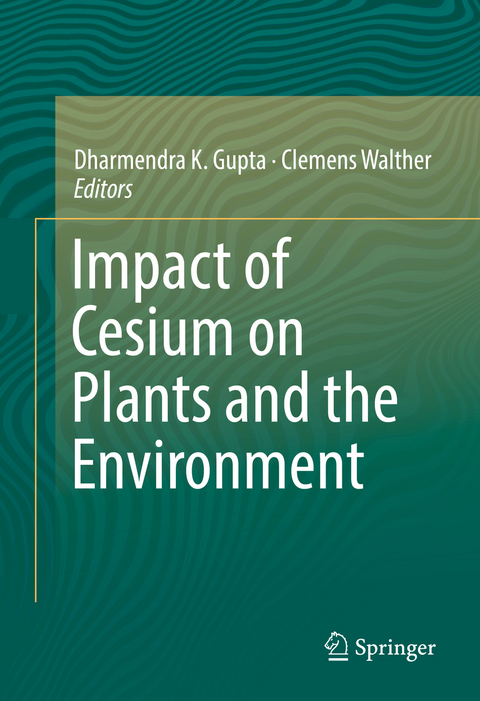
Impact of Cesium on Plants and the Environment (eBook)
X, 319 Seiten
Springer International Publishing (Verlag)
978-3-319-41525-3 (ISBN)
Dharmendra K. Gupta is Sr. Scientist of Environmental Biotechnology and already published more than 70 refereed research papers/review articles in peer reviewed journals and edited nine books. His field of research includes abiotic stress by heavy metals/radionuclides and xenobiotics in plants; antioxidative system in plants, environmental pollution (heavy metal/radionuclide) remediation through plants (phytoremediation).Clemens Walther is professor of radioecology and radiation protection and director of the Institute for Radioecology and Radiation Protection at the Leibniz Universität Hannover. He published more than 100 papers in peer reviewed journals. His field of research is actinide chemistry with a focus on solution species and formation of colloids, ultra-trace detection and speciation of radionuclides in the environment by mass spectrometry and laser spectroscopy.
Distribution of cesium in soil and its uptake by plants.- Factors influencing the soil to plant transfer of radiocaesium.- Role of mycorrhizal fungi in cesium uptake by plants.- Influence of biologically active preparations on Cs-137 transition to plants from soil in the territories contaminated as the result of Chernobyl accident.- The distribution of 137Cs in selected compartments of coniferous forests in the Czech Republic.- Cesium uptake in plants: Mechanism, regulation and application for phytoremediation.- Effective half-lives of radiocesium in terrestrial plants observed after nuclear power plant accidents.- Cultivar difference and fertilizer effects on radioactive cesium accumulation in rice grown in Fukushima paddy field from 2011 to 2014.- Distribution of 137Cs between the components of pine forest of Charnobyl NPP exclusion zone.- Cesium accumulation by aquatic plants and algae.- Regularities of accumulation of Cs-137 and other radionuclides in the aquatic vegetation in the territory of South-Ural biogeochemical province of technogenic radioactive isotopes.- Radiocesium phytotoxicity to single cell and higher plants.- Sorbents for radiocaesium removal from natural water and soil.- Analysis of transfer factor, anatomical changes and growth of plants during phytoremediation of cesium contaminated solutions.- Remediation of areas contaminated by caesium: Basic mechanisms behind remedial options and experience in application.
| Erscheint lt. Verlag | 14.10.2016 |
|---|---|
| Zusatzinfo | X, 319 p. 61 illus., 28 illus. in color. |
| Verlagsort | Cham |
| Sprache | englisch |
| Themenwelt | Sachbuch/Ratgeber ► Natur / Technik ► Natur / Ökologie |
| Naturwissenschaften ► Biologie | |
| Technik | |
| Schlagworte | Bioavailability of cesium • Cesium accumulation and homeostasis in plants • Cesium in forest and grassland • Cesium remediation methods • Root uptake and foliar uptake |
| ISBN-10 | 3-319-41525-5 / 3319415255 |
| ISBN-13 | 978-3-319-41525-3 / 9783319415253 |
| Informationen gemäß Produktsicherheitsverordnung (GPSR) | |
| Haben Sie eine Frage zum Produkt? |
 PDF (Wasserzeichen)
DRM: Digitales Wasserzeichen
Dieses eBook enthält ein digitales Wasserzeichen und ist damit für Sie personalisiert. Bei einer missbräuchlichen Weitergabe des eBooks an Dritte ist eine Rückverfolgung an die Quelle möglich.
Dateiformat: PDF (Portable Document Format)
Mit einem festen Seitenlayout eignet sich die PDF besonders für Fachbücher mit Spalten, Tabellen und Abbildungen. Eine PDF kann auf fast allen Geräten angezeigt werden, ist aber für kleine Displays (Smartphone, eReader) nur eingeschränkt geeignet.
Systemvoraussetzungen:
PC/Mac: Mit einem PC oder Mac können Sie dieses eBook lesen. Sie benötigen dafür einen PDF-Viewer - z.B. den Adobe Reader oder Adobe Digital Editions.
eReader: Dieses eBook kann mit (fast) allen eBook-Readern gelesen werden. Mit dem amazon-Kindle ist es aber nicht kompatibel.
Smartphone/Tablet: Egal ob Apple oder Android, dieses eBook können Sie lesen. Sie benötigen dafür einen PDF-Viewer - z.B. die kostenlose Adobe Digital Editions-App.
Buying eBooks from abroad
For tax law reasons we can sell eBooks just within Germany and Switzerland. Regrettably we cannot fulfill eBook-orders from other countries.
aus dem Bereich