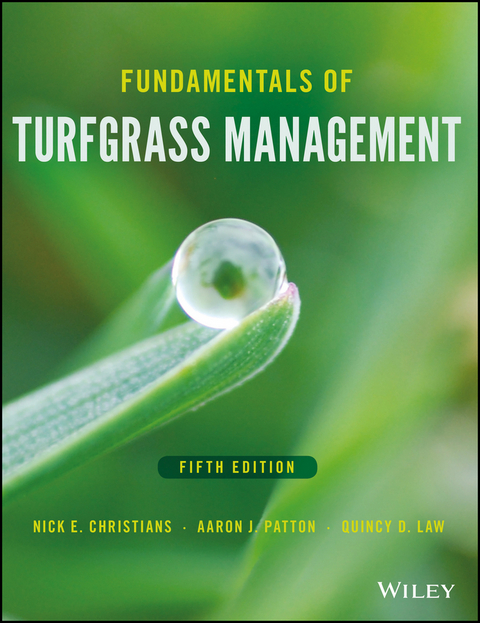
Fundamentals of Turfgrass Management (eBook)
John Wiley & Sons (Verlag)
978-1-119-20556-2 (ISBN)
THE PREMIER TURFGRASS MANAGEMENT HANDBOOK-UPDATED AND EXPANDED
Fundamentals of Turfgrass Management is the longstanding authority on all aspects of the science and practices behind world-class turfgrass care. This fully revised Fifth Edition comes enriched by two new authors who share their cutting-edge research and real-world expertise on such topics as growth, soil testing, nutrition, herbicides, insecticides, and fungicides. Coverage throughout is refreshed with new illustrations and charts, as well as:
- Expanded coverage on professional lawn care programs, including cool-season and warm-season turfgrasses, establishing methods and costs, cultivation, sand topdressing, and more
- Enhanced material on the most up-to-date thinking and practices in weed management
- Brand-new chapters on the environmental, economic, and quality-of-life benefits of well-maintained turf, as well as the influence of light on turf health
Whether you're earning a degree or a paycheck, Fundamentals of Turfgrass Management, Fifth Edition remains the most complete, respected guidebook of solutions for developing and maintaining the finest-standards of turfgrass.
NICK E. CHRISTIANS, PhD, is professor of Horticulture at Iowa State University. He is the author of numerous books, including The Mathematics of Turfgrass Maintenance, Fourth Edition, and Mathematics for the Green Industry.
AARON J. PATTON, PhD, is associate professor of Horticulture at Purdue University, West Lafayette, Indiana. He also serves as the executive director of the Midwest Regional Turf Foundation.
QUINCY D. LAW, MS, is a doctoral student in the Department of Horticulture and Landscape Architecture and the Ecological Science and Engineering Interdisciplinary Graduate Program at Purdue University.
NICK E. CHRISTIANS, PhD, is professor of Horticulture at Iowa State University. He is the author of numerous books, including The Mathematics of Turfgrass Maintenance, Fourth Edition, and Mathematics for the Green Industry. AARON J. PATTON, PhD, is associate professor of Horticulture at Purdue University, West Lafayette, Indiana. He also serves as the executive director of the Midwest Regional Turf Foundation. QUINCY D. LAW, MS, is a doctoral student in the Department of Horticulture and Landscape Architecture and the Ecological Science and Engineering Interdisciplinary Graduate Program at Purdue University.
Preface vii
Acknowledgments ix
Chapter 1 Benefits of Turf and Its Management 1
Part I Grasses 7
Chapter 2 Introduction to the Grasses 9
Chapter 3 Cool-Season Grasses 41
Chapter 4 Warm-Season Grasses 75
Chapter 5 Ornamental Grasses 97
Part II Turf Culture 109
Chapter 6 Establishment 111
Chapter 7 Soil Testing and Soil Amendments 147
Chapter 8 Turf Nutrition and Fertilization 171
Chapter 9 Mowing, Rolling, and Plant Growth Regulators 209
Chapter 10 Irrigation 225
Chapter 11 Thatch, Cultivation, and Topdressing 249
Chapter 12 Light Requirements and Shade Management 269
Part III Turf Pest Management 285
Chapter 13 Turf Weed Management 287
Chapter 14 Turf Insect Management 331
Chapter 15 Turf Disease Management 353
Part IV The Turf Industry 379
Chapter 16 Careers in the Turfgrass Industry 381
Chapter 17 Sports Turf Management 389
Chapter 18 Sod Production 407
Chapter 19 Professional Lawn Care 419
Chapter 20 Golf Course Maintenance 431
About the Authors 455
Index 457
Chapter 1
Benefits of Turf and Its Management
It is not difficult to find beauty in the natural world, especially when considering that much of the splendor arises from living organisms. Though turf is usually not the focal point of a landscape, it can cover a large portion of the managed landscape. In fact, managed turf accounts for approximately 13,840 mi2 (35,850 km2) in the United States (Milesi et al., 2005). Turf and its management benefit the environment, society, and economy in addition to the beauty provided. These benefits are why turf is planted and utilized in so many places in the landscape.
ENVIRONMENTAL BENEFITS
As a low-growing groundcover with an extensive, fibrous root system, turf benefits the environment by improving the air (atmosphere), water, and soil. Given the interconnectivity of an ecosystem, many of these benefits are collective. Further, managed turf is usually located in urban and suburban environments where pollution is likely to occur.
Turf benefits the atmosphere. By absorbing atmospheric pollutants, turf is able to improve air quality. An example currently of great interest is soil carbon sequestration. Soil carbon sequestration is the use of green plants to capture atmospheric carbon dioxide via photosynthesis, which is then stored in the soil as organic carbon. Societies are searching for ways to reduce atmospheric carbon dioxide concentrations, and carbon sequestration is one such method (Follett et al., 2011). Soil carbon sequestration is a collective benefit, as it both reduces atmospheric carbon dioxide and increases soil carbon (discussed below). Grasses are also able to absorb other atmospheric pollutants, including ozone, sulfur dioxide, nitrogen dioxide, ammonia, carbon monoxide, volatile organic compounds, and lead (Stier et al., 2013). However, absorbing too much of some of these pollutants can be detrimental to turf health.
Turf benefits water. Turfgrass plants increase the hydraulic resistance of moving water, which reduces surface runoff (Ree, 1949; Gross et al., 1991). Reduced surface runoff allows for greater water infiltration and subsequent groundwater recharge. As water infiltrates and passes through the grass, thatch, and soil, it is filtered and cleansed by microorganisms that digest and degrade organic chemicals or pollutants (Beard and Green, 1994). A buffer strip of Kentucky bluegrass has a similar groundwater recharge rate as a mixed forb and grass prairie and results in a reduction in drainage water volume compared to the absence of a buffer area (Steinke et al., 2009). Turfgrasses also act as vegetative filter strips that reduce the amount of sediment transported to surface streams and waters (Beard and Green, 1994).
Turf benefits soil. Turfgrasses can both conserve and improve soil by reducing sediment losses and adding organic matter to the soil. The extensive fibrous root system helps to knit the soil together. This keeps the soil in place and helps to reduce erosion, dust, and mud. Turf often allows otherwise unsuitable land to be utilized by communities, such as a grassed hillside park and amphitheater (Figure 1.1). Additionally, the turnover of plant tissue adds organic matter to the soil and thus increases soil carbon, nitrogen, and general fertility. Soil organic matter also increases the water holding and cation exchange capacities of the soil. In fact, a high percentage of the world's most fertile soils developed under a native vegetation of grass (Gould, 1968). Soil carbon helps to increase soil aggregate stability, decrease runoff and erosion, and improve water infiltration (Angers and Carter, 1996) as well as decrease soil bulk density (Blevins et al., 1983).
Figure 1.1 The turf on Slater Hill on the Purdue University campus allows for a steep sloping area to be used as a park and natural amphitheater.
SOCIETAL BENEFITS
Societal benefits are also known as ecosystem services, which are the benefits people obtain from ecosystems. In this case, it is the benefits people obtain from turfgrass ecosystems. Turfgrass ecosystems are unique in that they usually bridge the gap between disturbed and natural habitats.
Turf provides aesthetic value. A dense, lush turfgrass surface can grow into a nearly perfect, carpet-like groundcover that is visually pleasing. As a part of numerous landscapes, turf provides green color for a large portion of the year. Some turfgrasses still have ornamental value when dormant, such as the straw gold color of dormant zoysiagrass (Zoysia spp.). Turfgrasses with different shades of green can even be used to create a pattern in a turf sward (Figure 1.2). Though athletic fields are primarily maintained for recreation, they are often mown into intricate patterns that provide a very attractive appearance for major events (Figure 1.3). The low height of turf gives a feeling of openness that cannot be achieved with trees or shrubs, and it can act as a foreground and/or background for the focal points in a landscape.
Figure 1.2 A concentric circle pattern around these shrubs is achieved in the turf by using turfgrass cultivars with different genetic color near Tiananmen Square in Beijing, China.
Figure 1.3 An intricate mowing pattern on a baseball field that provides aesthetic appeal without influencing the playability.
(Courtesy of Joey Stevenson)
Turf provides recreation. Golf courses, athletic fields, parks, and other areas are often managed with recreation as the specific intent. Home lawns, courtyards, and industrial areas are also used for recreational purposes. Turfgrasses provide a cushioning effect that reduces injuries to participants when compared to poorly or nonturfed soils, especially in contact sports such as football, rugby, and soccer (Gramckow, 1968). Proper turfgrass management is also relevant, as there is a substantial benefit of maintaining quality turf for reducing the hardness of sports fields (Rogers and Waddington, 1992). Turfgrasses have a greater ability to tolerate traffic and reduce surface hardness compared to weeds such as large crabgrass (Digitaria sanguinalis) and white clover (Trifolium repens) (Brosnan et al., 2014). Many of the recreational opportunities associated with turf provide physical health and fitness benefits for humans as well.
Turf improves the living environment for humans. Through photosynthesis, actively growing turf removes carbon dioxide from the air and produces oxygen in return. Approximately 25 ft2 of turfgrass produces enough oxygen for one person for an entire day (Watschke, 1990). Turf is also able to dissipate radiant heat and provide a cooling effect via evapotranspiration, which can dissipate roughly half of the sun's heat (Watschke, 1990). The structure and density of turf help to reduce noise and glare. Turf absorbs jarring noises better than hard surfaces, and the multidirectional light reflectance between the leaf surfaces reduces glare. Turf can also reduce noxious pests and allergy-related pollens (Beard and Green, 1994), and it offers a less favorable habitat for unwanted nuisance insects and disease vectors (Clopton and Gold, 1993).
Turf improves the mental health of humans. Compared to an urban walk along a busy street, a nature walk through grasslands with scattered shrubs and oak trees lead to decreases in anxiety, rumination, and negative emotions (Bratman et al., 2015). Additionally, organized recreational activities improve mental health, alertness, and resiliency against stress (Street et al., 2007), which are often made possible by turf.
Turf provides a means of waste disposal and conservation. Biosolids are mainly organic, solid materials produced by wastewater treatment processes. Biosolids contain nutrients and thus can be used as a fertilizer. However, due to their origination, biosolids can be high in heavy metals, pathogens, pharmaceuticals, and anything else flushed down a toilet or rinsed down a drain. Further, sewage effluent or recycled water—the wastewater from sewage treatment facilities—is a source of irrigation water widely used for turf. Forty-five percent of golf courses in the Southwest United States use recycled water to conserve drinking water (Gelernter and Stowell, 2015). As such, turf is an ideal crop to use biosolids as a fertilizer and recycled water for irrigation because it is not a food crop and covers a large portion of the landscape where biosolids are produced and water is recycled (urban and suburban areas).
ECONOMIC BENEFITS
Turf benefits the economy. The turfgrass industry provides employment, spends money on inputs, earns income on the sale of turfgrass products and services, and pays taxes. It is through these means that the turfgrass industry directly benefits the economy. The United States turfgrass industry generated an estimated $57.9 billion in revenue and provided 822,849 jobs in 2002 (Haydu et al., 2006). These figures include sod farms, lawn care services, lawn and garden retail stores, lawn equipment manufacturing, and golf courses. Sports turf, which was not included in the study, benefits the economy in many of the same ways. There are other economic benefits, including increased home values. Behe et al. (2005) found that perceived home value increased by 5 to 11% for homes with a good landscape.
NET BENEFITS
The use of irrigation, fertilizers, pesticides, and frequent mowing for maintaining turf is often viewed negatively. Though these practices can have a detrimental impact on...
| Erscheint lt. Verlag | 24.10.2016 |
|---|---|
| Sprache | englisch |
| Themenwelt | Sachbuch/Ratgeber ► Natur / Technik ► Garten |
| Technik ► Architektur | |
| Weitere Fachgebiete ► Land- / Forstwirtschaft / Fischerei | |
| Schlagworte | Architecture • Architektur • Grünflächenmanagement • Grünflächenmanagement • Rasen • Sportrasen • Turf Management |
| ISBN-10 | 1-119-20556-5 / 1119205565 |
| ISBN-13 | 978-1-119-20556-2 / 9781119205562 |
| Informationen gemäß Produktsicherheitsverordnung (GPSR) | |
| Haben Sie eine Frage zum Produkt? |
 EPUB (Adobe DRM)
Kopierschutz: Adobe-DRM
Adobe-DRM ist ein Kopierschutz, der das eBook vor Mißbrauch schützen soll. Dabei wird das eBook bereits beim Download auf Ihre persönliche Adobe-ID autorisiert. Lesen können Sie das eBook dann nur auf den Geräten, welche ebenfalls auf Ihre Adobe-ID registriert sind.
Details zum Adobe-DRM
Dateiformat: EPUB (Electronic Publication)
EPUB ist ein offener Standard für eBooks und eignet sich besonders zur Darstellung von Belletristik und Sachbüchern. Der Fließtext wird dynamisch an die Display- und Schriftgröße angepasst. Auch für mobile Lesegeräte ist EPUB daher gut geeignet.
Systemvoraussetzungen:
PC/Mac: Mit einem PC oder Mac können Sie dieses eBook lesen. Sie benötigen eine
eReader: Dieses eBook kann mit (fast) allen eBook-Readern gelesen werden. Mit dem amazon-Kindle ist es aber nicht kompatibel.
Smartphone/Tablet: Egal ob Apple oder Android, dieses eBook können Sie lesen. Sie benötigen eine
Geräteliste und zusätzliche Hinweise
Buying eBooks from abroad
For tax law reasons we can sell eBooks just within Germany and Switzerland. Regrettably we cannot fulfill eBook-orders from other countries.
aus dem Bereich