


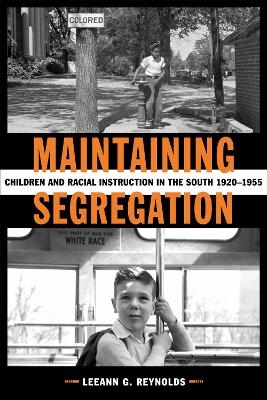
Maintaining Segregation
Children and Racial Instruction in the South, 1920-1955
Seiten
2017
Louisiana State University Press (Verlag)
978-0-8071-6564-5 (ISBN)
Louisiana State University Press (Verlag)
978-0-8071-6564-5 (ISBN)
- Lieferbar (Termin unbekannt)
- Versandkostenfrei
- Auch auf Rechnung
- Artikel merken
Explores how black and white children in the early twentieth-century South learned about segregation in their homes, schools, and churches. As public displays of racial violence declined in the 1920s, a culture of silence developed around segregation, serving to forestall, absorb, and deflect individual challenges to the racial hierarchy.
In Maintaining Segregation, LeeAnn G. Reynolds explores how black and white children in the early twentieth-century South learned about segregation in their homes, schools, and churches. As public lynchings and other displays of racial violence declined in the 1920s, a culture of silence developed around segregation, serving to forestall, absorb, and deflect individual challenges to the racial hierarchy. The cumulative effect of the racial instruction southern children received, prior to highly publicized news such as the Brown v. Board of Education decision and the Montgomery bus boycott, perpetuated segregation by discouraging discussion or critical examination.
As the system of segregation evolved throughout the early twentieth century, generations of southerners came of age having little or no knowledge of life without institutionalized segregation. Reynolds examines the motives and approaches of white and black parents to racial instruction in the home and how their methods reinforced the status quo. Whereas white families sought to preserve the legal system of segregation and their place within it, black families faced the more complicated task of ensuring the safety of their children in a racist society without sacrificing their sense of self-worth. Schools and churches functioned as secondary sites for racial conditioning, and Reynolds traces the ways in which these institutions alternately challenged and encouraged the marginalization of black Americans both within society and the historical narrative.
In order for subsequent generations to imagine and embrace the sort of racial equality championed by the civil rights movement, they had to overcome preconceived notions of race instilled since childhood. Ultimately, Reynolds's work reveals that the social change that occurred due to the civil rights movement can only be fully understood within the context of the segregation imposed upon children by southern institutions throughout much of the early twentieth century.
In Maintaining Segregation, LeeAnn G. Reynolds explores how black and white children in the early twentieth-century South learned about segregation in their homes, schools, and churches. As public lynchings and other displays of racial violence declined in the 1920s, a culture of silence developed around segregation, serving to forestall, absorb, and deflect individual challenges to the racial hierarchy. The cumulative effect of the racial instruction southern children received, prior to highly publicized news such as the Brown v. Board of Education decision and the Montgomery bus boycott, perpetuated segregation by discouraging discussion or critical examination.
As the system of segregation evolved throughout the early twentieth century, generations of southerners came of age having little or no knowledge of life without institutionalized segregation. Reynolds examines the motives and approaches of white and black parents to racial instruction in the home and how their methods reinforced the status quo. Whereas white families sought to preserve the legal system of segregation and their place within it, black families faced the more complicated task of ensuring the safety of their children in a racist society without sacrificing their sense of self-worth. Schools and churches functioned as secondary sites for racial conditioning, and Reynolds traces the ways in which these institutions alternately challenged and encouraged the marginalization of black Americans both within society and the historical narrative.
In order for subsequent generations to imagine and embrace the sort of racial equality championed by the civil rights movement, they had to overcome preconceived notions of race instilled since childhood. Ultimately, Reynolds's work reveals that the social change that occurred due to the civil rights movement can only be fully understood within the context of the segregation imposed upon children by southern institutions throughout much of the early twentieth century.
LeeAnn G. Reynolds is assistant professor of history at Samford University.
| Erscheinungsdatum | 29.04.2017 |
|---|---|
| Reihe/Serie | Making the Modern South |
| Verlagsort | Baton Rouge |
| Sprache | englisch |
| Maße | 158 x 230 mm |
| Gewicht | 333 g |
| Themenwelt | Sachbuch/Ratgeber ► Geschichte / Politik ► Regional- / Landesgeschichte |
| Geisteswissenschaften ► Geschichte ► Regional- / Ländergeschichte | |
| Geschichte ► Teilgebiete der Geschichte ► Kulturgeschichte | |
| Sozialwissenschaften ► Pädagogik | |
| Sozialwissenschaften ► Politik / Verwaltung ► Politische Theorie | |
| Sozialwissenschaften ► Soziologie ► Makrosoziologie | |
| ISBN-10 | 0-8071-6564-6 / 0807165646 |
| ISBN-13 | 978-0-8071-6564-5 / 9780807165645 |
| Zustand | Neuware |
| Informationen gemäß Produktsicherheitsverordnung (GPSR) | |
| Haben Sie eine Frage zum Produkt? |
Mehr entdecken
aus dem Bereich



aus dem Bereich
Die Revolution des Gemeinen Mannes
Buch | Softcover (2024)
C.H.Beck (Verlag)
CHF 16,80
Eine Geschichte des Geschmacks
Buch | Hardcover (2025)
C.H.Beck (Verlag)
CHF 49,95
vom Mittelalter bis zur Gegenwart
Buch | Softcover (2024)
C.H.Beck (Verlag)
CHF 16,80


