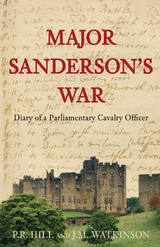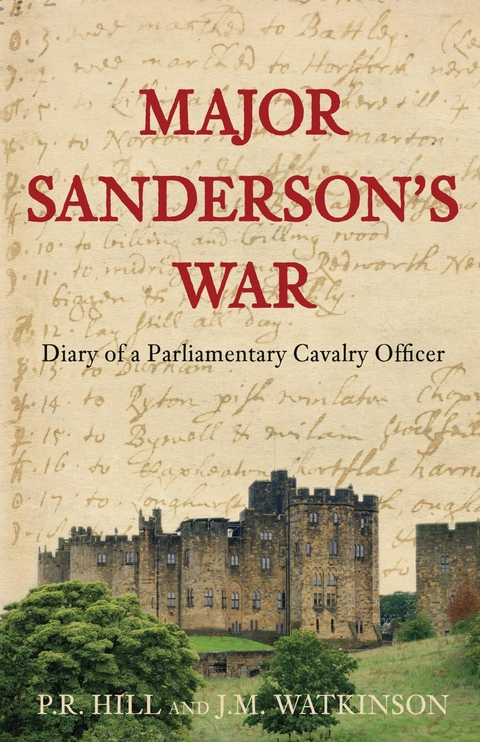
Major Sanderson's War (eBook)
192 Seiten
The History Press (Verlag)
9780750980104 (ISBN)
Dr Peter Hill has published works on the activities of the Roman army in the north in connection with Hadrian's Wall. During his research he came across the previous publication of the diary and realised its significance and potential. Jane Watkinson is a retired librarian and Membership Secretary of the Early English Text Society.
In 1919 the diary of a parliamentary cavalry officer, written on an interleaved copy of William Lilly's Merlini Anglici Ephemeris, was exhibited at the Society of Antiquaries of Newcastle upon Tyne. It was discovered to be that of Major John Sanderson for the year 1648, an officer in Colonel Robert Lilburne's regiment of horse. This was an extremely rare find, as while Civil War memoirs were common, daily accounts were not. Spanning from 11th January to 30th December, Sanderson's diary contained 270 entries that not only recalled well-known events, but also depicted the minutiae of patrol and skirmish. Major Sanderson's War is not merely a transcript of the diary, but an analysis of the role of cavalry and the northern campaign of the Second Civil War. No other book will provide the enthusiast with such a unique glimpse into the life of one of Cromwell's officers.
Dr Peter Hill has published works on the activities of the Roman army in the north in connection with Hadrian's Wall. During his research he came across the previous publication of the diary and realised its significance and potential. Jane Watkinson is a retired librarian and Membership Secretary of the Early English Text Society.
CHAPTER ONE
INTRODUCTION
In 1919 the manuscript diary of a parliamentary officer, written on an interleaved copy of William Lilly’s Merlini Anglici Ephemeris 1648, was exhibited by Mrs Wynne-Jones at the January meeting of the Society of Antiquaries of Newcastle upon Tyne. A transcript was produced the following month, and published in the Society’s Proceedings in 1921.1 The diary starts on 11th January and finishes on 30th December. Reference to other accounts of events mentioned show that the year covered is indeed 1648, the period of the Second Civil War.
Nowhere is the name of the diary’s author given but, from the nine references to Hedleyhope, the editor of PSAN was able to deduce that he was one of the Sandersons of that place, an estate some eight miles west of Durham City bought by the Sandersons in or before 1623 (map 1 (1) and plate 2). The identification is backed by other sources which describe the movements of Major John Sanderson in 1648 and confirm details given in the diary. His Will (Appendix 4) places him firmly in the Hedleyhope family.
Much has been written on the better-known campaigns of the English Civil War. Many commanders have left both contemporary and later letters and accounts but fewer of the junior officers have done so. Diaries written by participants in the Civil War in the true sense of a more or less daily account, are very rare. Memoirs are more common, but were usually written after the passage of some years, and tended to concentrate on what hindsight saw as important.
In many ways the most significant account is this diary for 1648 of Major John Sanderson, who was an officer in Colonel Robert Lilburne’s regiment of horse, originally part of the Northern Association of the parliamentary army. Of major importance is the sheer number of entries, all made within a few days at most of the events recorded, and the way in which they can be collated with other accounts to give a narrative thread. It is at times concerned with well-known events, but is also a remarkably detailed record of the endless day-to-day minutiae of patrol and skirmish. There is no other published source which allows the day-by-day reconstruction of a year in the Civil War.
Of other accounts which have been published, Captain Hodgson’s Memoir is not a diary and only occasionally mentions dates. It was probably not written until the 1660s,2 although the details may have been taken from a contemporary diary. He is telling a story, and concentrates very much on Happenings rather than the mundane everyday events. Atkyns Vindication is a document full of points of interest, but was written 25 years after he had served in the army. Gwyn is somewhat similar but is even less reliable as he wrote when advanced in years, some 35 years after the Civil War.3
Prince Rupert’s Journal4 is a simple record of where the prince went with very little detail given. For example, “23. Sunday, the Battle of Edgehill. The armyes all night in the feild” does not add anything to the history of the campaign. Its value, not inconsiderable in itself, lies largely in the detail of distances marched by an army.
The closest parallel to Sanderson’s Diary is that of Captain Birch, a parliamentary infantry officer. This is a genuine diary, which runs from 16th May 1648 to March 1650; it thus covers a longer period but there are only 83 entries in nearly two years, whereas Sanderson has 270 for the one year. He is generally more descriptive than Sanderson, chiefly on the subject of the weather and quarters, and his records of pay are especially useful, as will be seen. It is possible to plot Birch’s progress almost as closely as Sanderson’s, although he spent days and even weeks together in the same quarters and there is nowhere near the same sense of movement and activity.
John Sanderson’s Diary
Major Sanderson did not write his Diary as a history of the campaign in Northumberland and elsewhere. It seems to have been written more as an aide-memoire, very terse notes of where he went to and, sometimes, what he was doing (plate 1). It usually relates where he and his troop were quartered, it occasionally explains the reason for the journeys and, very rarely, tells us what other forces were doing. Sanderson concentrates on where he and his men were going; he has little interest in the activities of others. As Oxberry has commented “We could wish . . . that he had been endowed with just a touch of . . . a Boswell or a Pepys.”5
And yet, the very brevity of the entries, usually written within a day or two at most of the actual events, gives an immediacy and accuracy which would be missing if they were written at leisure much later, reviewing events in the light of history. Frustrating though it is, “today I did this” is in many ways of greater value than “this day ten years ago I did this because . . .” A history would be unlikely to relate what he paid for a yard of hay on 7th March, or that on 15th May “every Soldyer a bottle [a bundle of hay] under him.”
His Diary is not the only information on the Civil War which John Sanderson has left us. Two manuscript letters survive in the Baynes correspondence in the British Library, and his Relation of the battle of Preston was printed in 1648, the only known copy now in the library of Worcester College Oxford. Two letters of his from 1648 have already been published. All these contribute to the picture of the parliamentary major and his view of the war presented in this book, and are reproduced in Appendix 4. Some of the actions in which Major Sanderson was involved are reviewed in detail for the light they shed on the activities of the parliamentary army.
The Diary provides an unrivalled framework for a view of the Second Civil War but, just as it sheds occasional light on known events, so other sources are needed to explore its full potential. Chapter 5 uses the Diary in conjunction with all available sources to give a rounded view of the Civil War in the north in 1648.
This is a book written for the general reader, and can be read without recourse to the notes, which are largely devoted to the sources of information and quoted material.
The weather
The summer of 1648 was said to have been the worst in living memory with frequent rain, cold, storms, and bitter winds.6 In March there was a storm at Sherburn in Elmet with hailstones the size of walnuts and nutmegs, which broke windows, and killed ducks and geese.7 From mid-June to mid-July Capt. Birch complains of “extreame foul weather . . . in extreamity of wet and foul weather . . . Such a wet time this time of the yeare hath not been seen in the memory of man . . . extremely wet as it was.”8 In July Lambert wrote of “miserable marches”, “illness of weather”, and “bad weather.”9 In early August there was an “extraordinary storm, wind at North-East, with abundance of rain.”10 In his description of the battle of Preston, Burnet describes “the Rains which fell continually; for all the while there were such deluges of Rains not only over England, but over all Europe, that every Brook was a River.”
The weather was so bad that Parliament took notice of it: owing to “abundance of Rain and such unseasonable Weather, the like whereof hath scarce been known at this season of the year” the Lords and Commons “set apart a Day for Solemn Humiliation”.11
In the Isle of Wight “from Mayday to 15th September, we had scarce three dry days together. . . . When a dry day came they would reap [wheat] and carry it into the barns although they mowed it wet. . . . I told [the king] that in this 40 years I never knew the like before. . . . The rivers . . . have overflown . . . the rich vales stand knee deep with water . . .”12
There will not have been continuous heavy rain or no campaigning at all would have been possible, and the weather was certainly good enough for haymaking, as Sanderson was able, on 15th May, to obtain 100 country cart loads of hay. Rather, the records sound very like the weather experienced in 2007 as this text was being prepared, when violent storms, which caused serious flooding in June and July with up to two months’ rain falling in 24 hours, could ceased abruptly and give way rapidly to sunshine and scattered white clouds. Likewise, the retreat of the Scots from Preston to Wigan took place in very heavy rain and yet that night there was a full moon (see chapter 5, August). Unlike almost all other contemporary writers Sanderson mentions the weather only once, when rain caused a change of quarters on 20th June.
The calendar
In the middle of the seventeenth century the Julian calendar, in which the year began on 25th March, was still in use in England but the modern Gregorian style was also being used. Dates given in direct quotations are in their original style, which could be either, and sometimes both are used in the same document. Where there is room for doubt the old style is as quoted with the addition of the modern year in brackets: thus 1st January 1647[8]. A calendar for the Julian year 1648 is given in Appendix 1.
The maps
The sketch maps show most of the places listed in the ‘To’ column of the Transcript (Appendix 3), together with a few other towns as a guide to location. The general location of some small places for which there was no space on the maps is given in the Notes column of the Transcript, except where the distance from the previous place is only a few miles. No attempt has been made to...
| Erscheint lt. Verlag | 2.9.2016 |
|---|---|
| Verlagsort | London |
| Sprache | englisch |
| Themenwelt | Literatur ► Biografien / Erfahrungsberichte |
| Literatur ► Romane / Erzählungen | |
| Sachbuch/Ratgeber ► Geschichte / Politik ► Allgemeines / Lexika | |
| Geschichte ► Allgemeine Geschichte ► Neuzeit (bis 1918) | |
| Geisteswissenschaften ► Geschichte ► Regional- / Ländergeschichte | |
| Geschichte ► Teilgebiete der Geschichte ► Militärgeschichte | |
| Schlagworte | colonel robert lilburne's regiment of horse • Diary of a Parliamentary Cavalry Officer • Diary of a Parliamentary Cavalry Officer, william lilly's merlini anglici ephemeris, society of antiquities of newcastle upon tyne, major john sanderson, colonel robert lilburne's regiment of horse, role of cavalry, second civil war, northern campaign, english civil war, oliver cromwell • English Civil War • major john sanderson • northern campaign • Oliver Cromwell • role of cavalry • second civil war • society of antiquities of newcastle upon tyne • william lilly's merlini anglici ephemeris |
| ISBN-13 | 9780750980104 / 9780750980104 |
| Informationen gemäß Produktsicherheitsverordnung (GPSR) | |
| Haben Sie eine Frage zum Produkt? |
DRM: Digitales Wasserzeichen
Dieses eBook enthält ein digitales Wasserzeichen und ist damit für Sie personalisiert. Bei einer missbräuchlichen Weitergabe des eBooks an Dritte ist eine Rückverfolgung an die Quelle möglich.
Dateiformat: EPUB (Electronic Publication)
EPUB ist ein offener Standard für eBooks und eignet sich besonders zur Darstellung von Belletristik und Sachbüchern. Der Fließtext wird dynamisch an die Display- und Schriftgröße angepasst. Auch für mobile Lesegeräte ist EPUB daher gut geeignet.
Systemvoraussetzungen:
PC/Mac: Mit einem PC oder Mac können Sie dieses eBook lesen. Sie benötigen dafür die kostenlose Software Adobe Digital Editions.
eReader: Dieses eBook kann mit (fast) allen eBook-Readern gelesen werden. Mit dem amazon-Kindle ist es aber nicht kompatibel.
Smartphone/Tablet: Egal ob Apple oder Android, dieses eBook können Sie lesen. Sie benötigen dafür eine kostenlose App.
Geräteliste und zusätzliche Hinweise
Buying eBooks from abroad
For tax law reasons we can sell eBooks just within Germany and Switzerland. Regrettably we cannot fulfill eBook-orders from other countries.
aus dem Bereich