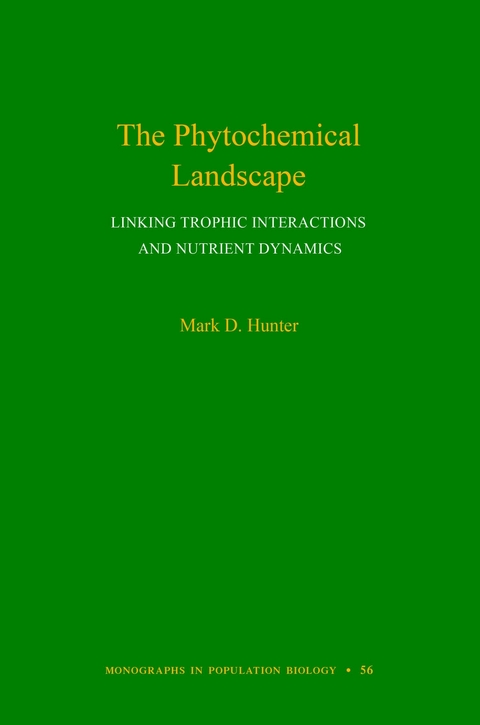
The Phytochemical Landscape (eBook)
Princeton University Press (Verlag)
9781400881208 (ISBN)
Mark D. Hunter is the Henry A. Gleason Collegiate Professor of Ecology and Evolutionary Biology at the University of Michigan. His books include Ecology of Insects: Concepts and Applications.
The dazzling variation in plant chemistry is a primary mediator of trophic interactions, including herbivory, predation, parasitism, and disease. At the same time, such interactions feed back to influence spatial and temporal variation in the chemistry of plants. In this book, Mark Hunter provides a novel approach to linking the trophic interactions of organisms with the cycling of nutrients in ecosystems.Hunter introduces the concept of the "e;phytochemical landscape"e;-the shifting spatial and temporal mosaic of plant chemistry that serves as the nexus between trophic interactions and nutrient dynamics. He shows how plant chemistry is both a cause and consequence of trophic interactions, and how it also mediates ecosystem processes such as nutrient cycling. Nutrients and organic molecules in plant tissues affect decomposition rates and the fluxes of elements such as carbon, nitrogen, and phosphorus. The availability of these same nutrients influences the chemistry of cells and tissues that plants produce. In combination, these feedback routes generate pathways by which trophic interactions influence nutrient dynamics and vice versa, mediated through plant chemistry. Hunter provides evidence from terrestrial and aquatic systems for each of these pathways, and describes how a focus on the phytochemical landscape enables us to better understand and manage the ecosystems in which we live.Essential reading for students and researchers alike, this book offers an integrated approach to population-, community-, and ecosystem-level ecological processes.
Mark D. Hunter is the Henry A. Gleason Collegiate Professor of Ecology and Evolutionary Biology at the University of Michigan. His books include Ecology of Insects: Concepts and Applications.
| Erscheint lt. Verlag | 9.8.2016 |
|---|---|
| Reihe/Serie | Monographs in Population Biology | Monographs in Population Biology |
| Zusatzinfo | 99 line illus. |
| Verlagsort | Princeton |
| Sprache | englisch |
| Themenwelt | Sachbuch/Ratgeber ► Natur / Technik ► Natur / Ökologie |
| Naturwissenschaften ► Biologie ► Botanik | |
| Naturwissenschaften ► Biologie ► Ökologie / Naturschutz | |
| Schlagworte | Abiotic component • algae • algal bloom • Alkaloid • Amino acid • apex predator • aphid • Aquatic ecosystem • Autotroph • Bacteria • biodiversity • Biogeochemical cycle • Biological interaction • Biomass (ecology) • Biome • Brown Algae • Carbohydrate • carnivore • Cellulose • Chemical defense • Copepod • cyanobacteria • Decomposer • Detritivore • Detritus • Diatom • Digestion • Dimethylsulfoniopropionate • dinoflagellate • domoic acid • Ecological Stoichiometry • Ecology • ecosystem • Enzyme • eutrophication • Evolution • Fertilizer • Flora • Food Chain • food web • foraging • fungus • Glucosinolate • Grassland • grazing • Green algae • Herbivore • Immobilization (soil science) • Lignin • macrophyte • Meta-analysis • Metabolism • Microcystin • Microorganism • Molecule • Mutualism (biology) • Nematode • nitrogen • nutrient • nutrient cycle • nutrient pollution • organic compound • palatability • parasitism • Parasitoid • pathogen • Phenotype • Phenotypic plasticity • Phlorotannin • photosynthesis • Phycotoxin • Phytochemical • phytochemistry • Phytoplankton • plant community • Plant litter • population dynamics • predation • primary producers • Primary production • Prochlorococcus • Red Algae • rhizosphere • Root • salt marsh • saxitoxin • seagrass • seawater • secondary metabolite • Sediment • Shrub • Soil • Starch • stoichiometry • Subsidy • tannin • Terrestrial ecosystem • trophic cascade • Trophic level • Zooplankton |
| ISBN-13 | 9781400881208 / 9781400881208 |
| Informationen gemäß Produktsicherheitsverordnung (GPSR) | |
| Haben Sie eine Frage zum Produkt? |
 PDF (Wasserzeichen)
Größe: 3,9 MB
DRM: Digitales Wasserzeichen
Dieses eBook enthält ein digitales Wasserzeichen und ist damit für Sie personalisiert. Bei einer missbräuchlichen Weitergabe des eBooks an Dritte ist eine Rückverfolgung an die Quelle möglich.
Dateiformat: PDF (Portable Document Format)
Mit einem festen Seitenlayout eignet sich die PDF besonders für Fachbücher mit Spalten, Tabellen und Abbildungen. Eine PDF kann auf fast allen Geräten angezeigt werden, ist aber für kleine Displays (Smartphone, eReader) nur eingeschränkt geeignet.
Systemvoraussetzungen:
PC/Mac: Mit einem PC oder Mac können Sie dieses eBook lesen. Sie benötigen dafür einen PDF-Viewer - z.B. den Adobe Reader oder Adobe Digital Editions.
eReader: Dieses eBook kann mit (fast) allen eBook-Readern gelesen werden. Mit dem amazon-Kindle ist es aber nicht kompatibel.
Smartphone/Tablet: Egal ob Apple oder Android, dieses eBook können Sie lesen. Sie benötigen dafür einen PDF-Viewer - z.B. die kostenlose Adobe Digital Editions-App.
Buying eBooks from abroad
For tax law reasons we can sell eBooks just within Germany and Switzerland. Regrettably we cannot fulfill eBook-orders from other countries.
 EPUB (Adobe DRM)
Kopierschutz: Adobe-DRM
Adobe-DRM ist ein Kopierschutz, der das eBook vor Mißbrauch schützen soll. Dabei wird das eBook bereits beim Download auf Ihre persönliche Adobe-ID autorisiert. Lesen können Sie das eBook dann nur auf den Geräten, welche ebenfalls auf Ihre Adobe-ID registriert sind.
Details zum Adobe-DRM
Dateiformat: EPUB (Electronic Publication)
EPUB ist ein offener Standard für eBooks und eignet sich besonders zur Darstellung von Belletristik und Sachbüchern. Der Fließtext wird dynamisch an die Display- und Schriftgröße angepasst. Auch für mobile Lesegeräte ist EPUB daher gut geeignet.
Systemvoraussetzungen:
PC/Mac: Mit einem PC oder Mac können Sie dieses eBook lesen. Sie benötigen eine
eReader: Dieses eBook kann mit (fast) allen eBook-Readern gelesen werden. Mit dem amazon-Kindle ist es aber nicht kompatibel.
Smartphone/Tablet: Egal ob Apple oder Android, dieses eBook können Sie lesen. Sie benötigen eine
Geräteliste und zusätzliche Hinweise
Buying eBooks from abroad
For tax law reasons we can sell eBooks just within Germany and Switzerland. Regrettably we cannot fulfill eBook-orders from other countries.
aus dem Bereich