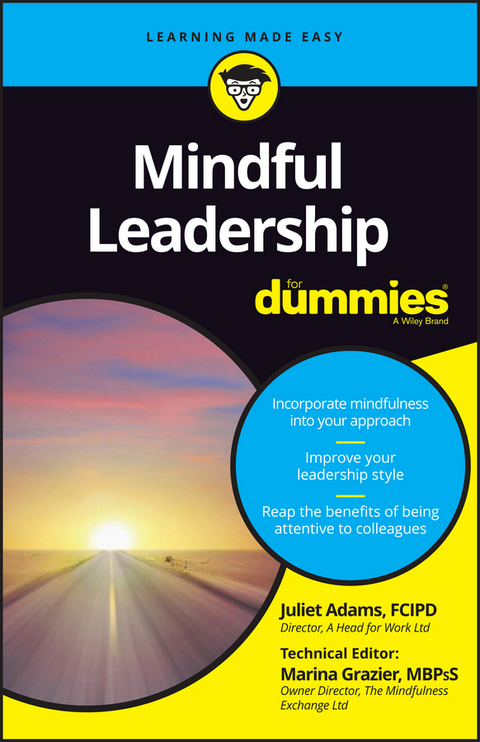
Mindful Leadership For Dummies (eBook)
John Wiley & Sons (Verlag)
978-1-119-06880-8 (ISBN)

Want to become a more mindful leader? With Mindful Leadership For Dummies, you'll find accessible and authoritative guidance for cultivating focus, clarity, and creativity from within your colleagues, Packed full of useful tips, this friendly how-to guide will help you incorporate mindfulness in your leadership style to manage and reap the benefits of a more attentive working life-all while nurturing compassion in the service of others, You'll discover how mindfulness can help improve decision-making and communication skills, manage modern workday challenges, and so much more,
Mindful leadership is currently a high-trending topic in the self-help/business world, making headlines in such prominent publications as Forbes, Time magazine and The Guardian, and even earning a dedicated blog on Huffington Post, And all for good reason-the benefits of practicing mindfulness in the workplace are far-reaching, and as we begin to uncover more research that supports its effectiveness, it's no wonder business leaders are jumping aboard this positive bandwagon,
- Includes tips on incorporating mindfulness into your leadership style
- Shows you how mindfulness can help develop and deepen your leadership qualities
- Explains how mindfulness enhances productivity and minimizes the effects of stress in the workplace
- Outlines how adding mindfulness to your leadership approach will enable you to make positive choices that support your well-being
If you're a businessperson looking to add mindfulness to your leadership tool belt, Mindful Leadership For Dummies has everything you need to get started today,
Juliet Adams is a learning and development professional who has pioneered workplace mindfulness training, A professional mindfulness teacher and trainer developer, she teaches internationally,
Marina Grazier retrained as a Psychologist to pioneer mindfulness tailored for the workplace, Marina qualified as an MBCT teacher at Oxford University, and she now develops workplace trainers internationally,
The easy way to become a more mindful leader Want to become a more mindful leader? With Mindful Leadership For Dummies, you'll find accessible and authoritative guidance for cultivating focus, clarity, and creativity from within your colleagues. Packed full of useful tips, this friendly how-to guide will help you incorporate mindfulness in your leadership style to manage and reap the benefits of a more attentive working life all while nurturing compassion in the service of others. You'll discover how mindfulness can help improve decision-making and communication skills, manage modern workday challenges, and so much more. Mindful leadership is currently a high-trending topic in the self-help/business world, making headlines in such prominent publications as Forbes, Time magazine and The Guardian, and even earning a dedicated blog on Huffington Post. And all for good reason the benefits of practicing mindfulness in the workplace are far-reaching, and as we begin to uncover more research that supports its effectiveness, it's no wonder business leaders are jumping aboard this positive bandwagon. Includes tips on incorporating mindfulness into your leadership style Shows you how mindfulness can help develop and deepen your leadership qualities Explains how mindfulness enhances productivity and minimizes the effects of stress in the workplace Outlines how adding mindfulness to your leadership approach will enable you to make positive choices that support your well-being If you're a businessperson looking to add mindfulness to your leadership tool belt, Mindful Leadership For Dummies has everything you need to get started today.
Juliet Adams is a learning and development professional who has pioneered workplace mindfulness training. A professional mindfulness teacher and trainer developer, she teaches internationally. Marina Grazier retrained as a Psychologist to pioneer mindfulness tailored for the workplace. Marina qualified as an MBCT teacher at Oxford University, and she now develops workplace trainers internationally.
Introduction 1
Part 1: Breaking the Mould 5
CHAPTER 1: Exploring Mindful Leadership 7
CHAPTER 2: Discovering Why Mindfulness Matters to Leaders 17
CHAPTER 3: Harnessing the Neuroscience of Mindful Leadership 31
Part 2: Learning from Mindful Leaders 45
CHAPTER 4: Case Study 1: Andrew Stone, Baron Stone of Blackheath 47
CHAPTER 5: Case Study 2: Tim Neild, Royal Navy Commander 57
CHAPTER 6: Case Study 3: Marion Furr, Director of MBPA 65
Part 3: Developing Mindfulness 73
CHAPTER 7: Setting the Stage for Transformation 75
CHAPTER 8: Week 1: Focusing Your Attention 83
CHAPTER 9: Week 2: Observing the Mind-Body Connection 101
CHAPTER 10: Week 3: Minding the Gap 121
CHAPTER 11: Week 4: Recognising That Thoughts Are Not Facts 143
CHAPTER 12: Week 5: Turning Towards Difficulties 163
CHAPTER 13: Week 6: Developing Intention 177
Part 4: Applying Mindful Leadership 195
CHAPTER 14: Enhancing Your Personal Presence and Influence 197
CHAPTER 15: Leading in a Digital Age 209
CHAPTER 16: Leading in Times of Change 221
Part 5: Becoming a Mindful Organisation 235
CHAPTER 17: Introducing Mindfulness to Your Organisation 237
CHAPTER 18: Integrating Mindfulness into Everyday Work Practices 251
Part 6: The Part of Tens 267
CHAPTER 19: Ten Mindful Ways to Make Better Decisions 269
CHAPTER 20: Ten Mindful Ways to Reduce the Risk of Burnout 279
CHAPTER 21: Ten Ways to Improve Your Attention with Mindfulness 289
CHAPTER 22: (More Than) Ten Sources of Info on Mindful Leadership 301
Index 311
Chapter 1
Exploring Mindful Leadership
IN THIS CHAPTER
Understanding mindfulness and leadership
Exploring the evolution of mindfulness
Discovering the benefits of mindful leadership
Mindful leadership is about flexibility of thought and actions, breaking out of autopilot and habitual behaviours and being the best you can be in any given moment. Mindfulness certainly isn’t a silver bullet or a quick fix; it takes time and practice. But every great journey starts with one step, and this book will be your companion and guide every step of the way.
Establishing the Facts about Mindfulness and Leadership
In this section, we start with the basics and establish a shared understanding of what mindfulness is and how it can enhance your leadership capability.
Understanding mindfulness
Mindfulness is all about your ability to focus attention on the situation at hand with the intention to observe the judgments you make and choose how to respond appropriately. Developing this ability helps you to step away from automatic habitual responses to observe present-moment reality with an open mind and to make smarter decisions.
Everyone has the capacity to be mindful, but like anything worthwhile, it takes time, effort and practice. In the section ‘Deconstructing Mindfulness’ you’ll find a more succinct definition of mindfulness and how to develop it for yourself.
Redefining leadership
The definition of leadership varies subtly from theory to theory. At its most basic, leadership is a process of social influence where a person (the leader) secures the help and support of others to accomplish a shared task.
In recent years, leadership theory has started to focus on the leader as one human being, leading other human beings. Recent discoveries in neuroscience and psychology have transformed our knowledge of how the human brain learns, reacts to different stimulus, and interprets what’s happening.
On a daily basis, as a leader, you’re involved in changing people’s brains – literally! Everyday ordinary and extraordinary life events are the catalysts for thoughts, decisions and learning, which in turn change the structure of the brain physically. Understanding your brain, and how and why others do what they do, helps you use your brain more effectively. Applying neuroscience to your actions and behaviours as a leader helps make you a more effective, adaptive and resilient leader. You can find out more about this in Chapter 3.
Mindfulness is now recognised as a foundational skill for effective leadership. Peter Drucker once said that we can’t manage others unless we learn to manage ourselves first. Mindfulness increases self-awareness, which enables you to manage yourself better. Mindful leadership combines the practice of mindfulness with practical management and leadership techniques, enabling leaders to engage a wider range of their capacities to the challenges at hand. Check out Chapters 15, 16 and 17 for the practical application of mindfulness to everyday work challenges.
Exploring the Benefits of Mindful Leadership
Having considered the meaning of both mindfulness and leadership (see previous section), you may be asking yourself, ‘What’s in it for me?’ The following sections drill deeper into the role of leadership today, the evolution and modern-day uses of mindfulness, and practical ways to apply mindfulness to your work as a leader.
Refreshing your knowledge of leadership
Ideas about what makes a good leader have changed and evolved dramatically over the years. In the 1920s and 1930s, trait theories argued that leaders were born. From the 1940s to the 1960s, behavioural theories argued that you can be taught leadership – it’s just a matter of adopting the right behaviours when attempting to lead.
In more recent times, contingency theories (such as situational leadership) argue that no one leadership style is correct and that as a leader you need to adopt the correct leadership style for the situation. Transformational theories view leaders as agents of change. As a transformational leader, you can transform the workplace via teamwork or team development, or by acting as an agent of change or a strategic visionary.
One of the most recent approaches to leadership is authentic leadership. It’s an approach that encourages honest relationships with followers, whose input is valued. Authentic leaders tend to be positive people with truthful self-concepts who seek clarity and promote openness. By building trust and generating enthusiastic support from their followers, authentic leaders are able to improve both individual and team performance. Authentic leadership is a growing area of study in academic research on leadership, and mindfulness is a core element. Read more about authentic leadership in Chapter 14.
Investigating human nature
If you want to be a good leader, you need to have some understanding of what makes people tick. At a deep level, most humans have a natural desire to be led, fuelled by a primeval desire to survive, have a purpose in life, and achieve. Abraham Maslow described this in his hierarchy of needs (see Figure 1-1).
© John Wiley & Sons, Inc.
FIGURE 1-1: Maslow’s hierarchy of needs.
Located at the foundation of Maslow’s triangle are basic needs – needs for survival. Like most animals, humans will do anything and everything to survive and sustain life. Challenging situations may result in a feeling of threat. Threats to pride, integrity and future success may lead to seeking guidance, support and leadership from others to minimise threats. In a work context, if your ability to complete a task is threatened, it can have a negative impact on your future success and progress, which is why people are naturally predisposed to need leaders.
Good leaders help individuals to gain a meaningful sense of purpose by helping them align their thoughts and clarify the reasons behind their work. Humans need understanding to fully engage, and good leadership meets this need.
According to Maslow, after basic needs (survival) and psychological needs (purpose) are met, humans strive for self-fulfilment. In a work context, leaders can greatly enhance individuals’ potential for success and achievement. Good leaders help individuals work towards their full potential and maximise their performance.
Deconstructing Mindfulness
As a human being, you perform at your best when you’re authentic to yourself and lead in a way that resonates with your values. Of course, doing so is often easier said than done. It takes time and effort and an acceptance of personal responsibility for your actions. Unravelling and revealing your true self involves self-awareness and reflection, which is where mindfulness comes in.
Defining mindfulness
When you strip away the hype and well-worn catchphrases, mindfulness is simply the cultivation of metacognition and maintenance of an optimum mind state (see Figure 1-2).
- Metacognition can be described as the ability to observe what’s going on in your mind. When developing mindfulness, you cultivate an open monitoring state where you’re aware of your thoughts, feelings and bodily sensations in any given moment of time.
- An optimum mind state can be described as a feeling of ease, when you feel safe and secure, and your body and mind is functioning in its optimum state. In other words, an optimum mind state occurs when you’re free from anxiety, anger and fear and are feeling secure, happy and comfortable with your surroundings. This state allows you to be the best you can and reach your full potential.
© A Head for Work Ltd
FIGURE 1-2: Mindfulness and mindful leadership.
The following sections explore these terms and what they mean in more detail.
Maintaining metacognition and an optimum mind state
Cultivating metacognition enables you to become more aware of your automatic tendencies and responses. This awareness allows you to make decisions and act appropriately based on present-moment reality instead of being hijacked by strong emotions and impulses triggered by past experiences and predictions of the future, which often lead to inappropriate actions and reactions.
Maintaining an optimum mind state is important. When you experience a negative emotional mind state, such as anger and fear, even to a small degree, your brain responds automatically. Your brain senses something is wrong and responds quickly to safeguard you.
For example, if you were standing in the middle of a road with a lorry hurtling towards you, you wouldn’t want to have to take a moment to decide what to do, would you? In this situation, it’s wholly appropriate that your brain should take control, quickly and efficiently evaluating the threat and the options and deciding on the right course of action. If this happened to you for real, you would almost certainly automatically jump out of the way without any conscious thought to avoid death or injury. In this instance, engaging in conscious thought would slow you down, but engaging autopilot allows you to live to tell the tale.
This lightning-fast, efficient, unconscious response has...
| Erscheint lt. Verlag | 2.6.2016 |
|---|---|
| Sprache | englisch |
| Themenwelt | Sachbuch/Ratgeber ► Beruf / Finanzen / Recht / Wirtschaft ► Wirtschaft |
| Wirtschaft ► Betriebswirtschaft / Management ► Unternehmensführung / Management | |
| Schlagworte | adding mindfulness to your leadership approach • add mindfulness to your leadership • become a more mindful leader • Business & Management • Business Self-Help • how mindfulness can help • how mindfulness can help improve decision-making • how mindfulness can help improve decision-making and communication skills • incorporate mindfulness in your leadership style • incorporating mindfulness into your leadership style • Juliet Adams • Leadership Style • Mindful Leader • Mindful Leadership • Mindful Leadership For Dummies • mindfulness in the workplace • practicing mindfulness in the workplace • Ratgeber Wirtschaft • the benefits of a more attentive working life • the benefits of practicing mindfulness in the workplace • Wirtschaft /Ratgeber • Wirtschaft u. Management |
| ISBN-10 | 1-119-06880-0 / 1119068800 |
| ISBN-13 | 978-1-119-06880-8 / 9781119068808 |
| Informationen gemäß Produktsicherheitsverordnung (GPSR) | |
| Haben Sie eine Frage zum Produkt? |
 EPUB (Adobe DRM)
Kopierschutz: Adobe-DRM
Adobe-DRM ist ein Kopierschutz, der das eBook vor Mißbrauch schützen soll. Dabei wird das eBook bereits beim Download auf Ihre persönliche Adobe-ID autorisiert. Lesen können Sie das eBook dann nur auf den Geräten, welche ebenfalls auf Ihre Adobe-ID registriert sind.
Details zum Adobe-DRM
Dateiformat: EPUB (Electronic Publication)
EPUB ist ein offener Standard für eBooks und eignet sich besonders zur Darstellung von Belletristik und Sachbüchern. Der Fließtext wird dynamisch an die Display- und Schriftgröße angepasst. Auch für mobile Lesegeräte ist EPUB daher gut geeignet.
Systemvoraussetzungen:
PC/Mac: Mit einem PC oder Mac können Sie dieses eBook lesen. Sie benötigen eine
eReader: Dieses eBook kann mit (fast) allen eBook-Readern gelesen werden. Mit dem amazon-Kindle ist es aber nicht kompatibel.
Smartphone/Tablet: Egal ob Apple oder Android, dieses eBook können Sie lesen. Sie benötigen eine
Geräteliste und zusätzliche Hinweise
Buying eBooks from abroad
For tax law reasons we can sell eBooks just within Germany and Switzerland. Regrettably we cannot fulfill eBook-orders from other countries.
aus dem Bereich