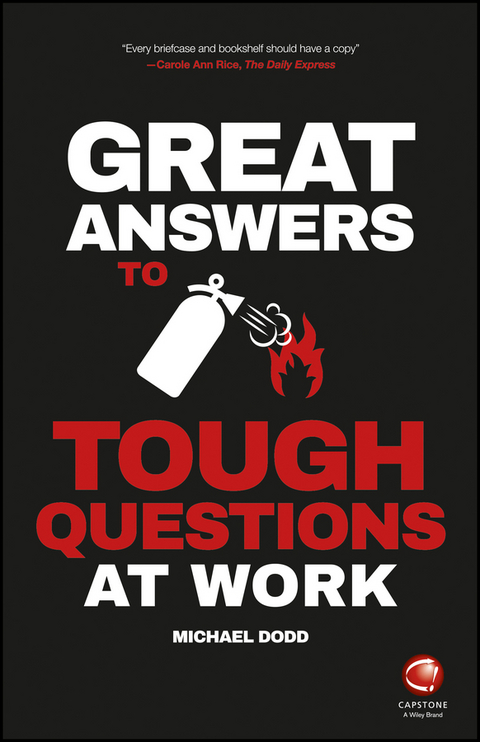
Great Answers to Tough Questions at Work (eBook)
John Wiley & Sons (Verlag)
978-0-85708-640-2 (ISBN)
SHORTLISTED FOR THE CMI MANAGEMENT BOOK OF THE YEAR AWARD
The essential guide to turning tough questions into positive opportunities
Difficult questions can be thrown at you from your first job interview through to challenges you get when you've made it to the top, If you find yourself on the firing line on a regular or occasional basis this is the perfect go-to guide to help you turn tough questions into positive opportunities,
Great Answers to Tough Questions at Work promotes a confident 'win-win-win' mindset for questioner, answerer and wider audiences beyond, Author Michael Dodd provides golden formulae and proven strategies for constructing inspirational answers-however challenging, vicious, tricky or stupid the question, He outlines simple but successful techniques for dealing with the kind of nightmare questions which all ambitious people in the workplace have to face along their journey, whatever stage of their career,
- Contains critical communication skills for executives, managers, leaders and those aspiring to fill these roles
- Covers a wide range of work place scenarios such as job interviews, performance reviews, negotiations, customer relations, parliamentary inquiries and cross-examination
- Discusses how to see the issues underlying tough questions that you face in a different, more positive, solution-oriented way
- Includes case study examinations of key moments where people in the public spotlight have done something particularly well or particularly badly while answering questions and draws out the lessons for readers,
Michael Dodd (Midlands, UK) is a speaker and international media and presentation trainer, working with businesses of all sizes, Michael speaks weekly (schedule attached in appendix below) and his targeted newsletter is distributed to 2000 people each month, His clients include representatives of UK Trade and Investment, in embassies, high commissions and consulates around the world, He speaks with audiences of United Nations officials on answering questions from the media in global trouble spots,
Michael also teaches as a Senior Lecturer in Broadcast Journalism at the University of Westminster and does media training for university clients, professors and business students, He also delivers guest lectures in other universities around the world,
Trained as a broadcast journalist, Michael has worked at the Australian Broadcasting Corporation on the AM programme, and then as the foreign correspondent travelling the world covering politics and revolutions,
SHORTLISTED FOR THE CMI MANAGEMENT BOOK OF THE YEAR AWARDThe essential guide to turning tough questions into positive opportunities Difficult questions can be thrown at you from your first job interview through to challenges you get when you ve made it to the top. If you find yourself on the firing line on a regular or occasional basis this is the perfect go-to guide to help you turn tough questions into positive opportunities. Great Answers to Tough Questions at Work promotes a confident 'win-win-win' mindset for questioner, answerer and wider audiences beyond. Author Michael Dodd provides golden formulae and proven strategies for constructing inspirational answers however challenging, vicious, tricky or stupid the question. He outlines simple but successful techniques for dealing with the kind of nightmare questions which all ambitious people in the workplace have to face along their journey, whatever stage of their career. Contains critical communication skills for executives, managers, leaders and those aspiring to fill these roles Covers a wide range of work place scenarios such as job interviews, performance reviews, negotiations, customer relations, parliamentary inquiries and cross-examination Discusses how to see the issues underlying tough questions that you face in a different, more positive, solution-oriented way Includes case study examinations of key moments where people in the public spotlight have done something particularly well or particularly badly while answering questions and draws out the lessons for readers.
Michael Dodd (Midlands, UK) is a speaker and international media and presentation trainer, working with businesses of all sizes. Michael speaks weekly (schedule attached in appendix below) and his targeted newsletter is distributed to 2000 people each month. His clients include representatives of UK Trade and Investment, in embassies, high commissions and consulates around the world. He speaks with audiences of United Nations officials on answering questions from the media in global trouble spots. Michael also teaches as a Senior Lecturer in Broadcast Journalism at the University of Westminster and does media training for university clients, professors and business students. He also delivers guest lectures in other universities around the world. Trained as a broadcast journalist, Michael has worked at the Australian Broadcasting Corporation on the AM programme, and then as the foreign correspondent travelling the world covering politics and revolutions.
Introduction: Helping You Thrive On "Blowtorch-On-The-Belly" Questioning 1
Part One: The Tools You Need 13
1. Winning Answers Every Time 15
2. Crafting the Right Message to Underpin Every Answer 33
3. Harnessing the Power of Stories 55
4. Finding Out in Advance - Then Planning for It 75
5. The First Golden Formula - Simple as ABCDE 85
6. The Second Golden Formula - What to Say When Something Goes Seriously Wrong 107
7. Maximizing the Impact of Your Examples and Stories 123
8. Getting Your Performance Right 137
9. Conveying Your Answers to Different Personality Types 157
Part Two: Using Your New Tools 171
10. Great Answers for Prospects 173
11. Great Answers During Price Negotiations 191
12. Great Answers for Clients 209
13. Great Answers in Those Nerve-Wracking Job Interviews 223
14. Great Answers for Your Boss 239
15. Great Answers in Presentations, at Events and in Meetings 253
16. Shining Out Through the Media and at Public Grillings 269
Ongoing Enhancement: Great Answers for Your Inspirational Future 287
About the Author 291
Acknowledgements 293
Index 297
Introduction: Helping You Thrive On “Blowtorch-On-The-Belly” Questioning
At some stage it happens to nearly all of us.
We're asked a question by the boss, a job selection board or a potential client – and we say something really stupid.
Or wrong.
Or self-defeating.
Maybe, on a bad day, it can even be a combination of all three.
And then you realize a short time afterwards what you should have said.
This human experience is so common, the French have an expression for it.
They talk about the annoying phenomenon of thinking up the perfect thing that should have come out of your lips all too late – while you're on the stairs leaving after that bruising verbal encounter: “L'espirit d'escalier”, otherwise known as “the spirit of the stairs” or “staircase wit”.
This book contains solutions to this and related problems.
It guides you on what you should say and how best to say it in challenging situations throughout your working life.
Whether you're asked “Why should you be promoted?”, “Why aren't there any pens in the stationery cabinet when I asked you to get some last month?” or “Why should I invest in your billion-dollar project?”, this book helps you formulate answers that are set to be more impressive, more reassuring and more inspiring than the ones you're giving now.
It gives you the techniques and the amazingly effective golden formulae for dealing with hard questions, nasty questions and stupid questions.
Drawing on my background as a broadcast interviewer, with training by the Australian Broadcasting Corporation in the art of putting business leaders, politicians, officials and others under pressure, this book will show you how to stand up to what have been described as “blowtorch-on-the-belly” questions.
This is a technical term from the world of Australian politics – reputedly the place where dialogue is the most vicious in the democratic world.
It applies to situations where interrogators subject you to sustained, rugged, painful questioning – the kind you could expect in the most ferocious of media interviews for instance.
“Blowtorch-on-the-belly” questioning can also be deployed against you in the boardroom, in a career appraisal and anytime something's gone wrong and the finger of blame is pointing at you.
Doing badly when subjected to this kind of questioning can damage your career and even lose you your job.
Doing well through decisive, positive and uplifting answers can help propel you towards outcomes you want in the workplace and beyond.
As a media interviewer, I've watched some business leaders, officials and politicians set fire to their careers and public image by losing their tempers, their nerve and their dignity when put under pressure by myself and others.
I've also seen some of them do what the front cover of this book suggests and successfully put the fire out – sometimes seemingly with very little effort – and then inject powerful, positive ideas and visions into the conversation to move things in the direction they want.
One particularly memorable incident was when Britain's highly controversial Margaret Thatcher came to Sydney in the earlier years of her prime ministership. At the time she was administering harsh and unpopular cost-cutting medicine to the struggling economy of the UK. Our star tough-guy interviewer at the Australian Broadcasting Corporation couldn't land a glove on her as she gave him and our audience a stern lecture about the importance of the principle she called “sound money”.
There was much to throw at her about the initial negative side-effects of the medicine – and the tough-guy interviewer didn't hold back from this. Yet the aptly named Iron Lady steamed through the interview as if a battle ship were being harried by the smallest of mosquitos.
I noticed the same phenomenon – of some politicians, business leaders and officials doing remarkably well in challenging interviews and some doing remarkably badly – when I became a foreign correspondent.
Shortly before the fall of the Iron Curtain in Europe, I got to subject the Polish Vice-Minister for Nuclear Energy in Warsaw to blowtorch-style questions about the dangers of communist-designed Chernobyl-era nuclear power stations in his country and the risk of another nuclear catastrophe in what was then the Soviet-dominated “Eastern Bloc”. These questions resulted in a string of nervous, bumbling answers that were put to air on the BBC World Service, making him and his reactors appear dangerously inept.
In contrast, amidst the anti-communist “Velvet Revolution” in 1989 in Prague, I and other foreign correspondents got to ask the leading revolutionary Václav Havel about whether he would seek the presidency of what was then Czechoslovakia. We were swept away by the smoothness and power of his impressively thoughtful and eloquent – though sometimes artfully non-committal – answers, which raised his standing and made it all the more likely that he would become president. He swiftly did.
When planning this book I have looked back analytically over all the interviews that I've been privileged to do around the world. It became clear that there was a massive difference between the way various people reacted to “blowtorch-on-the-belly” questioning.
Some would metaphorically collapse in a quivering heap under blowtorch-style questioning.
Others would sail through the interrogation as they might steer a yacht in a gentle breeze.
Eventually I discovered what made the difference.
It was largely down to planning, preparation and practice.
With the benefit of hindsight it was clear that some politicians, business leaders and officials had been successfully trained to deal with tough interview questions and had worked at perfecting their replies and their delivery style in advance.
Those who shone out in rigorous interviews had typically done some training or had effectively trained themselves.
It eventually became public knowledge that Margaret Thatcher had had intense coaching – on the recommendation of the Hamlet-playing acting maestro Lord Laurence Olivier no less. This was most evident in the way Mrs Thatcher lowered her voice to sound more authoritative as her career progressed. In fact, one coaching session was – embarrassingly – recorded, leaked and publicly broadcast in Australia, Britain and elsewhere. But it showed what a dedicated communications student she became.
As a playwright and one-time stage hand, Václav Havel was surrounded by actors and clearly appreciated the value of rehearsing for those big moments in the spotlight. No wonder he was so impressive when I and my fellow foreign correspondents sought to test him out while he was holding a press conference on the stage at one of the Czechoslovakian theatres that became a focal point during his theatrically choreographed revolution.
The more I looked at it, the more I discovered that the art and science behind giving great answers is a learnable skill – and that those who shone out worked in advance on their content, their structure and their delivery style.
There are ways of combatting the hottest of blowtorch-on-the-belly questions and turning them to your advantage. The methods for successfully dealing with challenging questions from media interviewers can also be adapted to the tough questions you can get in the workplace from all kinds of sources – prospects, clients, colleagues, shareholders and financiers.
And if world leaders can train to improve their answers, then so can everyone else in the workforce.
When I started working as a lecturer in broadcast journalism in British colleges and universities on my pathway to being an international professional speaker, I was invited into the fascinating world of media and communications training.
Public Relations (PR) firms and training companies would ask me to come in and rough up their clients in mock blowtorch-on-the-belly media interviews and other challenging professional conversations to see how they coped – and then work with me to help their clients perform more confidently at a higher level.
I got to witness how the PR experts equipped their clients to answer emotionally-charged questions, horrible questions and tricky questions. And I could utilise my own particular area of expertise coming from Down Under – really ignorant questions . . . the kind that can cause some people to explode with rage.
I began teaching and developing the methods and golden formulae myself in one-to-one coaching sessions, master classes and conference speeches – sometimes even to audiences of PR people themselves.
The techniques work with apprentices seeking to change jobs, sports professionals being interviewed ahead of their next match, and sales teams and business leaders wanting to grow their empires across a vast range of industries.
And I found the techniques highly useful when facing questioning myself, as I increasingly did in my role as an international broadcasting commentator and newspaper critic.
Having been interviewed hundreds of times as a newspaper reviewer and commentator on Sky TV, the BBC and Al Jazeera, I have found the techniques to be especially useful when I have...
| Erscheint lt. Verlag | 24.5.2016 |
|---|---|
| Sprache | englisch |
| Themenwelt | Sachbuch/Ratgeber ► Beruf / Finanzen / Recht / Wirtschaft ► Bewerbung / Karriere |
| Wirtschaft ► Betriebswirtschaft / Management ► Planung / Organisation | |
| Wirtschaft ► Betriebswirtschaft / Management ► Unternehmensführung / Management | |
| Schlagworte | Academy for Chief Executives • Breaking Bad News • Business & Management • Business Communication • Business Self-Help • communications training • critical communication • difficult conversations • Executive Communication • Executive Development • Grace Under Pressure • Great Answers to Tough Questions at Work • improving communication • Interview Skills • Leadership Communication • leadership development • Leadership Training • media training • Michael Dodd • Persuasion • presentation skills • Professional communication • Q&A training • Ratgeber Wirtschaft • Richard Bosworth • Simon Lester • tough interview questions • What if Business Leaders Group • Wirtschaft /Ratgeber • Wirtschaft u. Management • workplace communication |
| ISBN-10 | 0-85708-640-5 / 0857086405 |
| ISBN-13 | 978-0-85708-640-2 / 9780857086402 |
| Informationen gemäß Produktsicherheitsverordnung (GPSR) | |
| Haben Sie eine Frage zum Produkt? |
 EPUB (Adobe DRM)
Kopierschutz: Adobe-DRM
Adobe-DRM ist ein Kopierschutz, der das eBook vor Mißbrauch schützen soll. Dabei wird das eBook bereits beim Download auf Ihre persönliche Adobe-ID autorisiert. Lesen können Sie das eBook dann nur auf den Geräten, welche ebenfalls auf Ihre Adobe-ID registriert sind.
Details zum Adobe-DRM
Dateiformat: EPUB (Electronic Publication)
EPUB ist ein offener Standard für eBooks und eignet sich besonders zur Darstellung von Belletristik und Sachbüchern. Der Fließtext wird dynamisch an die Display- und Schriftgröße angepasst. Auch für mobile Lesegeräte ist EPUB daher gut geeignet.
Systemvoraussetzungen:
PC/Mac: Mit einem PC oder Mac können Sie dieses eBook lesen. Sie benötigen eine
eReader: Dieses eBook kann mit (fast) allen eBook-Readern gelesen werden. Mit dem amazon-Kindle ist es aber nicht kompatibel.
Smartphone/Tablet: Egal ob Apple oder Android, dieses eBook können Sie lesen. Sie benötigen eine
Geräteliste und zusätzliche Hinweise
Buying eBooks from abroad
For tax law reasons we can sell eBooks just within Germany and Switzerland. Regrettably we cannot fulfill eBook-orders from other countries.
aus dem Bereich