Physics I For Dummies
For Dummies (Verlag)
978-1-119-29359-0 (ISBN)
- Titel erscheint in neuer Auflage
- Artikel merken
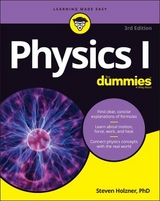
The fun and easy way to get up to speed on the basic concepts of physics
For high school and undergraduate students alike, physics classes are recommended or required courses for a wide variety of majors, and continue to be a challenging and often confusing course.
Physics I For Dummies tracks specifically to an introductory course and, keeping with the traditionally easy-to-follow Dummies style, teaches you the basic principles and formulas in a clear and concise manner, proving that you don't have to be Einstein to understand physics!
Explains the basic principles in a simple, clear, and entertaining fashion
New edition includes updated examples and explanations, as well as the newest discoveries in the field
Contains the newest teaching techniques
If just thinking about the laws of physics makes your head spin, this hands-on, friendly guide gets you out of the black hole and sheds light on this often-intimidating subject.
Steven Holzner, PhD, was a contributing editor at PC Magazine and was on the faculty of both MIT and Cornell University. He wrote Physics II For Dummies, Physics Essentials For Dummies, and Quantum Physics For Dummies.
Introduction 1
About This Book 1
Conventions Used in This Book 2
What You’re Not to Read 2
Foolish Assumptions 2
How This Book Is Organized 3
Part 1: Putting Physics into Motion 3
Part 2: May the Forces of Physics Be with You 3
Part 3: Manifesting the Energy to Work 3
Part 4: Laying Down the Laws of Thermodynamics 3
Part 5: The Part of Tens 4
Icons Used in This Book 4
Where to Go from Here 4
Part 1: Putting Physics Into Motion 5
Chapter 1: Using Physics to Understand Your World 7
What Physics Is All About 8
Observing the world 8
Making predictions 9
Reaping the rewards 9
Observing Objects in Motion 10
Measuring speed, direction, velocity, and acceleration 10
Round and round: Rotational motion 11
Springs and pendulums: Simple harmonic motion 11
When Push Comes to Shove: Forces 12
Absorbing the energy around you 13
That’s heavy: Pressures in fluids 13
Feeling Hot but Not Bothered: Thermodynamics 14
Chapter 2: Reviewing Physics Measurement and Math Fundamentals 15
Measuring the World around You and Making Predictions 15
Using systems of measurement 16
From meters to inches and back again: Converting between units 17
Eliminating Some Zeros: Using Scientific Notation 19
Checking the Accuracy and Precision of Measurements 21
Knowing which digits are significant 21
Estimating accuracy 23
Arming Yourself with Basic Algebra 23
Tackling a Little Trig 24
Interpreting Equations as Real-World Ideas 25
Chapter 3: Exploring the Need for Speed 27
Going the Distance with Displacement 28
Understanding displacement and position 28
Examining axes 29
Speed Specifics: What Is Speed, Anyway? 32
Reading the speedometer: Instantaneous speed 32
Staying steady: Uniform speed 33
Shifting speeds: Non uniform motion 33
Busting out the stopwatch: Average speed 33
Speeding Up (Or Down): Acceleration 36
Defining acceleration 36
Determining the units of acceleration 36
Looking at positive and negative acceleration 37
Examining average and instantaneous acceleration 40
Taking off: Putting the acceleration formula into practice 41
Understanding uniform and non uniform acceleration 42
Relating Acceleration, Time, and Displacement 42
Not-so-distant relations: Deriving the formula 43
Calculating acceleration and distance 44
Linking Velocity, Acceleration, and Displacement 47
Finding acceleration 48
Solving for displacement 49
Finding final velocity 49
Chapter 4: Following Directions: Motion in Two Dimensions 51
Visualizing Vectors 52
Asking for directions: Vector basics 52
Looking at vector addition from start to finish 53
Going head-to-head with vector subtraction 54
Putting Vectors on the Grid 55
Adding vectors by adding coordinates 55
Changing the length: Multiplying a vector by a number 57
A Little Trig: Breaking Up Vectors into Components 57
Finding vector components 58
Reassembling a vector from its components 60
Featuring Displacement, Velocity, and Acceleration in 2-D 63
Displacement: Going the distance in two dimensions 64
Velocity: Speeding in a new direction 67
Acceleration: Getting a new angle on changes in velocity 68
Accelerating Downward: Motion under the Influence of Gravity 70
The golf-ball-off-the-cliff exercise 70
The how-far-can-you-kick-the-ball exercise 74
Part 2: May The Forces Of Physics Be With You 77
Chapter 5: When Push Comes to Shove: Force 79
Newton’s First Law: Resisting with Inertia 80
Resisting change: Inertia and mass 81
Measuring mass 82
Newton’s Second Law: Relating Force, Mass, and Acceleration 82
Relating the formula to the real world 83
Naming units of force 84
Vector addition: Gathering net forces 84
Newton’s Third Law: Looking at Equal and Opposite Forces 90
Seeing Newton’s third law in action 90
Pulling hard enough to overcome friction 91
Pulleys: Supporting double the force 92
Analyzing angles and force in Newton’s third law 94
Finding equilibrium 96
Chapter 6: Getting Down with Gravity, Inclined Planes, and Friction 99
Acceleration Due to Gravity: One of Life’s Little Constants 100
Finding a New Angle on Gravity with Inclined Planes 100
Finding the force of gravity along a ramp 101
Figuring the speed along a ramp 103
Getting Sticky with Friction 103
Calculating friction and the normal force 104
Conquering the coefficient of friction 105
On the move: Understanding static and kinetic friction 106
A not-so-slippery slope: Handling uphill and downhill friction 108
Let’s Get Fired Up! Sending Objects Airborne 113
Shooting an object straight up 113
Projectile motion: Firing an object at an angle 115
Chapter 7: Circling around Rotational Motion and Orbits 117
Centripetal Acceleration: Changing Direction to Move in a Circle 118
Keeping a constant speed with uniform circular motion 118
Finding the magnitude of the centripetal acceleration 120
Seeking the Center: Centripetal Force 121
Looking at the force you need 121
Seeing how the mass, velocity, and radius affect centripetal force 122
Negotiating flat curves and banked turns 123
Getting Angular with Displacement, Velocity, and Acceleration 126
Measuring angles in radians 126
Relating linear and angular motion 127
Letting Gravity Supply Centripetal Force 129
Using Newton’s law of universal gravitation 129
Deriving the force of gravity on the Earth’s surface 130
Using the law of gravitation to examine circular orbits 131
Looping the Loop: Vertical Circular Motion 135
Chapter 8: Go with the Flow: Looking at Pressure in Fluids 139
Mass Density: Getting Some Inside Information 140
Calculating density 140
Comparing densities with specific gravity 141
Applying Pressure 142
Looking at units of pressure 142
Connecting pressure to changes in depth 143
Hydraulic machines: Passing on pressure with Pascal’s principle 147
Buoyancy: Float Your Boat with Archimedes’s Principle 149
Fluid Dynamics: Going with Fluids in Motion 152
Characterizing the type of flow 152
Picturing flow with streamlines 154
Getting Up to Speed on Flow and Pressure 155
The equation of continuity: Relating pipe size and flow rates 155
Bernoulli’s equation: Relating speed and pressure 158
Pipes and pressure: Putting it all together 160
Part 3: Manifesting The Energy To Work 163
Chapter 9: Getting Some Work Out of Physics 165
Looking for Work 165
Working on measurement systems 166
Pushing your weight: Applying force in the direction of movement 166
Using a tow rope: Applying force at an angle 168
Negative work: Applying force opposite the direction of motion 170
Making a Move: Kinetic Energy 171
The work-energy theorem: Turning work into kinetic energy 171
Using the kinetic energy equation 173
Calculating changes in kinetic energy by using net force 174
Energy in the Bank: Potential Energy 176
To new heights: Gaining potential energy by working against gravity 177
Achieving your potential: Converting potential energy into kinetic energy 178
Choose Your Path: Conservative versus Non conservative Forces 179
Keeping the Energy Up: The Conservation of Mechanical Energy 180
Shifting between kinetic and potential energy 180
The mechanical-energy balance: Finding velocity and height 183
Powering Up: The Rate of Doing Work 184
Using common units of power 185
Doing alternate calculations of power 186
Chapter 10: Putting Objects in Motion: Momentum and Impulse 189
Looking at the Impact of Impulse 189
Gathering Momentum 191
The Impulse-Momentum Theorem: Relating Impulse and Momentum 192
Shooting pool: Finding force from impulse and momentum 193
Singing in the rain: An impulsive activity 195
When Objects Go Bonk: Conserving Momentum 196
Deriving the conservation formula 196
Finding velocity with the conservation of momentum 198
Finding firing velocity with the conservation of momentum 199
When Worlds (Or Cars) Collide: Elastic and Inelastic Collisions 201
Determining whether a collision is elastic 202
Colliding elastically along a line 203
Colliding elastically in two dimensions 205
Chapter 11: Winding Up with Angular Kinetics 209
Going from Linear to Rotational Motion 210
Understanding Tangential Motion 211
Finding tangential velocity 211
Finding tangential acceleration 213
Finding centripetal acceleration 214
Applying Vectors to Rotation 216
Calculating angular velocity 216
Figuring angular acceleration 217
Doing the Twist: Torque 219
Mapping out the torque equation 221
Understanding lever arms 223
Figuring out the torque generated 223
Recognizing that torque is a vector 225
Spinning at Constant Velocity: Rotational Equilibrium 225
Determining how much weight Hercules can lift 226
Hanging a flag: A rotational equilibrium problem 229
Ladder safety: Introducing friction into rotational equilibrium 231
Chapter 12: Round and Round with Rotational Dynamics 235
Rolling Up Newton’s Second Law into Angular Motion 235
Switching force to torque 236
Converting tangential acceleration to angular acceleration 237
Factoring in the moment of inertia 237
Moments of Inertia: Looking into Mass Distribution 238
DVD players and torque: A spinning-disk inertia example 240
Angular acceleration and torque: A pulley inertia example 242
Wrapping Your Head around Rotational Work and Kinetic Energy 244
Putting a new spin on work 245
Moving along with rotational kinetic energy 246
Let’s roll! Finding rotational kinetic energy on a ramp 247
Can’t Stop This: Angular Momentum 249
Conserving angular momentum 250
Satellite orbits: A conservation-of-angular-momentum example 250
Chapter 13: Springs ’n’ Things: Simple Harmonic Motion 253
Bouncing Back with Hooke’s Law 253
Stretching and compressing springs 254
Pushing or pulling back: The spring’s restoring force 254
Getting Around to Simple Harmonic Motion 256
Around equilibrium: Examining horizontal and vertical springs 256
Catching the wave: A sine of simple harmonic motion 258
Finding the angular frequency of a mass on a spring 264
Factoring Energy into Simple Harmonic Motion 267
Swinging with Pendulums 268
Part 4: Laying Down The Laws Of Thermodynamics 271
Chapter 14: Turning Up the Heat with Thermodynamics 273
Measuring Temperature 274
Fahrenheit and Celsius: Working in degrees 274
Zeroing in on the Kelvin scale 275
The Heat Is On: Thermal Expansion 276
Linear expansion: Getting longer 276
Volume expansion: Taking up more space 279
Heat: Going with the Flow (Of Thermal Energy) 281
Getting specific with temperature changes 282
Just a new phase: Adding heat without changing temperature 284
Chapter 15: Here, Take My Coat: How Heat Is Transferred 289
Convection: Letting the Heat Flow 289
Hot fluid rises: Putting fluid in motion with natural convection 290
Controlling the flow with forced convection 291
Too Hot to Handle: Getting in Touch with Conduction 292
Finding the conduction equation 293
Considering conductors and insulators 297
Radiation: Riding the (Electromagnetic) Wave 298
Mutual radiation: Giving and receiving heat 299
Blackbodies: Absorbing and reflecting radiation 300
Chapter 16: In the Best of All Possible Worlds: The Ideal Gas Law 305
Digging into Molecules and Moles with Avogadro’s Number 305
Relating Pressure, Volume, and Temperature with the Ideal Gas Law 307
Forging the ideal gas law 307
Working with standard temperature and pressure 309
A breathing problem: Checking your oxygen 310
Boyle’s and Charles’s laws: Alternative expressions of the ideal gas law 311
Tracking Ideal Gas Molecules with the Kinetic Energy Formula 313
Predicting air molecule speed 314
Calculating kinetic energy in an ideal gas 314
Chapter 17: Heat and Work: The Laws of Thermodynamics 317
Thermal Equilibrium: Getting Temperature with the Zeroth Law 318
Conserving Energy: The First Law of Thermodynamics 318
Calculating with conservation of energy 319
Staying constant: Isobaric, isochoric, isothermal, and adiabatic processes 322
Flowing from Hot to Cold: The Second Law of Thermodynamics 337
Heat engines: Putting heat to work 337
Limiting efficiency: Carnot says you can’t have it all 340
Going against the flow with heat pumps 343
Going Cold: The Third (And Absolute Last) Law of Thermodynamics 346
Part 5: The Part Of Tens 347
Chapter 18: Ten Physics Heroes 349
Galileo Galilei 349
Robert Hooke 350
Sir Isaac Newton 350
Benjamin Franklin 351
Charles-Augustin de Coulomb 352
Amedeo Avogadro 352
Nicolas Léonard Sadi Carnot 353
James Prescott Joule 353
William Thomson (Lord Kelvin) 353
Albert Einstein 354
Chapter 19: Ten Wild Physics Theories 355
You Can Measure a Smallest Distance 355
There May Be a Smallest Time 356
Heisenberg Says You Can’t Be Certain 356
Black Holes Don’t Let Light Out 357
Gravity Curves Space 357
Matter and Antimatter Destroy Each Other 358
Supernovas Are the Most Powerful Explosions 359
The Universe Starts with the Big Bang and Ends with the Gnab Gib 359
Microwave Ovens Are Hot Physics 360
Is the Universe Made to Measure? 361
Glossary 363
Index 367
| Erscheinungsdatum | 11.07.2016 |
|---|---|
| Sprache | englisch |
| Maße | 188 x 234 mm |
| Gewicht | 522 g |
| Themenwelt | Sachbuch/Ratgeber ► Natur / Technik |
| Naturwissenschaften ► Physik / Astronomie | |
| ISBN-10 | 1-119-29359-6 / 1119293596 |
| ISBN-13 | 978-1-119-29359-0 / 9781119293590 |
| Zustand | Neuware |
| Informationen gemäß Produktsicherheitsverordnung (GPSR) | |
| Haben Sie eine Frage zum Produkt? |
aus dem Bereich