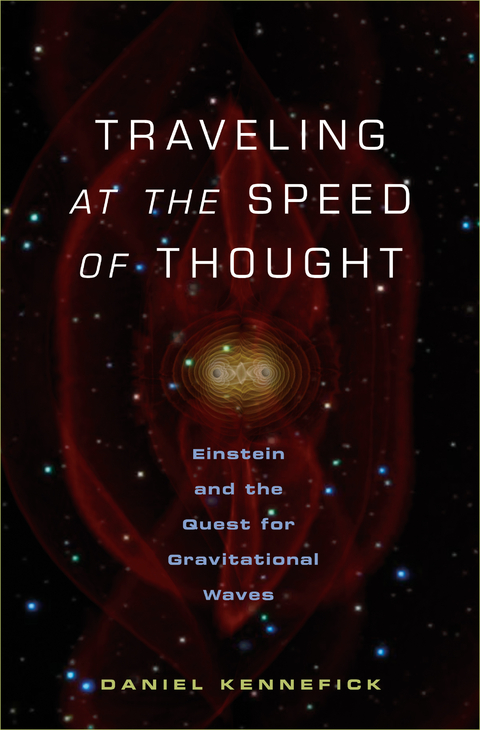
Traveling at the Speed of Thought (eBook)
Princeton University Press (Verlag)
9781400882748 (ISBN)
KennefickDaniel:
Daniel Kennefick is Visiting Assistant Professor of Physics at the University of Arkansas. He is an editor of The Collected Papers of Albert Einstein (Princeton).Daniel Kennefick is Visiting Assistant Professor of Physics at the University of Arkansas. He is an editor of The Collected Papers of Albert Einstein (Princeton).
Since Einstein first described them nearly a century ago, gravitational waves have been the subject of more sustained controversy than perhaps any other phenomenon in physics. These as yet undetected fluctuations in the shape of space-time were first predicted by Einstein's general theory of relativity, but only now, at the dawn of the twenty-first century, are we on the brink of finally observing them. Daniel Kennefick's landmark book takes readers through the theoretical controversies and thorny debates that raged around the subject of gravitational waves after the publication of Einstein's theory. The previously untold story of how we arrived at a settled theory of gravitational waves includes a stellar cast from the front ranks of twentieth-century physics, including Richard Feynman, Hermann Bondi, John Wheeler, Kip Thorne, and Einstein himself, who on two occasions avowed that gravitational waves do not exist, changing his mind both times. The book derives its title from a famously skeptical comment made by Arthur Stanley Eddington in 1922--namely, that "e;gravitational waves propagate at the speed of thought."e; Kennefick uses the title metaphorically to contrast the individual brilliance of each of the physicists grappling with gravitational-wave theory against the frustratingly slow progression of the field as a whole. Accessibly written and impeccably researched, this book sheds new light on the trials and conflicts that have led to the extraordinary position in which we find ourselves today--poised to bring the story of gravitational waves full circle by directly confirming their existence for the very first time.
Daniel Kennefick is Visiting Assistant Professor of Physics at the University of Arkansas. He is an editor of The Collected Papers of Albert Einstein (Princeton).
| Erscheint lt. Verlag | 29.3.2016 |
|---|---|
| Zusatzinfo | 20 halftones. 20 line illus. |
| Verlagsort | Princeton |
| Sprache | englisch |
| Themenwelt | Literatur ► Biografien / Erfahrungsberichte |
| Literatur ► Romane / Erzählungen | |
| Sachbuch/Ratgeber ► Natur / Technik | |
| Geisteswissenschaften ► Geschichte | |
| Naturwissenschaften ► Physik / Astronomie ► Astronomie / Astrophysik | |
| Naturwissenschaften ► Physik / Astronomie ► Thermodynamik | |
| Schlagworte | Absorber • acceleration • Albert Einstein • Analogy • Andrzej Trautman • Anecdote • anti-gravity • Approximation • Astronomer • Astronomical Object • Astronomy • astrophysics • Back action (quantum) • back-reaction • Binary Pulsar • binary star • Bryce DeWitt • Calculation • California Institute of Technology • Celestial mechanics • classical electromagnetism • classical mechanics • coordinate system • Dissipation • earth • Einstein Field Equations • Einstein Papers Project • Einstein tensor • Electromagnetic field • Electromagnetic radiation • electromagnetism • Equations of motion • Equivalence Principle • Felix Pirani • Fred Hoyle • general covariance • General relativity • Gravitational collapse • Gravitational Energy • Gravitational Field • gravitational potential • Gravitational Wave • Graviton • Gravity • Gravity wave • Hermann Bondi • hypothesis • Illustration • Interview • Inverse-square law • Kip Thorne • LIGO • mathematician • Mathematics • Maxwell's equations • Minkowski space • Modern Physics • Nathan Rosen • neutron star • Newton's law of universal gravitation • Orbit • orbital decay • Particle physics • Perihelion and aphelion • Perturbation theory (quantum mechanics) • Peter Bergmann • Photon • physicist • physics beyond the standard model • plane wave • Post-Newtonian expansion • Prediction • Quadrupole • Quadrupole formula • Quantity • quantum field theory • Quantum Gravity • quantum mechanics • Radiation damping • result • Retarded potential • Richard Feynman • Scientist • skepticism • Special relativity • Suggestion • theoretical physics • theory • Theory of relativity • Thomas Gold • Thought experiment • Tidal force • two-body problem • Vladimir Fock • wave equation • Wavefront • Wavelength • Wave power • Wheeler–Feynman absorber theory • Wolfgang Pauli |
| ISBN-13 | 9781400882748 / 9781400882748 |
| Informationen gemäß Produktsicherheitsverordnung (GPSR) | |
| Haben Sie eine Frage zum Produkt? |
 PDF (Wasserzeichen)
Größe: 5,9 MB
DRM: Digitales Wasserzeichen
Dieses eBook enthält ein digitales Wasserzeichen und ist damit für Sie personalisiert. Bei einer missbräuchlichen Weitergabe des eBooks an Dritte ist eine Rückverfolgung an die Quelle möglich.
Dateiformat: PDF (Portable Document Format)
Mit einem festen Seitenlayout eignet sich die PDF besonders für Fachbücher mit Spalten, Tabellen und Abbildungen. Eine PDF kann auf fast allen Geräten angezeigt werden, ist aber für kleine Displays (Smartphone, eReader) nur eingeschränkt geeignet.
Systemvoraussetzungen:
PC/Mac: Mit einem PC oder Mac können Sie dieses eBook lesen. Sie benötigen dafür einen PDF-Viewer - z.B. den Adobe Reader oder Adobe Digital Editions.
eReader: Dieses eBook kann mit (fast) allen eBook-Readern gelesen werden. Mit dem amazon-Kindle ist es aber nicht kompatibel.
Smartphone/Tablet: Egal ob Apple oder Android, dieses eBook können Sie lesen. Sie benötigen dafür einen PDF-Viewer - z.B. die kostenlose Adobe Digital Editions-App.
Buying eBooks from abroad
For tax law reasons we can sell eBooks just within Germany and Switzerland. Regrettably we cannot fulfill eBook-orders from other countries.
 EPUB (Adobe DRM)
Kopierschutz: Adobe-DRM
Adobe-DRM ist ein Kopierschutz, der das eBook vor Mißbrauch schützen soll. Dabei wird das eBook bereits beim Download auf Ihre persönliche Adobe-ID autorisiert. Lesen können Sie das eBook dann nur auf den Geräten, welche ebenfalls auf Ihre Adobe-ID registriert sind.
Details zum Adobe-DRM
Dateiformat: EPUB (Electronic Publication)
EPUB ist ein offener Standard für eBooks und eignet sich besonders zur Darstellung von Belletristik und Sachbüchern. Der Fließtext wird dynamisch an die Display- und Schriftgröße angepasst. Auch für mobile Lesegeräte ist EPUB daher gut geeignet.
Systemvoraussetzungen:
PC/Mac: Mit einem PC oder Mac können Sie dieses eBook lesen. Sie benötigen eine
eReader: Dieses eBook kann mit (fast) allen eBook-Readern gelesen werden. Mit dem amazon-Kindle ist es aber nicht kompatibel.
Smartphone/Tablet: Egal ob Apple oder Android, dieses eBook können Sie lesen. Sie benötigen eine
Geräteliste und zusätzliche Hinweise
Buying eBooks from abroad
For tax law reasons we can sell eBooks just within Germany and Switzerland. Regrettably we cannot fulfill eBook-orders from other countries.
aus dem Bereich