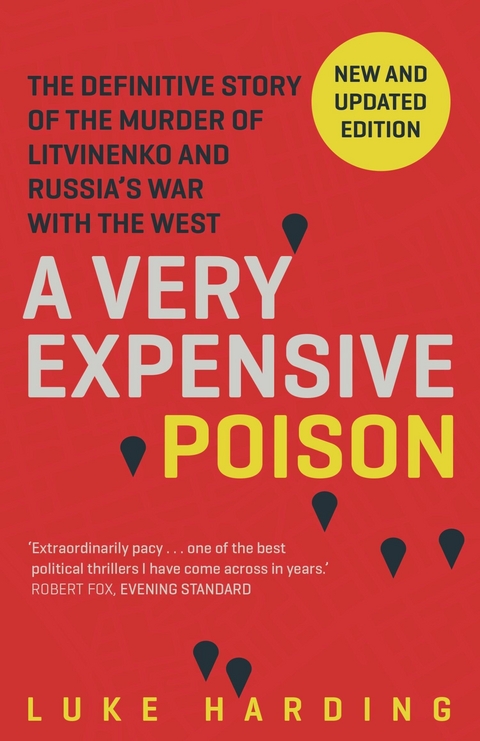
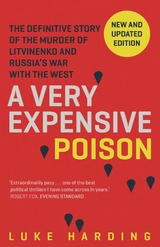
Very Expensive Poison (eBook)
240 Seiten
Guardian Faber Publishing (Verlag)
978-1-78335-095-7 (ISBN)
Luke Harding is an award-winning foreign correspondent with the Guardian. He has reported from Delhi, Berlin and Moscow and has also covered wars in Afghanistan and Iraq, Libya and Syria. Between 2007 and 2011 he was the Guardian's Moscow bureau chief. The Kremlin expelled him from the country in the first case of its kind since the cold war and in summer 2022 put him on an official blacklist. He is the author of Mafia State and co-author of WikiLeaks: Inside Julian Assange's War on Secrecy,The Liar: The Fall of Jonathan Aitken (nominated for the Orwell Prize) and The Snowden Files. Two of Harding's books have been made into films; The Fifth Estate and Snowden.
1 November 2006. Alexander Litvinenko is brazenly poisoned in central London. Twenty two days later he dies, killed from the inside. The poison? Polonium; a rare, lethal and highly radioactive substance. His crime? He had made some powerful enemies in Russia. Based on the best part of a decade's reporting, as well as extensive interviews with those closest to the events (including the murder suspects), and access to trial evidence, Luke Harding's A Very Expensive Poison is the definitive inside story of the life and death of Alexander Litvinenko. Harding traces the journey of the nuclear poison across London, from hotel room to nightclub, assassin to victim; it is a deadly trail that seemingly leads back to the Russian state itself. This is a shocking real-life revenge tragedy with corruption and subterfuge at every turn, and walk-on parts from Russian mafia, the KGB, MI6 agents, dedicated British coppers, Russian dissidents. At the heart of this all is an individual and his family torn apart by a ruthless crime.
Luke Harding is an award-winning foreign correspondent with the Guardian. Between 2007 and 2011 he was the Guardian's Moscow bureau chief; the Kremlin expelled him from the country in the first case of its kind since the cold war. He is the author of Mafia State and co-author of WikiLeaks: Inside Julian Assange's War on Secrecy, The Liar: The Fall of Jonathan Aitken (nominated for the Orwell Prize) and The Snowden Files. Two of Harding's books have been made into films; The Fifth Estate and Snowden.
‘You realise, of course, that you can be poisoned here and we cannot really help you?’
UNKNOWN FSB OFFICER TO ALEXANDER LITVINENKO, BUTYRKA PRISON, MOSCOW, 1999
In September 2006, in London, the exiled Litvinenko put the finishing touches to a secret report. It was explosive stuff. The subject was Viktor Ivanov, one of Vladimir Putin’s closest friends and top advisers. Ivanov was a career KGB officer, the head of Russia’s powerful federal anti-narcotics agency, and one of very few people who had ‘direct access’ to the ear of the president.
Ivanov – so the report alleged – was also a vindictive, sociopathic ‘monster’, with long-standing links to the St Petersburg mafia. This mafia in turn did business with Colombian drug-smugglers. Putin, so the report said, had connections with the same mafia gang in what was Russia’s most criminalised city. He even advised the board of one of the mafia’s front companies.
The report included colourful details about Ivanov’s biography. According to Litvinenko, he’d been a mediocre spy. While his colleagues were sent on important overseas missions, Ivanov had been shuffled into the human resources department of Leningrad’s KGB office – ‘a sort of dump place’, as the report put it, and ‘the dead and gloomy end of a professional career’. It continued: ‘Other KGB men treated human resources people with contempt.’
In human resources, however, Ivanov made useful discoveries. He found himself well placed to collect compromising information on his KGB comrades. He could use this kompromat to destroy other people’s careers. Ivanov also developed a set of personal operational rules that would allow him to thrive in the KGB. And to overleap his more able but less crafty co-workers. His two years serving in Afghanistan – invaded by the Soviet Union in 1979 – confirmed to Ivanov the efficacy of these insights.
Rule one: it was important never to come up with an initiative in the KGB. If you did you’d be asked to implement it and then punished for not doing it successfully. According to the report, Ivanov was silent in meetings. He transformed himself into ‘a sort of professional Mr Nobody’. Rule two: he realised it was necessary to suck up to anybody more senior in the KGB’s hierarchy – to recognise who had ‘more rights in a bureaucratic sense’. The boss was always right.
Ivanov’s rise coincided with the collapse of the Soviet Union, and followed a late-1980s order from the KGB’s top brass to go into business. At the time, the only people who understood the free market were criminals. Ivanov established relations with the Tambovskaya crime gang and its leader Viktor Kumarin, a villain with a mop of dark hair and a neat moustache. Kumarin was then embroiled in a major turf war with his rival Alexander Malyshev, and Malyshev’s gangster army.
The prize was control of St Petersburg’s seaport. The port was a major trans-shipment facility for Colombian drugs, which arrived here before continuing their lucrative journey to Western Europe. According to Litvinenko, Ivanov helped Kumarin wipe out the competition. In return, he got a share of the seaport’s business. The Tambovskaya group structured its criminal activities via a series of subsidiaries and daughter companies; Ivanov set up firms of his own, ‘Block’ and ‘Basis’.
It was the early 1990s. Another KGB spy helped Ivanov. This was Vladimir Putin. Officially, he was no longer with the kontora – as the KGB styled itself. Instead, he was working for St Petersburg’s new mayor, Anatoly Sobchak. As every recruit knew, though, hardly anybody ever quite leaves the KGB. The two spies, Ivanov and Putin, had something else in common: the KGB had marked them down as second-raters, mediocrities unfit for high office, something they must have resented.
Litvinenko’s report said: ‘Ironically, while Ivanov was cooperating with the gangsters, he was promoted to the operational department of [the] fight against smuggling and became its boss. His former subordinates described him as a monster boss – rude, authoritative and stubborn. It was a time when the line between the law enforcement officers and professional criminals was often very thin.’
The next paragraph reads: ‘While Ivanov was cooperating with gangsters, he was protected by Vladimir Putin, who was responsible for foreign economic relations at the office of St Petersburg mayor Anatoly Sobchak.’ It adds: ‘Putin was himself not Mr Clean at that time.’
This was something of an understatement. Links between Putin and the criminal underworld turned up in all sorts of places. The report quoted leaked tape-recordings made in 2000 of Leonid Kuchma, Ukraine’s then-president, who said his own spy agency had got hold of documents concerning a German company named SPAG that was a front for criminal activities. Its main job was ‘laundering [the] money of a Colombian drug cartel by buying out real estate in St Petersburg’. Kumarin, the gangster, sat on the board of a SPAG daughter company. Putin, in the mayor’s office, was SPAG’s adviser.
Gangsters, cocaine, the KGB, spies, sleaze, millions of dollars in cash – all of it on Europe’s doorstep, as Russia morphed in the late twentieth century from communist dictatorship to a new and murky form of hyper-capitalism. It was, as the report frankly put it, a ‘weird time’. The masters of this changing universe were organised criminals and their upwardly mobile friends in Russian politics. What Ivanov and Putin were allegedly doing wasn’t unusual for the standards of the time: taking a cut here, a bribe there. Everybody did that, given a chance.
What was unusual was that they would go on to rule the Russian Federation.
*
Litvinenko’s 2006 report amounted to an eight-page hand grenade, tossed into the control room of Russian power. It was written for RISC management, a British security company based in London. RISC specialised in due diligence. This meant carrying out extensive checks on Russian firms and prominent individuals at the behest of western businesses. Such reports involved a mixture of official and more sensitive secret sources.
Litvinenko provided the detail on the St Petersburg mafia and its activities in the 1990s. Another exile actually wrote the report, a former KGB major called Yuri B. Shvets. Shvets was everything that Putin and Ivanov weren’t. He was an intelligent and enterprising secret agent blessed with literary gifts. Tall, handsome, and with a sweeping mane of dark black hair, he looked every inch the romantic spy abroad. The KGB had recruited him in 1980, inviting him to join its prestigious external intelligence service, the First Chief Directorate.
Shvets had studied at the Patrice Lumumba People’s Friendship University in Moscow. It was, he wrote, a surprisingly liberal institution by the standards of the late USSR, which attracted young men and women from ninety different countries. He described himself in his memoir as ‘neither a convinced communist nor a dissident’. Not all of the university’s students were so politically ambivalent: one of Shvets’s predecessors was a Marxist-Leninist from Venezuela named Ilich Ramirez Sanchez. Sanchez, Shvets wrote later, was not your typical student, spending most of his time away and abroad. He would become better known as the terrorist Carlos the Jackal.
After graduation, Shvets spent two years at the Yuri Andropov Red Banner Intelligence Institute. The KGB training school was based in a pleasant forest in Yurlovo, not far from Moscow. There, he said, he was taught the secrets of the trade. He learned from legendary spymasters who had worked with the Cold War’s most famous western defectors – the Rosenbergs, who stole the US’s atomic secrets, and the upper-class Cambridge spy ring, Kim Philby, Guy Burgess and Donald Maclean.
Shvets also did a two-month training stint with a Spetsnaz or special forces unit. He parachuted from planes, learned how to handle a variety of weapons and to plant mines. He was taught how to blow up bridges and to interrogate enemy prisoners. He learned guerrilla tactics. He was instructed not to think or query the state. Shvets recalled how one wiry paratrooper colonel told him: ‘Your duty is to execute, at any cost, any task assigned by our motherland.’
One of Shvets’s classmates at the KGB academy was Putin. Putin had grown up in a working-class family in Leningrad; an older brother died during the Nazi siege of the city; his grandfather was Lenin’s cook. As a teenager he learned judo to defend himself from neighbourhood toughs. From an early age he aspired to join the KGB, inspired – he later said – by the Soviet TV spy drama The Shield and the Sword. He studied law. The KGB recruited him in 1975 after he finished Leningrad University.
Putin’s world view reflected the a priori thinking of the KGB. The agency was suspicious, paranoid and prone to conspiratorial reasoning. Putin was convinced that the US and the western world were engaged in an unsleeping plot against the Soviet Union.
Virtually all the graduates from the KGB institute got jobs afterwards in the first directorate and were sent to foreign ‘residencies’, as the KGB termed its covert offices abroad. For reasons which are mysterious, Putin didn’t make the grade, Shvets believed. ‘Putin belonged to the 1 per cent of losers. He was sent back to St Petersburg,’ he said later. Others say Putin went back to his home city and was given...
| Erscheint lt. Verlag | 11.2.2016 |
|---|---|
| Verlagsort | London |
| Sprache | englisch |
| Themenwelt | Literatur ► Biografien / Erfahrungsberichte |
| Literatur ► Krimi / Thriller / Horror | |
| Literatur ► Romane / Erzählungen | |
| Sachbuch/Ratgeber ► Geschichte / Politik ► Politik / Gesellschaft | |
| Recht / Steuern ► Strafrecht ► Kriminologie | |
| Sozialwissenschaften ► Politik / Verwaltung ► Staat / Verwaltung | |
| Schlagworte | Litvinenko • New Cold War • Polonium • Putin • radioactive poisoning • russian poisoning • Sergei Skripal |
| ISBN-10 | 1-78335-095-4 / 1783350954 |
| ISBN-13 | 978-1-78335-095-7 / 9781783350957 |
| Informationen gemäß Produktsicherheitsverordnung (GPSR) | |
| Haben Sie eine Frage zum Produkt? |
 EPUB (Adobe DRM)
Kopierschutz: Adobe-DRM
Adobe-DRM ist ein Kopierschutz, der das eBook vor Mißbrauch schützen soll. Dabei wird das eBook bereits beim Download auf Ihre persönliche Adobe-ID autorisiert. Lesen können Sie das eBook dann nur auf den Geräten, welche ebenfalls auf Ihre Adobe-ID registriert sind.
Details zum Adobe-DRM
Dateiformat: EPUB (Electronic Publication)
EPUB ist ein offener Standard für eBooks und eignet sich besonders zur Darstellung von Belletristik und Sachbüchern. Der Fließtext wird dynamisch an die Display- und Schriftgröße angepasst. Auch für mobile Lesegeräte ist EPUB daher gut geeignet.
Systemvoraussetzungen:
PC/Mac: Mit einem PC oder Mac können Sie dieses eBook lesen. Sie benötigen eine
eReader: Dieses eBook kann mit (fast) allen eBook-Readern gelesen werden. Mit dem amazon-Kindle ist es aber nicht kompatibel.
Smartphone/Tablet: Egal ob Apple oder Android, dieses eBook können Sie lesen. Sie benötigen eine
Geräteliste und zusätzliche Hinweise
Buying eBooks from abroad
For tax law reasons we can sell eBooks just within Germany and Switzerland. Regrettably we cannot fulfill eBook-orders from other countries.
aus dem Bereich