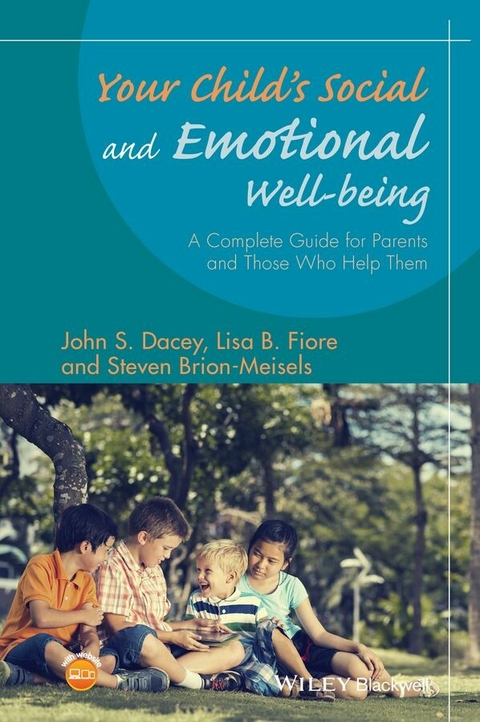
Your Child's Social and Emotional Well-Being (eBook)
John Wiley & Sons (Verlag)
978-1-118-97704-0 (ISBN)
- A practical guide designed to support parents and education professionals in developing social and emotional skills in children, a form of learning that can be neglected in formal education
- Demonstrates how to foster social and emotional learning (SEL) at home and in the classroom, and shows how parents and professionals can work together for success
- Includes a wealth of exercises for promoting social and emotional wellbeing, along with tips, tools, and coverage of new developments such as computer-assisted instruction
- Written by authors with a wealth of practical and writing experience
John S. Dacey teaches courses in creativity and human development at the College of Arts and Sciences at Boston College in Chestnut Hill, MA. He also runs a practice as a licensed psychotherapist. He is the author of 14 books on the subjects of anxiety, creativity and human development, including Your Anxious Child (Wiley 2000).
Lisa B. Fiore is Professor and Dean of Faculty in the Graduate School of Education, Lesley University, Cambridge, MA. She is an expert on social and emotional learning, giving workshops and conference presentations, as well as a licensed Early Childhood teacher.
Steven Brion-Meisels (1949-2014) worked in schools for over 40 years teaching and writing about social and emotional development, peace-making, and building democratic classrooms. Among other accomplishments, Steven was a founding and long-time member of the Peaceable Schools and Communities Project and a founding member of the Social-Emotional Alliance of Massachusetts.Your Child's Social and Emotional Well-Being provides a practical guide full of proven strategies for promoting social and emotional learning (SEL) skills in children aged 4-16. A practical guide designed to support parents and education professionals in developing social and emotional skills in children, a form of learning that can be neglected in formal education Demonstrates how to foster social and emotional learning (SEL) at home and in the classroom, and shows how parents and professionals can work together for success Includes a wealth of exercises for promoting social and emotional wellbeing, along with tips, tools, and coverage of new developments such as computer-assisted instruction Written by authors with a wealth of practical and writing experience
John S. Dacey teaches courses in creativity and human development at the College of Arts and Sciences at Boston College in Chestnut Hill, MA. He also runs a practice as a licensed psychotherapist. He is the author of 14 books on the subjects of anxiety, creativity and human development, including Your Anxious Child (Wiley 2000). Lisa B. Fiore is Professor and Dean of Faculty in the Graduate School of Education, Lesley University, Cambridge, MA. She is an expert on social and emotional learning, giving workshops and conference presentations, as well as a licensed Early Childhood teacher. Steven Brion-Meisels (1949-2014) worked in schools for over 40 years teaching and writing about social and emotional development, peace-making, and building democratic classrooms. Among other accomplishments, Steven was a founding and long-time member of the Peaceable Schools and Communities Project and a founding member of the Social-Emotional Alliance of Massachusetts.
Title Page 5
Copyright Page 6
Contents 9
Acknowledgments 11
About the Companion Website 12
Chapter 1 All Children Need Social and Emotional Well-being 13
An Example of SEL 17
Reciprocal Development and Sel 18
A Brief History of the Sel Movement 19
Parent–Teacher Alliances Need Support 21
Using our Strategies to Teach Sel 22
Part I Self-awareness 23
Chapter 2 Building Character 25
Forming Character: Awareness and Openness 27
Building Character: Transcultural Experience 31
My Mexican Childhood 32
Building Character: Humility 34
Building Character: Modeling 37
My Role-modeling Parents 37
Building Character: Courage 39
Malala Yousafzai: “The Bravest Girl in the World” 39
Building Character: Clear Values 42
Undesirable Character Traits 44
Chapter 3 Practicing Mindfulness 49
Activities that Foster Awareness 51
Activities that Foster Accurate Decision-Making 59
If She Could Only Tell Me What’s Wrong! 59
Part II Self-management 65
Chapter 4 Resiliency: Calming Fears and Anxiety 67
Chapter 5 Independent Thinking 83
Activities that Foster Exploration 85
Activities that Foster Multiple Perspectives 89
Activities that Foster Conviction in One’s Instincts 92
Chapter 6 Self-regulating 99
Old Abe, the Rock 99
What Self–regulation Means 100
Delay of Gratification 103
Locus of Control 106
Risk-Taking 108
The Shapiro Model—Yielding 110
Realistic Expectations 112
Scaffolding 113
Homework 115
Fluency and Flexibility of Self-Control Strategies 116
When to Withdraw Support 117
Part III Social Awareness 119
Chapter 7 Competing and Cooperating 121
Competition, Cooperation, and CASEL 122
Activities that Foster Better Competition 123
Activities that Foster Better Cooperation 127
Activities that Foster Cooperation and Competition 131
Chapter 8 Neither Being Bullied nor Being a Bully 135
Activities that Promote Empathy 138
Conflict Resolution and Negotiation 141
Activities that Promote Positive Group Interaction 143
Part IV Relationship Skills 147
Chapter 9 Building Successful Friendships 149
Activities that Foster Compassion 150
Activities that Foster Tolerance and Appreciation 155
Activities that Foster Connectedness 158
Chapter 10 Demonstrating Leadership 165
The Army Leadership Challenge 168
Activities that Promote Understanding of Power 168
Activities that Promote Self-awareness 173
Part V Responsible Decision-making 181
Chapter 11 Thinking Creatively 183
Fluency 187
Flexibility 189
Originality 192
Elaboration 194
Chapter 12 Thinking Critically and Wisely 201
Activities that Foster Recognition and Prediction 203
Activities that Foster Discernment 207
Activities that Promote Ethical Reflection 212
Part VI Achieving Your Goals Even More Effectively 217
Chapter 13 Getting Help with Your Efforts 219
Support for Caregivers and Teachers 220
Actions that Create Support in the School Context 225
Actions that Generate Support from External Resources 227
Chapter 14 The Future of SEL 233
Greater Importance of SEL 233
Facilitation of Sel Goals 234
Return of the Arts 237
Online Sel 237
Non-Classroom Settings for Sel 238
Non-School Settings for Sel 238
More Caring Citizens 238
More Research 239
References 241
Index 251
EULA 257
| Erscheint lt. Verlag | 2.3.2016 |
|---|---|
| Sprache | englisch |
| Themenwelt | Sachbuch/Ratgeber ► Gesundheit / Leben / Psychologie ► Familie / Erziehung |
| Geisteswissenschaften ► Psychologie ► Entwicklungspsychologie | |
| Sozialwissenschaften ► Pädagogik ► Didaktik | |
| Schlagworte | Bildungswesen • Biopsychosocial • Bullying • childrens wellbeing • Education • Educational & School Psychology • Educators • emotional skills • emotional wellbeing • Erziehung • Erziehungs- u. Schulpsychologie • K-12 • K-12 / Lehren u. Lernen • Less Testing • Mindfulness in education • non-cognitive development • parenting • Psychologie • Psychology • Ratgeber • Ratgeber Erziehung • Relationship Skills • responsible decision-making • School Counselors • SEL • Self-Help • self-management • social awareness • Social-Emotional Learning and Development • social-emotional skills • Social Skills • social wellbeing • Teaching & Learning (K-12) |
| ISBN-10 | 1-118-97704-1 / 1118977041 |
| ISBN-13 | 978-1-118-97704-0 / 9781118977040 |
| Informationen gemäß Produktsicherheitsverordnung (GPSR) | |
| Haben Sie eine Frage zum Produkt? |
 PDF (Adobe DRM)
Kopierschutz: Adobe-DRM
Adobe-DRM ist ein Kopierschutz, der das eBook vor Mißbrauch schützen soll. Dabei wird das eBook bereits beim Download auf Ihre persönliche Adobe-ID autorisiert. Lesen können Sie das eBook dann nur auf den Geräten, welche ebenfalls auf Ihre Adobe-ID registriert sind.
Details zum Adobe-DRM
Dateiformat: PDF (Portable Document Format)
Mit einem festen Seitenlayout eignet sich die PDF besonders für Fachbücher mit Spalten, Tabellen und Abbildungen. Eine PDF kann auf fast allen Geräten angezeigt werden, ist aber für kleine Displays (Smartphone, eReader) nur eingeschränkt geeignet.
Systemvoraussetzungen:
PC/Mac: Mit einem PC oder Mac können Sie dieses eBook lesen. Sie benötigen eine
eReader: Dieses eBook kann mit (fast) allen eBook-Readern gelesen werden. Mit dem amazon-Kindle ist es aber nicht kompatibel.
Smartphone/Tablet: Egal ob Apple oder Android, dieses eBook können Sie lesen. Sie benötigen eine
Geräteliste und zusätzliche Hinweise
Buying eBooks from abroad
For tax law reasons we can sell eBooks just within Germany and Switzerland. Regrettably we cannot fulfill eBook-orders from other countries.
aus dem Bereich