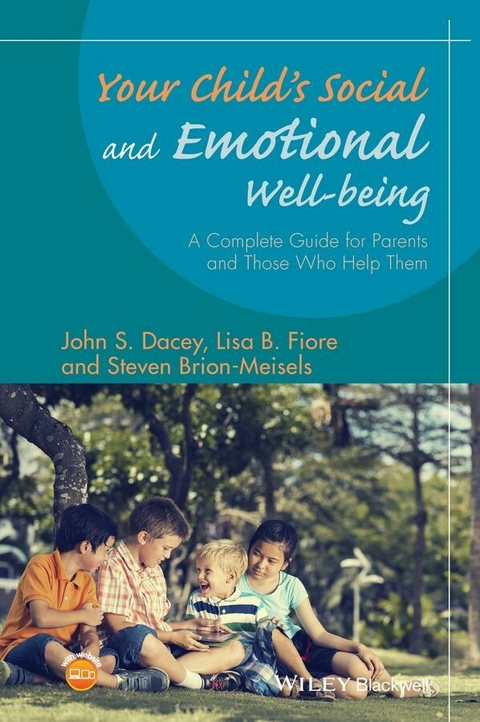
Your Child's Social and Emotional Well-Being (eBook)
John Wiley & Sons (Verlag)
978-1-118-97623-4 (ISBN)
- A practical guide designed to support parents and education professionals in developing social and emotional skills in children, a form of learning that can be neglected in formal education
- Demonstrates how to foster social and emotional learning (SEL) at home and in the classroom, and shows how parents and professionals can work together for success
- Includes a wealth of exercises for promoting social and emotional wellbeing, along with tips, tools, and coverage of new developments such as computer-assisted instruction
- Written by authors with a wealth of practical and writing experience
John S. Dacey teaches courses in creativity and human development at the College of Arts and Sciences at Boston College in Chestnut Hill, MA. He also runs a practice as a licensed psychotherapist. He is the author of 14 books on the subjects of anxiety, creativity and human development, including Your Anxious Child (Wiley 2000).
Lisa B. Fiore is Professor and Dean of Faculty in the Graduate School of Education, Lesley University, Cambridge, MA. She is an expert on social and emotional learning, giving workshops and conference presentations, as well as a licensed Early Childhood teacher.
Steven Brion-Meisels (1949-2014) worked in schools for over 40 years teaching and writing about social and emotional development, peace-making, and building democratic classrooms. Among other accomplishments, Steven was a founding and long-time member of the Peaceable Schools and Communities Project and a founding member of the Social-Emotional Alliance of Massachusetts.Your Child's Social and Emotional Well-Being provides a practical guide full of proven strategies for promoting social and emotional learning (SEL) skills in children aged 4-16. A practical guide designed to support parents and education professionals in developing social and emotional skills in children, a form of learning that can be neglected in formal education Demonstrates how to foster social and emotional learning (SEL) at home and in the classroom, and shows how parents and professionals can work together for success Includes a wealth of exercises for promoting social and emotional wellbeing, along with tips, tools, and coverage of new developments such as computer-assisted instruction Written by authors with a wealth of practical and writing experience
John S. Dacey teaches courses in creativity and human development at the College of Arts and Sciences at Boston College in Chestnut Hill, MA. He also runs a practice as a licensed psychotherapist. He is the author of 14 books on the subjects of anxiety, creativity and human development, including Your Anxious Child (Wiley 2000). Lisa B. Fiore is Professor and Dean of Faculty in the Graduate School of Education, Lesley University, Cambridge, MA. She is an expert on social and emotional learning, giving workshops and conference presentations, as well as a licensed Early Childhood teacher. Steven Brion-Meisels (1949-2014) worked in schools for over 40 years teaching and writing about social and emotional development, peace-making, and building democratic classrooms. Among other accomplishments, Steven was a founding and long-time member of the Peaceable Schools and Communities Project and a founding member of the Social-Emotional Alliance of Massachusetts.
Acknowledgments ix
About the Companion Website x
1 All Children Need Social and Emotional Well-being 1
Part I Self-awareness 11
2 Building Character 13
3 Practicing Mindfulness 37
Part II Self-management 53
4 Resiliency: Calming Fears and Anxiety 55
5 Independent Thinking 71
6 Self-regulating 87
Part III Social Awareness 107
7 Competing and Cooperating 109
8 Neither Being Bullied nor Being a Bully 123
Part IV Relationship Skills 135
9 Building Successful Friendships 137
10 Demonstrating Leadership 153
Part V Responsible Decision-making 169
11 Thinking Creatively 171
12 Thinking Critically and Wisely 189
Part VI Achieving Your Goals Even More Effectively 205
13 Getting Help with Your Efforts 207
14 The Future of SEL 221
References 229
Index 239
1
All Children Need Social and Emotional Well-being
The survival of the human race depends at least as much on the cultivation of social and emotional intelligence as it does on the development of technological knowledge and skills.1
The need to refocus American schools on the holistic development of children is profound. One national survey discovered, for example, that among 148,000 middle and high school students, well under half felt they had developed social competencies such as empathy, decision-making, and conflict resolution skills. Only 29% indicated that their school provided caring, encouraging environments. Other research has found that as many as 60% of students become chronically disengaged from school, and 30% of high school students engage in multiple high risk behaviors such as substance abuse, sexual activity, violence, and attempted suicide.2
“Refocus schools on the holistic development of children”? The rising tide of dysfunctional behaviors throughout the world clearly supports social and emotional, as well as academic, learning.3 Unfortunately, joining these three goals is not likely to be pursued any time soon. The “whole child” and “well-being” are objectives most parents favor for their children, but not if they get in the way of going to a good college or getting a good job. Since teaching for holistic well-being tends to take time from academic learning, it is most often remanded to the back burner of the educational stove.
Let’s take a closer look at well-being, which refers to “the psychological capacity to cope with the demands arising across time, circumstances, and setting.” In this book, we call training for well-being “social and emotional learning (SEL).” In international education, SEL is known by a variety of names: “education for mutual understanding,” “peace education,” “values education,” “multicultural/intercultural education,” “human rights education,” “life skills,” “citizenship, humanitarian or emotional education,” “emotional intelligence,” and “education for sustainable development.”4 Depending on the area of the world, the meaning of SEL also differs somewhat:
Whereas Europe and Latin America commonly emphasize [SEL] links with human rights, Asia and sub-Saharan Africa highlight connections with a return to indigenous, cultural and religious values. Other differences exist across countries, such as a strong focus on the importance of citizenship education in enhancing national economic productivity in some places, and the role of citizenship education and the prevention of aggression and violence in others.5
We distinguish SEL from the other educational goal most societies have: academic learning (AL). AL refers to learning the knowledge and skills of the several subject-matter areas (math, science, etc.). We wish both SEL and AL would take place in schools everywhere. However, with so many countries concentrating on teaching and measuring AL, this goal appears unlikely. Therefore, we believe that for the most part, SEL will have to be fostered by parents and other adult members of the family.
Most of us agree on what social/emotional traits we want our children to learn in life. They need to:
- Know who they are and be mindful of the repercussions of their actions.
- Control themselves and make good judgments.
- Refrain from drug and alcohol abuse and abstain from premature sexual activity.
- Understand when to compete and when to cooperate.
- Neither bully nor be bullied.
- Build successful friendships and to become a leader when appropriate.
- Think critically and be creative problem finders and solvers.
In short, we want children to have social and emotional well-being. And this, of course, derives from SEL. Some parents think that schools should provide this instruction. Others believe it ought to take place at home. Wherever you think it ought to happen, clearly it isn’t happening enough. Here’s an example of what we mean:
In one ninth-grade class, a group of bored students calling themselves the “Six Sexy Sisters” decided to see if they could “bounce” some other girl from their school. They wondered if they could actually get her to transfer to another school without them getting caught. To add to the challenge, they chose their victim from among ordinary girls, not someone with an obvious handicap. They put 10 names into a hat and drew out a slip with Jessica C. on it. Then they began their online bullying campaign:
- When Jessica posted her Sweet 16 pictures online, they wrote anonymously “I'd rather cut off my arm than touch you, you’re so ugly!”
- Another post: “Only cool girls wear the kind of pants you had on today, and you shouldn't wear them, because you are definitely not cool!”
- In an orchestrated attack, the girls signed onto a site, registering as Jennifer. Several members on the site were then attacked, and Jessica was blamed.
- Posing as a guy named Fred, they wrote on Jessica’s Facebook page, “I hate u, everyone hates u … u should just die!”
- Using her boyfriend’s name, they posted that he thought she was “just a slutty girl,” and was through with her.
Jessica's school is in a state that has a mandated school policy: no tolerance for bullying. When Jessica complained to the principal, naming the six girls she suspected were bullying her, he asked each of the girls if she were guilty. Each denied participating, so the principal issued an announcement to all students that he would not tolerate bullying, thus fulfilling what he thought the mandate called for. The SSSs continued their vicious attacks with impunity. Now Jessica’s family is suing the principal and district for nearly $2 million. They have a good chance of getting this money, which, of course, the district can ill afford. Would this have happened if this school had offered SEL instruction?
As reported in an online study, “Eighty percent of teens say they have read or spread gossip online; more than 50% say they have seen Web sites that made fun of their peers. Yet there seems to be a code of silence—what happens online stays online—leaving those who might help, in school and at home, in the dark”.6
So how should society address social and emotional learning? One educational specialist answers this way: “SEL has gained traction in recent years, driven in part by concerns over school violence, bullying and teen suicide. But while prevention programs tend to focus on a single problem, the goal of SEL is grander: to instill a deep psychological intelligence that will help children regulate their emotions.”7 Teachers used to include SEL in their curricula, but not many do any more.
You will find few cross-disciplinary class projects, creativity exercises, or anti-bullying lessons these days in classrooms in the western world. The east is not that different.8 Most educators are too busy imparting facts and academic skills, because their very jobs depend on how well their students succeed on high-stakes tests. These mostly multiple-choice tests primarily measure factual knowledge. Of course our children need to know these facts, but they must also experience and use SEL.
From newspaper headlines to parenting journals and forums, in parent-teacher groups and along the sidelines at school sporting events, SEL is becoming a hot topic. A national group, the Collaborative for Academic, Social and Emotional Learning (CASEL), has been formed, and about a third of the states in the United States have CASEL associations. Many teachers support and belong to these groups, as they are unhappy with the current situation, too. Most did not go into the profession so they could drill children on facts. As one Seattle teacher puts it, “I am opposed to these tests because they narrow what education is supposed to be about. I think collaboration, imagination, and critical thinking skills are all left off these tests and can’t be assessed by circling A, B, C, or D.”9 Many teachers would like to include SEL in the curriculum, but only if the instruction meets one of the Common Core State Standards. Because large numbers of parents have given up on changing school objectives, they are ready to pursue the goals of SEL in their own homes, on their own. Both groups want to learn how, but it looks like parents will have to take the lead.
Here is how one family researcher put it: “This is the actual crisis of parenting today—not whether we’re breast feeding too little or ‘helicoptering’ too much, or feeding our kids the French way or teaching piano with Tiger ferocity, but whether we’re abdicating our biggest responsibility—to make sure kids treat each other [and themselves] humanely.”10 This concern is not new. Eight years ago, Professor Jonathan Cohen, in a cogent article in the Harvard Educational Review, warned us about the looming problem in most U.S. classrooms:
If federal and state policymakers and education colleges continue to ignore the importance of social/emotional competencies, I believe this amounts to a violation of human rights. Our children...
| Erscheint lt. Verlag | 2.3.2016 |
|---|---|
| Sprache | englisch |
| Themenwelt | Sachbuch/Ratgeber ► Gesundheit / Leben / Psychologie ► Familie / Erziehung |
| Geisteswissenschaften ► Psychologie ► Entwicklungspsychologie | |
| Sozialwissenschaften ► Pädagogik ► Didaktik | |
| Schlagworte | Bildungswesen • Biopsychosocial • Bullying • childrens wellbeing • Education • Educational & School Psychology • Educators • emotional skills • emotional wellbeing • Erziehung • Erziehungs- u. Schulpsychologie • K-12 • K-12 / Lehren u. Lernen • Less Testing • Mindfulness in education • non-cognitive development • parenting • Psychologie • Psychology • Ratgeber • Ratgeber Erziehung • Relationship Skills • responsible decision-making • School Counselors • SEL • Self-Help • self-management • social awareness • Social-Emotional Learning and Development • social-emotional skills • Social Skills • social wellbeing • Teaching & Learning (K-12) |
| ISBN-10 | 1-118-97623-1 / 1118976231 |
| ISBN-13 | 978-1-118-97623-4 / 9781118976234 |
| Informationen gemäß Produktsicherheitsverordnung (GPSR) | |
| Haben Sie eine Frage zum Produkt? |
 EPUB (Adobe DRM)
Kopierschutz: Adobe-DRM
Adobe-DRM ist ein Kopierschutz, der das eBook vor Mißbrauch schützen soll. Dabei wird das eBook bereits beim Download auf Ihre persönliche Adobe-ID autorisiert. Lesen können Sie das eBook dann nur auf den Geräten, welche ebenfalls auf Ihre Adobe-ID registriert sind.
Details zum Adobe-DRM
Dateiformat: EPUB (Electronic Publication)
EPUB ist ein offener Standard für eBooks und eignet sich besonders zur Darstellung von Belletristik und Sachbüchern. Der Fließtext wird dynamisch an die Display- und Schriftgröße angepasst. Auch für mobile Lesegeräte ist EPUB daher gut geeignet.
Systemvoraussetzungen:
PC/Mac: Mit einem PC oder Mac können Sie dieses eBook lesen. Sie benötigen eine
eReader: Dieses eBook kann mit (fast) allen eBook-Readern gelesen werden. Mit dem amazon-Kindle ist es aber nicht kompatibel.
Smartphone/Tablet: Egal ob Apple oder Android, dieses eBook können Sie lesen. Sie benötigen eine
Geräteliste und zusätzliche Hinweise
Buying eBooks from abroad
For tax law reasons we can sell eBooks just within Germany and Switzerland. Regrettably we cannot fulfill eBook-orders from other countries.
aus dem Bereich