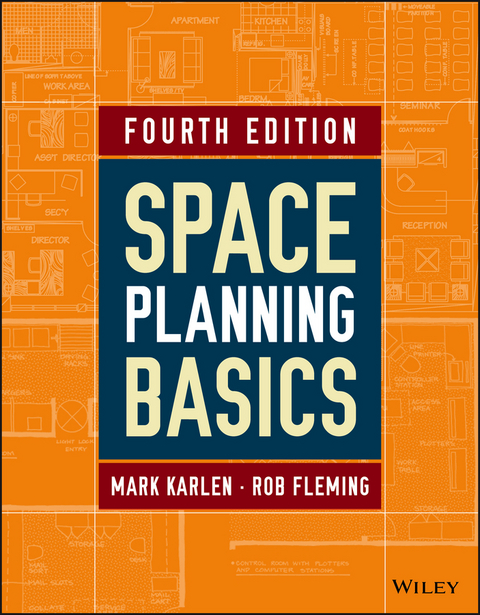
Space Planning Basics (eBook)
John Wiley & Sons (Verlag)
978-1-118-88259-7 (ISBN)
Conquer the complexity of interior design with a logical, methodical approach
Space Planning Basics is a definitive introduction and principle resource for thousands of designers. With step-by-step methodology based on the author's several decades of design experience, this authoritative guide has become the de facto reference for an entire generation of designers. This updated fourth edition includes digitized drawings, diagrams, and matrices throughout, and newly added supplemental photographs. The text has been revised to reflect the latest developments in sustainable and universal design, including coverage of daylighting, benchmarking, LEED system standards, and green code issues. The companion website provides AutoCAD files, intrustor videos and matrices to give you a deeper real-world understanding of the design process. This book is perfect preparation for the NCIDQ exam.
Proper space planning goes way beyond sketching a preliminary floor plan. Successful implementation includes a balanced integration of code compliance, system support, and adherence to the client's functional needs. Sustainability adds a new, important layer of complexity. This book shows you how to approach space planning in a way that ensures all considerations are met, and nothing gets lost in the process.
- Adopt an organized and comprehensive planning methodology
- Work effectively with dimensionally challenging spaces
- Consider building systems, codes, lighting, acoustics, and more
- Develop advanced skills and conquer new challenges
Space planning encompasses many components and processes, making a comprehensive reference necessary for mastery of the field. Space Planning Basics is a thorough, methodical resource that gets you started on the right track, with plenty of room for creativity.
MARK KARLEN, PHD, AIA, has been practicing, teaching, and writing about interior design and architecture for several decades. A practicing architect, he currently teaches at Philadelphia University, in Pennsylvania.
ROB FLEMING, AIA, LEED® AP BD&C, co-founded the Master of Science in Sustainable Design at Philadelphia University, where he currently serves as the Program Director.
MARK KARLEN, PHD, AIA, has been practicing, teaching, and writing about interior design and architecture for several decades. A practicing architect, he currently teaches at Philadelphia University, in Pennsylvania. ROB FLEMING, AIA, LEED¯® AP BD&C, co-founded the Master of Science in Sustainable Design at Philadelphia University, where he currently serves as the Program Director.
Preface. ix
Introduction. xi
Chapter 1 Planning Methodology 1
Defining Terms and Intent 2
The Synthesis Gap 3
The Design Program 5
Criteria Matrix 12
Prototypical Plan Sketches 14
Completing the Criteria Matrix 21
Relationship Diagrams 28
A Final Note on Planning Methodology 33
Recommended Reading 34
Chapter 2 The First Planning Steps: Bubble Diagrams and Block Plans 35
Bubble Diagramming 35
Space Planning Exercises 41
Block Planning 42
Recommended Reading 46
Chapter 3 Small and Dimensionally Demanding Spaces 47
Human Factors 52
Barrier-Free Design Standards 53
Travel and Egress 54
Furniture Planning and Placement 59
Recommended Reading 62
Chapter 4 The Building Shell and Major Systems 63
The Building Shell 64
Plumbing Systems 67
Heating, Ventilating, and Air-Conditioning Systems 69
Recommended Reading 72
Chapter 5 Important Influencing Factors 73
Building Codes 73
Green Building Rating Systems 75
Lighting Design 75
Acoustical Planning 81
Planning Rules of Thumb 84
Flexibility/Multiuse 85
Furniture 86
Spatial Quality 86
Interior Design Specialties 87
Recommended Reading 88
Chapter 6 Developing a Rough Floor Plan 91
Getting Started 93
Construction Reality 94
Start with Plumbing 95
Major Spaces Next 96
Circulation Spaces 96
Basic Room Allocations 98
Furniture and Equipment 98
Storage and Filing 101
Spatial Quality 101
Sustainability Objectives 103
Review 103
Revisions 105
Recommended Reading 109
Chapter 7 Refining the Solution 111
Refining the Rough Plan 112
The Preliminary Floor Plan 113
Drawing Quality and Techniques 114
Recommended Reading 124
Chapter 8 Developing Skills beyond the Basic Level 125
Basic Implications 125
Programs within Programs 127
Open Plan/Systems Furniture 129
The Speculative Office Building 130
Future Expansion 131
Planning New Buildings 132
A Final Note 134
Chapter 9 Stair Design Basics 135
Codes, Dimensions, and Configurations 148
Stair Design Case Studies--Phase I 168
Stair Design Case Studies--Phase II 179
Recommended Reading 189
Appendix A: Stair Terminology. 191
Appendix B: Design Programs and Building Shells. 193
Design Program 1A: Suite for Dual Pediatric Practice 193
Design Program 1B: Township Youth Organization 195
Design Program 1C: A Small Accounting Firm Suite 197
Design Program 2A: Regional Management Office 199
Design Program 2B: Popular Culture Institute 201
Design Program 2C: Meeting/Marketing Facility 204
Design Program 2S: University Career Counseling Center 206
Design Program 3A: Market Research Group 209
Design Program 3B: The Cosmopolitan Club 212
Design Program 3C: Community Counseling Consortium 213
BUILDING SHELLS 216
Building Description 1A 216
Building Description 1B 218
Building Description 1C 219
Building Description 2A 220
Buiding Description 2B 222
Building Description 2C 223
Building Description 2S 225
Building Description 3A 225
Building Description 3B 228
Building Description 3C 229
Index. 231
1
Planning Methodology
Space planners are presented with their task in a great variety of ways. Most users or clients are inexperienced in working with planning professionals and present their space planning problems without significantly prepared data. It is not uncommon for a business owner or manager to come to an interior designer and say, in effect, “Our staff has grown by 60 percent over the past few years, and we are still growing at a very fast rate. Our space is terribly overcrowded; what should we do?” In cases of this kind, the designer must begin with the basic tasks of charting organizational structure; identifying personnel, their tasks, and necessary equipment; analyzing the operational process; identifying important sustainability factors; and gaining an understanding of the human and cultural qualities of the organization. In effect, the planning professional must take full responsibility for organizing, analyzing, and interpreting the problem at hand.
At the other extreme are clients with considerable experience in space planning, and who may also have an in-house facilities manager or staff. They may present the designer or architect with extensive data on the number and types of personnel (including their equipment and square footage needs), spatial adjacency studies, and the desired human and esthetic qualities of the completed project—in effect, a complete space planning program. In such cases, you are relieved of the responsibility of data gathering, organization, and analysis. Obviously, the designer must fully absorb and understand the design problem or program that is presented, and may need to perform some tasks of program interpretation. These issues are discussed later in this chapter.
There is a wide range of client or program situations between the two extremes presented above. Most clients have given some thoughtful consideration and analysis to their spatial needs before engaging professional services but do not have the in-house expertise to make a complete analysis of their problem and present it in terms easily translated into a planning solution. It is this middle ground into which most professionals step when presented with a space planning problem.
Regardless of a client’s experience with planning professionals, the issues of design sensitivity and insight play a major role in the discussion. Some space planning programs that are prepared by in-house facilities management personnel deal only with hard data and are of little use in understanding the subtleties of organizational dynamics or the detailed requirements of lighting or acoustics. What at first glance may appear to be a complete and professional program may still require a great deal of organization, analysis, and interpretation on the part of the designer. Conversely, some clients who are completely inexperienced in space planning matters will bring invaluable design sensitivity and insight to the project, despite their lack of categorized data.
It is very difficult to simulate a real client or program situation in the classroom. Typically, students are presented with a written program that defines all the detailed requirements of a project, along with floor plans (and possibly additional drawings) of a real or imagined space. A space planning solution is drawn from this data. Although useful as a learning tool for students, these exercises lack the dynamics of personal interchange with a client and also ignore such real problems as internal conflicts in the client’s organization, corporate mergers or takeovers, changes in management personnel, budget constraints, green rating systems, and dealings with building code administrators—all of which exist in professional situations. Bringing real or role-playing clients to classroom assignments can be helpful, just as using actual spaces that students can walk into and survey has value in making the space planning problem realistic. Even with these simulations, be aware that dealing with a broad variety of personalities, unusual time frames (from projects with tight deadlines to those that extend over years), and stringent budget requirements add unexpected and challenging elements to the space planning process when students move from the classroom to the professional setting.
DEFINING TERMS AND INTENT
The title of this chapter, “Planning Methodology,” is a phrase used throughout this text to describe the phase of the space planning process that begins when the planning problem is presented to you (with or without a program) and ends when physical planning commences, usually with bubble diagrams or block plans. In some professional circles, this is called the pre-design process—meaning all the necessary steps of data gathering, research, analysis, and interpretation before actual planning. For many in the design fields, “planning methodology” and “programming” are synonymous, although some would argue that the charting and diagramming described here as part of planning methodology fall outside the bounds of programming and are part of the design process.
A great deal has been written about the general area of planning methodology. Books and articles are available about the interview process, questionnaires, observation techniques, idea generation, spatial analysis and theory, programming, design methods, problem solving, graphic thinking, and so on. As noted in the introduction, no unified terminology is used universally or accepted by professionals in the field. Despite this lack, comprehensive reading in this subject area will reveal a body of knowledge that provides a broad variety of useful approaches to the pre-design process.
Very little has been written about space planning techniques, particularly from an instructional viewpoint. Space planning skills generally have been learned in a mentorship mode, at the drawing board or the workstation, in the studio classroom and/or the professional design firm. The primary intent of this book is to provide a written foundation for the space planning process. Although a planning methodology is described and recommended here, it is dealt with in a concise manner so as to give full attention to the more elusive planning and design-related parts of the process. This should not be construed as minimizing the value of the pre-design process; to the contrary, good space planning cannot be accomplished without the professionally thorough pre- design analysis generally defined here. The text presents a simple and workable method succinctly so as to move on quickly to the physical planning phase. You are strongly encouraged to read about and acquire skills in a broad range of pre-design techniques, both verbal and graphic, in order to gain many analytical tools to apply to the problem-solving challenges you will face as a professional. The Recommended Reading at the end of this chapter provides direction for expanding that knowledge and those skills.
Another brief note on terminology: Several steps in the space planning process described and recommended throughout the text are identified by words or phrases unique to the text, such as “criteria matrix” and “relationship diagram.” In each case, these words or phrases are defined thoroughly, and potential conflicts with other terminology common to the field are identified.
THE SYNTHESIS GAP
Among professionals working in the field, a generally accepted process or sequence of tasks occurs from the point at which the planner begins to work on a project to the point at which project analysis is complete and the physical planning process begins. Despite many variations in technique or terminology that planners may apply, the basic process of creating a design program consists of the next eight steps, presented here in an extremely abbreviated form, using a typical corporate or institutional setting for this instance.
- Interview
- Executive level (organizational overview)
- Managerial level (departmental function)
- Operations level (process and equipment detail)
- Observe (existing or similar facilities)
- Assisted observation
- Unobtrusive observation
- Inventory of existing furniture and equipment (when it is to be reused)
- Establish architectural parameters
- Acquire complete base plan data (including mechanical and electrical services)
- Compile contextual data (architectural, historical, social)
- Research environmental and code constraints
- Complete basic site inventory (sun angles, breeze directions, and rainfall amounts)
- Organize collected data (the first-phase program)
- Place data in sequential format most useful for planning
- Summarize confirmed quantitative factors (square footage, FF+E (furniture, fixtures and equipment) count, equipment sizes, etc.)
- Record first thoughts on conceptual planning approach
- Research the unknowns
- Gather detailed information on process and equipment
- Gather case study information on similar facilities
- Integrate researched data with first-phase program
- Analyze the data
- Discover planning affinities (working interrelationships, public/private zoning, special acoustic needs, etc.)
- Discover scheduling affinities (maximize use of space)
- Identify planning or architectural relationships (site, environmental, structural, mechanical, sustainability, and electrical conditions)
- Interpret and diagram the data (the complete program)
- Define the functional...
| Erscheint lt. Verlag | 23.2.2016 |
|---|---|
| Sprache | englisch |
| Themenwelt | Kunst / Musik / Theater ► Design / Innenarchitektur / Mode |
| Sachbuch/Ratgeber ► Freizeit / Hobby ► Hausbau / Einrichten / Renovieren | |
| Technik ► Architektur | |
| Schlagworte | Architecture • Architektur • commercial space planning • Innenarchitektur • Interior design • interior design basics • interior design process • interior design reference • interior design resource • interior design standards • interior design text • interior design textbook • learning interior design • Mark Karlen • NCIDQ • Planning • Planung • residential space planning • Rob Fleming • Space Planning Basics Fourth Edition • space planning bible • space planning concepts • space planning considerations • space planning essentials • space planning methods • space planning reference • space planning techniques • space planning tools |
| ISBN-10 | 1-118-88259-8 / 1118882598 |
| ISBN-13 | 978-1-118-88259-7 / 9781118882597 |
| Informationen gemäß Produktsicherheitsverordnung (GPSR) | |
| Haben Sie eine Frage zum Produkt? |
 EPUB (Adobe DRM)
Kopierschutz: Adobe-DRM
Adobe-DRM ist ein Kopierschutz, der das eBook vor Mißbrauch schützen soll. Dabei wird das eBook bereits beim Download auf Ihre persönliche Adobe-ID autorisiert. Lesen können Sie das eBook dann nur auf den Geräten, welche ebenfalls auf Ihre Adobe-ID registriert sind.
Details zum Adobe-DRM
Dateiformat: EPUB (Electronic Publication)
EPUB ist ein offener Standard für eBooks und eignet sich besonders zur Darstellung von Belletristik und Sachbüchern. Der Fließtext wird dynamisch an die Display- und Schriftgröße angepasst. Auch für mobile Lesegeräte ist EPUB daher gut geeignet.
Systemvoraussetzungen:
PC/Mac: Mit einem PC oder Mac können Sie dieses eBook lesen. Sie benötigen eine
eReader: Dieses eBook kann mit (fast) allen eBook-Readern gelesen werden. Mit dem amazon-Kindle ist es aber nicht kompatibel.
Smartphone/Tablet: Egal ob Apple oder Android, dieses eBook können Sie lesen. Sie benötigen eine
Geräteliste und zusätzliche Hinweise
Buying eBooks from abroad
For tax law reasons we can sell eBooks just within Germany and Switzerland. Regrettably we cannot fulfill eBook-orders from other countries.
aus dem Bereich