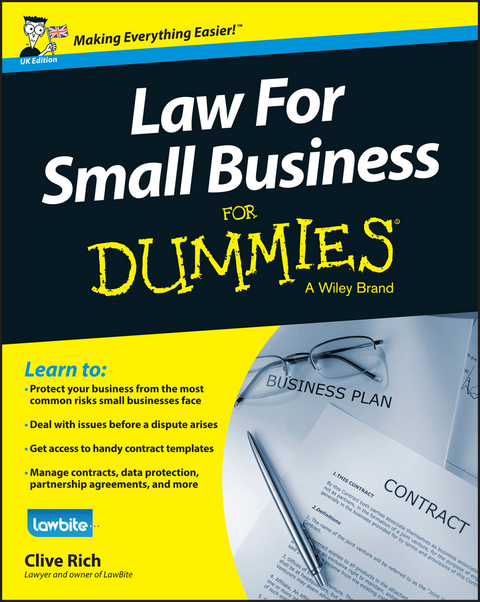
Law for Small Business For Dummies, UK Edition (eBook)
John Wiley & Sons (Verlag)
978-1-118-97045-4 (ISBN)
Written in plain-English for business people without any legal training, Law For Small Business For Dummies covers everything you need to be aware of regarding the law when you're starting and running your own business, Cutting through the jargon that can make even the pros scratch their heads, this book quickly gets you up-to-speed on the key areas of business law, including contracts, websites, intellectual property, data protection and partnership agreements, Plus, you'll find out how small business law applies to advertising and marketing, confidentiality agreements, the sale and supply of goods (including e-commerce), negligence and product liability,
There were 526,000 new businesses registered in the UK in 2013-and, at some point, all of them will be faced with legal risks that could make the difference between success and failure, One claim could wipe out a fledgling business' profits, and hit even big businesses harder than they could ever imagine, If you're the owner of a new business and need to get a handle on the ins and outs of small business law-and don't have the budget to employ an in-house legal advisor-this trusted, approachable guide is your answer,
- Covers the laws surrounding the most common risks small businesses face
- Addresses how to deal with legal issues before a potentially costly dispute arises
- Provides access to handy sample contract templates on Dummies,com
- Serves as your own in-house legal advisor-at a fraction of the cost
If you're an existing business owner or an aspiring entrepreneur thinking about starting your own business, Law For Small Business For Dummies gives you answers to questions you didn't even know to ask!
Clive Rich is a lawyer, mediator, arbitrator and negotiator, He is Chairman of LawBite, an online legal service providing 'Simple Law for Small Companies' (www,lawbite,co,uk),
Your own in-house legal advisor at a fraction of the cost Written in plain-English for business people without any legal training, Law For Small Business For Dummies covers everything you need to be aware of regarding the law when you're starting and running your own business. Cutting through the jargon that can make even the pros scratch their heads, this book quickly gets you up-to-speed on the key areas of business law, including contracts, websites, intellectual property, data protection and partnership agreements. Plus, you'll find out how small business law applies to advertising and marketing, confidentiality agreements, the sale and supply of goods (including e-commerce), negligence and product liability. There were 526,000 new businesses registered in the UK in 2013 and, at some point, all of them will be faced with legal risks that could make the difference between success and failure. One claim could wipe out a fledgling business' profits, and hit even big businesses harder than they could ever imagine. If you're the owner of a new business and need to get a handle on the ins and outs of small business law and don't have the budget to employ an in-house legal advisor this trusted, approachable guide is your answer. Covers the laws surrounding the most common risks small businesses face Addresses how to deal with legal issues before a potentially costly dispute arises Provides access to handy sample contract templates on Dummies.com Serves as your own in-house legal advisor at a fraction of the cost If you're an existing business owner or an aspiring entrepreneur thinking about starting your own business, Law For Small Business For Dummies gives you answers to questions you didn't even know to ask!
Clive Rich is a lawyer, mediator, arbitrator and negotiator. He is Chairman of LawBite, an online legal service providing 'Simple Law for Small Companies' (www.lawbite.co.uk).
Introduction 1
Part I: Getting Started with Legal Requirements 5
Chapter 1: Starting Your Legal Journey: Business Structures and Initial Research 7
Chapter 2: Setting up and Running Your Business Structure: Legal Formalities 23
Chapter 3: Choosing Your Funding Partner 43
Chapter 4: Closing the Funding Agreement 59
Part II: Launching Your Business - Legal Essentials 81
Chapter 5: Contracting Consultants and Employees 83
Chapter 6: Dealing with Your Online Responsibilities 107
Chapter 7: Staying Onside in the Workplace 123
Chapter 8: Protecting What You Own: Intellectual Property 147
Chapter 9: Acquiring and Using Your Own Software 173
Part III: Growing the Business - The Legal Blueprint 191
Chapter 10: Cooking Up a Tasty Contract with Your Suppliers 193
Chapter 11: Contracting with Suppliers for Services 213
Chapter 12: Creating Legal Contracts with Consumers 227
Chapter 13: Saying Bonjour, Ciao, Hola, Ni Hao to Trading Abroad 245
Part IV: Staying in Business - Legal Pitfalls 263
Chapter 14: Managing Your Legal Risks 265
Chapter 15: Winning Disputes (When You Can't Avoid Them) 279
Chapter 16: Coping with Liquidation and Insolvency 299
Part V: Exiting Successfully - Legal Secrets 323
Chapter 17: Lifting-Off to Further Business Goals 325
Chapter 18: Cashing In: Selling Your Business 341
Part VI: The Part of Tens 359
Chapter 19: Top Ten Legal Bear Pits to Avoid 361
Chapter 20: Ten Documents You Need to Get Signed 367
Chapter 21: Shush! Ten Secrets of Negotiation 375
Chapter 22: Ten Ways You Can Expect Your Lawyer to Behave 385
Index 395
Chapter 1
Starting Your Legal Journey: Business Structures and Initial Research
In This Chapter
Deciding on the right legal structure for you
Checking various business registers
So, you have a big idea for a business: maybe you’ve created a prototype for a machine that removes the overpowering aroma of gorgonzola or invented a cost-effective method of transporting irritating celebrities to another solar system. Perhaps you’ve created a minimum viable product (an initial version of your product that’s good enough to test in the market) – and identified one or more individuals you want to work with. The sunlit peaks of entrepreneurial success lie before you. Exciting times!
Although I’m reluctant to draw cloudy shadows over this sunlit image, I have to point out that legal dangers lurk for the unwary new business owner, which can ruin your enterprise before you even start. Therefore, you need clear, comprehensible legal information from the initial start-up, through business growth and especially with disputes and serious problems (turn to Chapters 15 and 16, respectively, when you feel ready to think about that). You wouldn’t start your business without a business plan, and I suggest you have a legal plan too.
For example, before you can get going as a small and medium-size enterprise (SME), you have to decide what business structure you want for your undertaking. Fortunately, along with some considerations for when you’re registering your business, that’s exactly the subject I cover in this chapter! Along the way, this chapter also acts as your guide to the rest of this book, which can continue to help you when you’re ready to trade overseas (travel to Chapter 13), expand into other adventures (see Chapter 17) or sell your company for a well-earned cushy retirement (saunter with sand between your toes to Chapter 18)!
Deciding on Your Trading Structure
You can choose one of the following three main trading structures for a commercial business:
- Sole trader
- Partnership (including a limited liability partnership)
- Limited liability company
Each structure has different characteristics and distinct advantages and disadvantages, which I describe in this section. (When forming a charity you have some other options, but I don’t cover that subject in this book.)
If you want more information, jump to Chapter 2, which talks you through the legal formalities of each type. For funding ideas and legalities, slip a coin into the slot and dispense the info in Chapters 3 and 4.
Going it alone: Sole trader
A sole trader arrangement is essentially a ‘one-man band’ where the business owner is self-employed and in effect is the business. Sole trading is one of the oldest and most traditional models of business ownership and has been used widely throughout many industries. A significant increase in the number of people setting up businesses as sole traders has occurred due to the sense of independence it brings. As a sole trader you have complete control over the business and can run it in any manner you choose.
This structure is also popular because of the ease with which you can combine it with other employment. On the other hand, personal liability attaches to you if the business gets into any difficulties.
Advantages
Here are some of the advantages of sole trading:
-
Autonomy and control: The sole trader is truly independent and is in full control of the business and how it’s conducted and any earned profits. You can therefore fully realise and develop your vision for the business without interference. Great!
- Low administrative burden: The lack of a formal setting-up structure makes for a cost-effective process requiring less paperwork. Usually, you don’t need specialist legal or accountancy advice.
- Less statutory obligations: The Companies Acts don’t apply to sole traders, and you have no requirement to file annual accounts or fulfil the other administrative burdens that fall on limited companies (see the later section ‘Protecting your liability: Limited company’ for details).
- Flexibility: As a sole trader, you can make decisions quickly because you don’t need to consult anyone. Similarly, you can implement new decisions or ideas instantly.
- Personal reputation: A sole trader can build up an invaluable rapport with customers as the ‘face’ of the business.
- Privacy: Personal details of the sole trader, including address and profits, aren’t in the public domain, because you don’t have to register with Companies House (flip to the later ‘Checking Companies House’ section for more details).
-
Great for testing a new business idea: Setting up as a sole trader is an inexpensive way to determine whether your business idea has true potential before you leave full-time employment.
If you’re an employee of someone else though, check that you aren’t breaching your employment contract by, for example, potentially competing with your employer or using confidential information.
- Earning potential: You retain any profits earned as the sole trader and (after tax) don’t have to share them. When you’ve got your cake, you can eat it all yourself!
- Ability to adapt: If you begin your business as a sole trader, you can transition it into a limited liability company (see the ‘Protecting your liability: Limited company’ section later in this chapter) if it expands to a sufficient degree. No bar exists to incorporating the business at a later date by turning it into a limited company.
Disadvantages
Life as a sole trader isn’t all sweetness and light. Here are some of the difficulties you can face:
-
Personal liability: As a sole trader you can be held personally liable for losses suffered by the business, because no distinction exists between your personal and business assets. This disadvantage is a real ‘biggie’ – don’t underestimate its significance. If you’re a sole trader, you can end up funding the losses of the business out of your own savings, pension or house. Ouch! For this reason, you need to get your official Terms and Conditions (T&Cs) sorted to minimise your liabilities – check out Chapters 6 and 12 for your website T&Cs and other customer contracts, respectively, whatever business structure you choose.
- Status or prestige: An inherent snobbery exists regarding the sole-trader arrangement. Whether justifiable or not, sole traders are perceived as being less professional in nature and lacking professional credibility. Certain larger companies adhere to a strict policy of only dealing with limited companies.
- Sole burden of responsibility: A sole trader must operate as a ‘jack of all trades’. Whether you have an aptitude for a particular area or not, you’re required to fulfil all aspects of the business, such as administration (invoicing, filing, replying to customer queries and complaints) and finances (tax and National Insurance), as well as carrying responsibility for the core business’s operation. Life can seem like a daily triathlon, followed by a decathlon, followed by a marathon.
- Financial support or funding: Sole traders have to rely on their own personal credit rating when seeking financial support. Potential lenders don’t look on them favourably or as a secure option, which can cause difficulties in getting loans, a mortgage or investment for the business. (Chapter 3 has loads of great tips for early-stage funding).
- Modest profits: The effort you have to expend to achieve a profit can be burdensome when you’re working on your own: achieving a good work–life balance can be difficult, particularly in the initial stages of the business. Your domestic partner may have something to say about this aspect, even if you’re happy with it.
- Unprotected business names: No statutory protection exists for business names of sole traders, because they don’t have to be registered with Companies House, unlike limited companies (flip to the later section ‘Checking Companies House’). Protecting your name is therefore more complicated (see Chapter 8 under the heading ‘Enforcing Unregistered Trademarks’).
- Less social security benefits: A sole trader isn’t entitled to the same social security benefits as employees. Sole traders are classified as ‘self-employed’ and so the amount of National Insurance they pay is usually lower than an employee has to pay. Therefore, if your business as a sole trader gets into trouble and ceases to trade, you can find that you have less entitlements built up to access unemployment assistance and less contributions towards your state pension.
-
Insurance: As a sole trader, you usually need public liability insurance if you deal with members of the public. Plus, if you take on even one employee, employer’s liability insurance is also necessary. These kinds of policy can be harder for a sole trader to get than a limited company or partnership – a double whammy given your risk of...
| Erscheint lt. Verlag | 13.1.2016 |
|---|---|
| Sprache | englisch |
| Themenwelt | Sachbuch/Ratgeber ► Beruf / Finanzen / Recht / Wirtschaft ► Wirtschaft |
| Recht / Steuern ► EU / Internationales Recht | |
| Recht / Steuern ► Wirtschaftsrecht | |
| Wirtschaft ► Betriebswirtschaft / Management ► Planung / Organisation | |
| Wirtschaft ► Betriebswirtschaft / Management ► Unternehmensführung / Management | |
| Schlagworte | Business & Management • Business Law • Claudia Gerrard • common risks small businesses face • data protection • how small business law applies to advertising and marketing • in-house legal advisor • Intellectual Property • key areas of business law • Klein- u. mittelständische Unternehmen u. Existenzgründung • Klein- u. mittelständische Unternehmen u. Existenzgründung • Klein- und Mittelbetrieb • Klein- und Mittelbetrieb /Recht • Law • law for small business • Law For Small Business For Dummies • laws surrounding the most common risks small businesses face • Legal Advisor • owner of a new business • partnership agreements • Rechtswissenschaft • running your own business • Small Business • Small Business & Entrepreneurship • small business law • starting and running your own business • the most common risks small businesses face • Wirtschaftsrecht • Wirtschaft u. Management |
| ISBN-10 | 1-118-97045-4 / 1118970454 |
| ISBN-13 | 978-1-118-97045-4 / 9781118970454 |
| Informationen gemäß Produktsicherheitsverordnung (GPSR) | |
| Haben Sie eine Frage zum Produkt? |
 EPUB (Adobe DRM)
Kopierschutz: Adobe-DRM
Adobe-DRM ist ein Kopierschutz, der das eBook vor Mißbrauch schützen soll. Dabei wird das eBook bereits beim Download auf Ihre persönliche Adobe-ID autorisiert. Lesen können Sie das eBook dann nur auf den Geräten, welche ebenfalls auf Ihre Adobe-ID registriert sind.
Details zum Adobe-DRM
Dateiformat: EPUB (Electronic Publication)
EPUB ist ein offener Standard für eBooks und eignet sich besonders zur Darstellung von Belletristik und Sachbüchern. Der Fließtext wird dynamisch an die Display- und Schriftgröße angepasst. Auch für mobile Lesegeräte ist EPUB daher gut geeignet.
Systemvoraussetzungen:
PC/Mac: Mit einem PC oder Mac können Sie dieses eBook lesen. Sie benötigen eine
eReader: Dieses eBook kann mit (fast) allen eBook-Readern gelesen werden. Mit dem amazon-Kindle ist es aber nicht kompatibel.
Smartphone/Tablet: Egal ob Apple oder Android, dieses eBook können Sie lesen. Sie benötigen eine
Geräteliste und zusätzliche Hinweise
Buying eBooks from abroad
For tax law reasons we can sell eBooks just within Germany and Switzerland. Regrettably we cannot fulfill eBook-orders from other countries.
aus dem Bereich