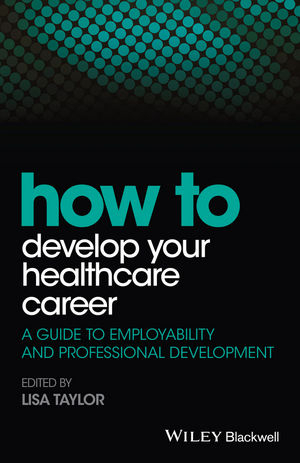
How to Develop Your Healthcare Career (eBook)
John Wiley & Sons (Verlag)
978-1-118-91081-8 (ISBN)

- An informative guide to all key aspects of employability for graduating students, educators, managers, and qualified healthcare professionals.
- Written specifically for health professionals, focusing on their needs and the challenges they face, maximising employability potential, and managing career progression.
- Packed full of potential interview questions, reflection opportunities, and case studies throughout
- Includes chapter on Professionalism, Continuing Professional Development (CPD), and Leadership
An informative guide to all key aspects of employability for graduating students, educators, managers, and qualified healthcare professionals. Written specifically for health professionals, focusing on their needs and the challenges they face, maximising employability potential, and managing career progression. Packed full of potential interview questions, reflection opportunities, and case studies throughout Includes chapter on Professionalism, Continuing Professional Development (CPD), and Leadership
Lisa E. Taylor, Lecturer in Occupational Therapy and Employability Lead for the School of Rehabilitation Sciences (RSC), University of East Anglia, Norwich, UK
Chapter 1
What is employability and what does it mean for you?
Lisa Taylor
School of Health Sciences, University of East Anglia, Norwich, UK
Introduction
Employability may be something that you have never really considered in detail before. Perhaps you have been focusing on completing your studies without really thinking about what will happen when you have finished? Will you continue studying as a postgraduate, go travelling or try to find a job in your chosen profession? Your consideration of your own employability should start as soon as possible and is a lifelong journey of learning and reflection about yourself and what you can offer the world of work. What can the world of work offer you? In a changing health and social care environment the opportunities within your profession are changing too – What do you need to do to respond to that in a proactive manner?
This chapter provides you with some of the history and theory behind employability and encourages you to consider where you are in your employability journey. There are suggestions on what you can do to help develop your own employability. The remainder of the book builds upon the concept of employability presented in this chapter, focusing on key areas of personal and professional development that are particularly relevant for healthcare employability. Throughout this chapter you are encouraged to reflect and consider how the information presented affects you own perceptions of employability and your own employability journey.
What does the literature say on employability and how it has evolved?
Employability is complex and it is clear from the available literature that being able to develop a precise and clear focus on it as a concept is difficult (Harvey, 2001; Hillage and Pollard, 1998). Employability and career development are very often conflated as concepts but are addressed individually in this book. The debate on employability has been longstanding, reaching far beyond the United Kingdom (Harvey and Knight, 2003). Although the meaning of employability has changed over time (Moreau and Leathwood, 2006), the importance of employability within the strategic direction of the Department of Education has been highlighted (Hillage and Pollard, 1998). Some authors state that employability has historically been viewed from a number of perspectives – economic social, organisational and individual – with the individual perspective emerging more in the 1990s (Nauta et al., 2009).
Rosenburg, Heimler and Morote (2012) discuss employability as the basic skills needed for job performance and once an individual is in employment, employability develops into transferable core proficiencies. They are, therefore, suggesting that employability is a continuing process of personal and professional development. Yorke (2006) states that employability as a concept was developed within education and focuses on the possession of relevant achievements and the ability to function in a job, not actually the process of acquiring a job. Dacre Pool and Sewell (2007) support this assertion, suggesting that employability is more than just getting a job. Employability is rarely defined as an individual being equipped to do a job (Harvey, 2001). Some approaches appear to confuse employability and employment (McQuaid and Lindsay, 2005). Harvey and Knight (2003) present different perspectives on employability – from developing attributes for graduate employment to the ability of a graduate to get a job and to succeed in a job. Therefore, there are a wide range of perspectives on employability, most of which reinforce the notion that employability is more than just a set of skills and is a continuing process.
Time for reflection
How does the literature above inform your understanding of employability as a concept? What and who do you think influences your own employability?
Towards a common language of employability
Despite the arguments presented that propose that employability is wider than just a group of skills that individuals develop, skill acquisition still appears to be the basis used for policy formation (Holmes, 2001). There appears to be an assumption that skills are synonymous with employability (Holmes, 2006). It is critical that education establishments and employers have the same understanding of employability (Holmes, 2001). This shared understanding is essential to ensure consistency in expectations and to assist the transitions individuals make, firstly from studies to employment and then within their careers. It is unfortunate that little research exists to underpin the alternative approaches to the skills approach to employability (Hinchliffe and Jolly, 2011). With employability being high on some governments’ agenda (Moreau and Leathwood, 2006), it is crucial that this concept is adequately defined and researched to enable individuals to understand and enhance their employability through a common language.
It is the employers that convert the employability of graduates into employment (Harvey, 2001) – so, as previously suggested, employability is the process of equipping yourself for a job with employment being the outcome when you are actually in a job. You need an awareness of what employers are looking for; this may change in response to policy changes and economic changes, which are critical to keep abreast of. Professional bodies keep abreast and inform members of changes that impact on their profession. However, on a local level the individual needs to understand the impact of changes on the work context. For example, a speech and language service going through the tendering and contracting process requires flexibility and proactiveness of its employees. The journey of employability continues for an individual as he/she continues to develop personally and professionally in their job/s as they develop their careers (Figure 1.1).
Figure 1.1 The journey of employability
Time for reflection
If you could design a model of employability – what would it look like?
Models of employability
The main models of employability reported in the literature are presented here. This provides an opportunity for you to consider how these reflect your understanding of employability and whether they are models that you would find helpful to apply to your own personal construct of employability.
Bennett et al. model on course provision
Bennett, Dunne and Carré (1999) proposed a model focusing on course provision within education – with five main areas of focus for education establishments to adequately prepare students for the world of work:
- Disciplinary content knowledge, for example anatomy and physiology.
- Disciplinary skills, for example taking someone’s blood pressure.
- Workplace awareness, for example knowledge of what is offered and what is required of you within the hospital workplace or area that you are working.
- Workplace experience, for example placement experiences.
- Generic skill, for example team working, time management, communication.
Watts DOTS model
Further suggested models include the DOTS model, which is discussed by Watts (2006). It is made up of four main components that break down employability into manageable areas to focus on – Decision learning, Opportunity awareness, Transition learning and Self-awareness. The interesting aspect of the DOTS model is a self-awareness of your skills interests and values. For example – if you are a physiotherapist – does women’s health interest you or does musculoskeletal physiotherapy interest you? If you are considering working within a social enterprise, do their care values match your values and if they do not match up then how comfortable are you working within such an environment?
Dacre Pool and Sewell Career EDGE model
Career EGDE was presented in a paper by Dacre Pool and Sewell (2007). It is a three-tiered system. In the first tier, the following employability components are included: career development, experience in life and work, degree (knowledge and understanding), generic transferable skills and emotional intelligence to motivate yourself and others. The second tier of the model is a reflection and evaluation tier – reinforcing the importance for you to reflect upon your experiences. The reflection and evaluation feeds into the third tier, which includes self-esteem, self-confidence and self-efficacy. Reflection upon your experiences is something that as healthcare students/practitioners you are used to undertaking regularly.
The unique value of the Career EDGE model lies in its transferability to any stage in a career. It is not exclusive to students, which reinforces the message that employability is a life-long journey and does not end when employment has been secured.
Yorke and Knight USEM model
The USEM (understanding, skills, efficacy beliefs and metacognition) model presented by Yorke and Knight (2006) is reported to be one of the most used and respected models of employability and offers another model that looks beyond the skill development aspect of employability (Hinchliffe and Jolly, 2011; Dacre Pool and Sewell, 2007). The USEM model contributes to a large body of academic work on employability which can make it inaccessible for individuals to use, resulting in it becoming more of a guide...
| Erscheint lt. Verlag | 22.1.2016 |
|---|---|
| Reihe/Serie | HOW - How To |
| HOW - How To | How To |
| Sprache | englisch |
| Themenwelt | Sachbuch/Ratgeber ► Gesundheit / Leben / Psychologie |
| Medizin / Pharmazie ► Allgemeines / Lexika | |
| Medizin / Pharmazie ► Gesundheitswesen | |
| Medizin / Pharmazie ► Medizinische Fachgebiete ► Medizinethik | |
| Schlagworte | and case studies • application • Berufe u. Ausbildung im Gesundheitswesen • business • Career • Case Studies • Educators • Employability • Framework • Gesundheits- u. Sozialwesen • Gesundheitswesen • Health & Health Care Special Topics • Health & Social Care • Healthcare • Health Care Professional Development & Education • Improvement • Interview • Job • Krankenpflege • Leadership • Leitungstätigkeit u. Management i. d. Krankenpflege • Leitungstätigkeit u. Management i. d. Krankenpflege • Management • Managers • nursing • Nursing Management & Leadership • Planning • Professionals • qualified • questions • reflection • reflection opportunities • rofessionalism • Service • Skills • Spezialthemen Gesundheitswesen • students • tinuing Professional Development |
| ISBN-10 | 1-118-91081-8 / 1118910818 |
| ISBN-13 | 978-1-118-91081-8 / 9781118910818 |
| Informationen gemäß Produktsicherheitsverordnung (GPSR) | |
| Haben Sie eine Frage zum Produkt? |
 PDF (Adobe DRM)
Größe: 1,7 MB
Kopierschutz: Adobe-DRM
Adobe-DRM ist ein Kopierschutz, der das eBook vor Mißbrauch schützen soll. Dabei wird das eBook bereits beim Download auf Ihre persönliche Adobe-ID autorisiert. Lesen können Sie das eBook dann nur auf den Geräten, welche ebenfalls auf Ihre Adobe-ID registriert sind.
Details zum Adobe-DRM
Dateiformat: PDF (Portable Document Format)
Mit einem festen Seitenlayout eignet sich die PDF besonders für Fachbücher mit Spalten, Tabellen und Abbildungen. Eine PDF kann auf fast allen Geräten angezeigt werden, ist aber für kleine Displays (Smartphone, eReader) nur eingeschränkt geeignet.
Systemvoraussetzungen:
PC/Mac: Mit einem PC oder Mac können Sie dieses eBook lesen. Sie benötigen eine
eReader: Dieses eBook kann mit (fast) allen eBook-Readern gelesen werden. Mit dem amazon-Kindle ist es aber nicht kompatibel.
Smartphone/Tablet: Egal ob Apple oder Android, dieses eBook können Sie lesen. Sie benötigen eine
Geräteliste und zusätzliche Hinweise
Buying eBooks from abroad
For tax law reasons we can sell eBooks just within Germany and Switzerland. Regrettably we cannot fulfill eBook-orders from other countries.
 EPUB (Adobe DRM)
Kopierschutz: Adobe-DRM
Adobe-DRM ist ein Kopierschutz, der das eBook vor Mißbrauch schützen soll. Dabei wird das eBook bereits beim Download auf Ihre persönliche Adobe-ID autorisiert. Lesen können Sie das eBook dann nur auf den Geräten, welche ebenfalls auf Ihre Adobe-ID registriert sind.
Details zum Adobe-DRM
Dateiformat: EPUB (Electronic Publication)
EPUB ist ein offener Standard für eBooks und eignet sich besonders zur Darstellung von Belletristik und Sachbüchern. Der Fließtext wird dynamisch an die Display- und Schriftgröße angepasst. Auch für mobile Lesegeräte ist EPUB daher gut geeignet.
Systemvoraussetzungen:
PC/Mac: Mit einem PC oder Mac können Sie dieses eBook lesen. Sie benötigen eine
eReader: Dieses eBook kann mit (fast) allen eBook-Readern gelesen werden. Mit dem amazon-Kindle ist es aber nicht kompatibel.
Smartphone/Tablet: Egal ob Apple oder Android, dieses eBook können Sie lesen. Sie benötigen eine
Geräteliste und zusätzliche Hinweise
Buying eBooks from abroad
For tax law reasons we can sell eBooks just within Germany and Switzerland. Regrettably we cannot fulfill eBook-orders from other countries.
aus dem Bereich