


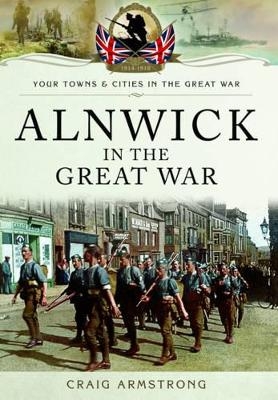
Alnwick in the Great War
Seiten
2016
Pen & Sword Military (Verlag)
978-1-4738-2739-4 (ISBN)
Pen & Sword Military (Verlag)
978-1-4738-2739-4 (ISBN)
- Keine Verlagsinformationen verfügbar
- Artikel merken
Features rare images, many of which have not been seen since the war and fills key areas in the overall account of the experience of the First World War in Northumberland and the north of England
As a market town and one of the seats of government of the county authority, Alnwick played a key role in the coordination of Northumberland's war effort. With a wide rural hinterland, the town was considerably important in the production and dispersal of food, which was vital to the war effort. As the home of the Duke of Northumberland, the town had a hugely influential role in the overall Northumbrian war effort from civilian affairs to military recruitment. The town shared a proud tradition of military service with the wider region, and this was reflected in the huge numbers of Alnwick men and women who came forward for service in the military or in roles such as nursing. The town was a regional recruitment centre and hosted its own unit of the 1/7th (Territorial) Battalion, Northumberland Fusiliers, as well as other military units. From 1915, Alnwick was also one of the largest infantry training bases in the north of England. Many of the locally raised Pal's Battalions, which were raised in the north, received their training here. For those left behind in Alnwick, the war was a time of worry and hardship, however others saw the business opportunities.This book includes accounts of the struggle that local families faced in coping with rising wartime prices, longer working hours and endless worry, sometimes in the face of accusations of drunkenness or idleness from the authorities and unfair criticism of the rural districts' recruiting record.
Despite these hardships, the people of Alnwick provided incredible charitable support right up until the end of the war, in addition to their normal efforts. Several military hospitals were set up in the town and surrounding area, with the training base later becoming a recuperation base for injured soldiers. These momentous efforts are explained throughout this compelling book, which is a testimony to the bravery, self-sacrifice and determination of the people of Alnwick during the Great War.
As a market town and one of the seats of government of the county authority, Alnwick played a key role in the coordination of Northumberland's war effort. With a wide rural hinterland, the town was considerably important in the production and dispersal of food, which was vital to the war effort. As the home of the Duke of Northumberland, the town had a hugely influential role in the overall Northumbrian war effort from civilian affairs to military recruitment. The town shared a proud tradition of military service with the wider region, and this was reflected in the huge numbers of Alnwick men and women who came forward for service in the military or in roles such as nursing. The town was a regional recruitment centre and hosted its own unit of the 1/7th (Territorial) Battalion, Northumberland Fusiliers, as well as other military units. From 1915, Alnwick was also one of the largest infantry training bases in the north of England. Many of the locally raised Pal's Battalions, which were raised in the north, received their training here. For those left behind in Alnwick, the war was a time of worry and hardship, however others saw the business opportunities.This book includes accounts of the struggle that local families faced in coping with rising wartime prices, longer working hours and endless worry, sometimes in the face of accusations of drunkenness or idleness from the authorities and unfair criticism of the rural districts' recruiting record.
Despite these hardships, the people of Alnwick provided incredible charitable support right up until the end of the war, in addition to their normal efforts. Several military hospitals were set up in the town and surrounding area, with the training base later becoming a recuperation base for injured soldiers. These momentous efforts are explained throughout this compelling book, which is a testimony to the bravery, self-sacrifice and determination of the people of Alnwick during the Great War.
Born and bred in Northumberland, Dr Craig Armstrong is an experienced historian, with a special interest in the history of the North East of England and the Anglo-Scottish Borders. He has expertise in nineteenth- and twentieth-century history, with a particular focus on social and military history. Dr Armstrong currently splits his time between teaching at Newcastle University and working as a freelance researcher and writer on all things North Eastern.
| Erscheinungsdatum | 05.10.2016 |
|---|---|
| Zusatzinfo | 176 pages integrated illustrations |
| Verlagsort | South Yorkshire |
| Sprache | englisch |
| Maße | 156 x 234 mm |
| Themenwelt | Sachbuch/Ratgeber |
| Geschichte ► Allgemeine Geschichte ► Neuzeit (bis 1918) | |
| Geschichte ► Allgemeine Geschichte ► 1918 bis 1945 | |
| Geisteswissenschaften ► Geschichte ► Regional- / Ländergeschichte | |
| ISBN-10 | 1-4738-2739-6 / 1473827396 |
| ISBN-13 | 978-1-4738-2739-4 / 9781473827394 |
| Zustand | Neuware |
| Informationen gemäß Produktsicherheitsverordnung (GPSR) | |
| Haben Sie eine Frage zum Produkt? |
Mehr entdecken
aus dem Bereich

aus dem Bereich
Geschichte einer wilden Handlung
Buch | Hardcover (2024)
C.H.Beck (Verlag)
CHF 47,60


