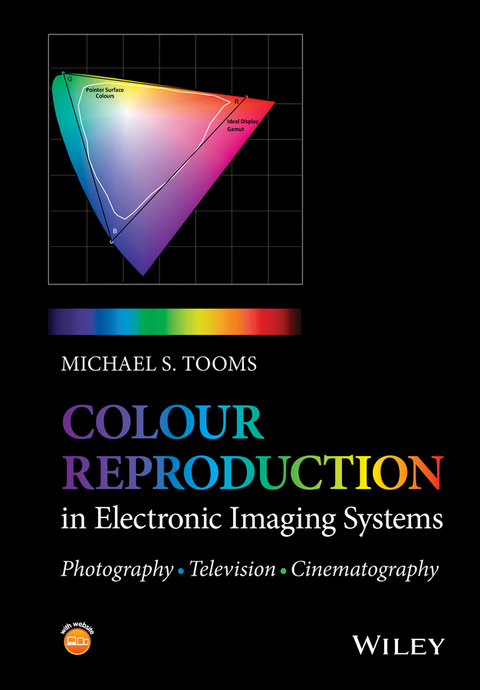
Colour Reproduction in Electronic Imaging Systems (eBook)
This book is concerned with providing readers with all they need to know about colour: how it is perceived and described, how it is measured and generated and how it is reproduced in colour systems. It serves as both a tutorial and a reference book, defining what we mean by colour and providing an explanation of the proper derivation of chromaticity charts and through to the means of ensuring accurate colour management.
Key Features:
- Addresses important theory and common misconceptions in colour science and reproduction, from the perception and characteristics of colour to the practicalities of its rendering in the fields of television, photography and cinematography
- Offers a clear treatment of the CIE chromaticity charts and their related calculations, supporting discussion on system primaries, their colour gamuts and the derivation of their contingent red, green and blue camera spectral sensitivities
- Reviews the next state-of-the-art developments in colour reproduction beyond current solutions, from Ultra-High Definition Television for the 2020s to laser projectors with unprecedented colour range for the digital cinema
- Includes a companion website hosting a workbook consisting of invaluable macro-enabled data worksheets; JPEG files containing images referred to in the book, including colour bars and grey scale charts to establish perceived contrast range under different environmental conditions; and, guides to both the workbook and JPEG files
With the move of cinema away from film, the adoption of electronic-based production throughout all media is now complete. In order to exploit its advantages, the accurate definition, measurement and reproduction of colour has become more important than ever to achieve the best fidelity of colour reproduction. This book is concerned with providing readers with all they need to know about colour: how it is perceived and described, how it is measured and generated and how it is reproduced in colour systems. It serves as both a tutorial and a reference book, defining what we mean by colour and providing an explanation of the proper derivation of chromaticity charts and through to the means of ensuring accurate colour management. Key Features: Addresses important theory and common misconceptions in colour science and reproduction, from the perception and characteristics of colour to the practicalities of its rendering in the fields of television, photography and cinematography Offers a clear treatment of the CIE chromaticity charts and their related calculations, supporting discussion on system primaries, their colour gamuts and the derivation of their contingent red, green and blue camera spectral sensitivities Reviews the next state-of-the-art developments in colour reproduction beyond current solutions, from Ultra-High Definition Television for the 2020s to laser projectors with unprecedented colour range for the digital cinema Includes a companion website hosting a workbook consisting of invaluable macro-enabled data worksheets; JPEG files containing images referred to in the book, including colour bars and grey scale charts to establish perceived contrast range under different environmental conditions; and, guides to both the workbook and JPEG files
Michael S. Tooms has had a career in the television industry spanning 45 years, from operations and design to senior and project management roles. He was responsible for the conception, outline, design and project management of a number of multi-million pound television centre projects, most notably working for Granada Television, TV3 Scansat, ITV, Wharf Cable, BT and Spectrum Consultants/Siemens among others. He has served on industry standards committees responsible for developing new television system specifications and lectured on colour reproduction for the Royal Television Society, the Royal Photographic Society and the British Kinematograph Sound and Television Society. He represented ITV on the EBU Colour Primaries committee and was a founding member of the UK Independent Broadcast Authority's Quality Control Section, a body that was concerned with classifying and regulating colour reproduction standards in broadcasting.
"Michael Toom's book is the technical manual about colour that every colour scientist or engineer working in professional digital imaging has ever dreamt of reading. Not only it does cover and elegantly narrates the generic aspects of the discipline and the pragmatic reasons behind many technical and/or historical choices. It's also a fundamental compendium of detailed formulae, hard to find at all (if ever, well organized, in one piecework)." - Walter Arrighetti, Frame by Frame Italia srl
"The author's approach in developing the subjects from a fundamental level will be of great benefit to those who want a thorough grasp of colour reproduction, and should avoid some of the misconceptions that can arise where the fundamentals are only given a cursory treatment.
The book deserves to be regarded as a 'go to' resource for those working in the field of colour reproduction, or those who have a strong interest in colour reproduction. It is a book well suited to the needs of engineers and scientists." - The Imaging Science Journal, 2016 Vol. 64 No. 3
Preface
Many excellent books are available which deal in one way or another with image reproduction, either generically for example across photography or television, or in a more specialist manner for a particular technology such as digital television. Invariably colour is discussed as an integral part of the reproduction process, often as an adjunct to the technology of the media being covered. However, few books leave the reader who is specifically interested in the reproduction of colour entirely happy that the colour reproduction process has been fully understood at a fundamental level.
Often the more obscure elements of colorimetry are glossed over, which is fine for those who require only a superficial understanding in this area but is frustrating for those who need to understand fully the derivation and interpretation of the various chromaticity diagrams in use. In contrast, the aim of this book is to cover comprehensively the complete process of colour reproduction from capturing the scene to rendering the final image, whether it be in the form of a display or a print. Emphasis is placed on the analysis and processing of the colour components, rather than the technology associated with generating and conveying the components representing the original image from the camera to the point where the image is rendered.
Nevertheless, aspects of colorimetry, such as the derivation of the CIE1 x,y chromaticity diagram, for example, are fundamentally quite mathematical. So in order not to detract from the flow of the text, the development of the subject is described in a heuristic manner and the supporting mathematics are constrained to the appendices for those who wish to grasp the complete picture at a deeper fundamental level.
The material for this book evolved initially from notes used to support the ‘Television Image Formation, Analysis and Reproduction’ lecture given by the author in a series of annual engineering lectures for the Royal Television Society (RTS) and subsequently developed into a chapter for the planned RTS book on television engineering. He was also able to build upon the material used more recently in a presentation to the Image Science Section of The Royal Photographic Society on colour management as a means of achieving accurate colour reproduction in photography. As a member of the Society of Motion Picture and Television Engineers (SMPTE), he has watched with interest his colleagues driving the evolution of international standards for colour reproduction in digital cinematography and has drawn upon this material for the part dealing with this topic; this step completed the transformation of the three major picture media systems: television, photography and cinematography to electronic-based systems.
In recent years, electronic image reproduction has made tremendous strides not only in television, to embrace digital, high definition and 3D television, but also by expanding into photography and latterly into ‘digital cinema’, where digital cameras have virtually replaced film at the shooting stage and digital large screen projectors have become the norm in most cinemas. Despite these advances, the fidelity of colour reproduction continues to have limitations and there remain enticing approaches to extending the range of colours which may be reproduced as described in the book.
The book sets out to provide an in-depth analysis of colour, its measurement and its reproduction at a fundamental level before going on to provide a comprehensive coverage of its application in uniquely different ways to television, photography and cinematography, respectively.
The application of colour reproduction theory to practical systems is addressed from a historical perspective, since the application of electronics to each media system has always been built on the technology developed for digitising the previous media. Much of the groundwork of applying the then relatively new understanding and standardisation of colour analysis and measurement of the 1930s, through the work of the CIE, was brought to bear by the members of the National Television System Committee (NTSC) of the United States in the early 1950s, when the first practical colour television system was introduced. The European television systems (Phase Alternating Line (PAL) and Sequential Colour with Memory (SECAM)) which followed in the 1960s were essentially based upon the same colour fundamentals. However, they differed from the earlier system in that they evolved methods of encoding the colour signals for transmission that were less prone to the effects of the distortions apparent in the electronic systems of the day, which in its early days had given the NTSC system a poor reputation.
In electronic terms, these pioneer colour television systems reigned supreme for some 40 years before developments in technology in the 1980/90s gave rise to the possibility of adopting a new world-wide standard for television which included a tightening up of the standards associated with the specifications for colour reproduction. Some would claim the opportunity was missed at that time to introduce standards which would embrace developments in colour reproduction which had already been foreseen, and are now waiting on the side-lines for the opportunity to come to the fore.
During broadly the same period of the early 1990s, these developments also saw the evolution of the standardisation of digital video signals, the JPEG digital compression system and cost-effective solid-state image sensors, making practical digital stills cameras available at increasingly affordable prices for general consumer use. Finally in the early 2000s, with the adaptation of specialised television cameras of high resolution for recording sequences for the cinema, and the availability of suitably bright and high-resolution projectors, the way was open in the late 2000s for experts within the cinematographic standards bodies2 to set the colour specifications for the digital cinema. Part 5 of this book describes that journey in terms of the colour techniques and specifications adopted by each of the three media: television, photography and cinematography.
Acknowledgements
Without the encouragement I have been fortunate enough to receive from so many people, I would not have been in a position to write this book. I am resolved therefore to acknowledge not only those who have assisted me in preparing the book but also those who in one way or another have encouraged my interest and enthusiasm for colour from the beginning, albeit that some are no longer with us.
It was evident to me as a young child that my interest in the exciting range of colours around me went well beyond the norm of those in my circle of family and friends, with the possible exception of my mother who did her best to assist me with the difficult topic of colour naming. I remember well one particular, rather unusual colour that when questioning was told it was ‘cerise’.
My formal introduction to colour came whilst serving as a radar technician in the RAF when I selected as a birthday present, John W. Wentworth's book ‘Colour Television Engineering’. This was read avidly during the plentiful non-shift time available and became my bible for many years; I am much indebted to the author for dealing so comprehensively and insightfully with colour measurement and its application to reproduction.
Subsequently, when working for EMI at the time of the introduction of their NTSC encoder, I was grateful to its designer, David Kent, for his patient detailed explanations of the workings of each of the several unique circuits of which it was comprised.
I joined ABC Television in the United Kingdom at a time when broadcasters were experimenting with colour television and Michael Cox was leading the work there on the SECAM system. Eventually it became clear that the PAL system developed under the leadership of Dr. Bruch in Germany was to be the likely choice of system for the United Kingdom and at that time I began to work for Mike who taught me a lot as I ‘bread-boarded’ an experimental PAL encoder whilst he tackled the more difficult decoder.
In preparation for the introduction of a colour television service during this period, I, together with my colleague and friend Ray Knight, attended a post-graduate colour course under Professor Wright at Imperial College London, which turned out to be a milestone event. W. David Wright was one of the two colour scientists who had undertaken the work which led to the CIE standards on the measurement of colour. We were privileged to be able to derive our personal colour matching functions on the Wright colorimeter that had been used to obtain the data for those standards. David Wright's tremendous knowledge of the subject and his enthusiasm for sharing it with his students helped cement in me a lifelong interest in the subject.
The effect on my friend Ray Knight was very similar and since then we have kept in constant touch, sharing our interest in colour from slightly different perspectives. Nevertheless, we have continued to exchange ideas and, as the result of many, many discussions over the years, my knowledge of the subject has been further broadened by his enthusiasm and determination to ensure that we shared a common understanding of the more obscure aspects of the subject. Ray has also written on colour, particularly from the perception of an artist, on picture-matching and colour-mixing. As a result he has produced many excellent diagrams and I am very grateful for his generosity in allowing me to use several of them in...
| Erscheint lt. Verlag | 30.11.2015 |
|---|---|
| Sprache | englisch |
| Themenwelt | Kunst / Musik / Theater ► Film / TV |
| Kunst / Musik / Theater ► Fotokunst | |
| Sachbuch/Ratgeber ► Freizeit / Hobby ► Fotografieren / Filmen | |
| Technik ► Elektrotechnik / Energietechnik | |
| Schlagworte | Bildgebende Systeme u. Verfahren • chromaticity • Chromaticity Chart • Cie • Cinematography • Colour • Colour Management • Colour reproduction • Colour theory • digital • Electrical & Electronics Engineering • Elektrotechnik u. Elektronik • Imaging Systems & Technology • luminance • Luminosity • photography • Photoshop • Tonal Range • Tone • Ultra High Definition |
| ISBN-13 | 9781119021773 / 9781119021773 |
| Informationen gemäß Produktsicherheitsverordnung (GPSR) | |
| Haben Sie eine Frage zum Produkt? |
 EPUB (Adobe DRM)
Kopierschutz: Adobe-DRM
Adobe-DRM ist ein Kopierschutz, der das eBook vor Mißbrauch schützen soll. Dabei wird das eBook bereits beim Download auf Ihre persönliche Adobe-ID autorisiert. Lesen können Sie das eBook dann nur auf den Geräten, welche ebenfalls auf Ihre Adobe-ID registriert sind.
Details zum Adobe-DRM
Dateiformat: EPUB (Electronic Publication)
EPUB ist ein offener Standard für eBooks und eignet sich besonders zur Darstellung von Belletristik und Sachbüchern. Der Fließtext wird dynamisch an die Display- und Schriftgröße angepasst. Auch für mobile Lesegeräte ist EPUB daher gut geeignet.
Systemvoraussetzungen:
PC/Mac: Mit einem PC oder Mac können Sie dieses eBook lesen. Sie benötigen eine
eReader: Dieses eBook kann mit (fast) allen eBook-Readern gelesen werden. Mit dem amazon-Kindle ist es aber nicht kompatibel.
Smartphone/Tablet: Egal ob Apple oder Android, dieses eBook können Sie lesen. Sie benötigen eine
Geräteliste und zusätzliche Hinweise
Buying eBooks from abroad
For tax law reasons we can sell eBooks just within Germany and Switzerland. Regrettably we cannot fulfill eBook-orders from other countries.
aus dem Bereich