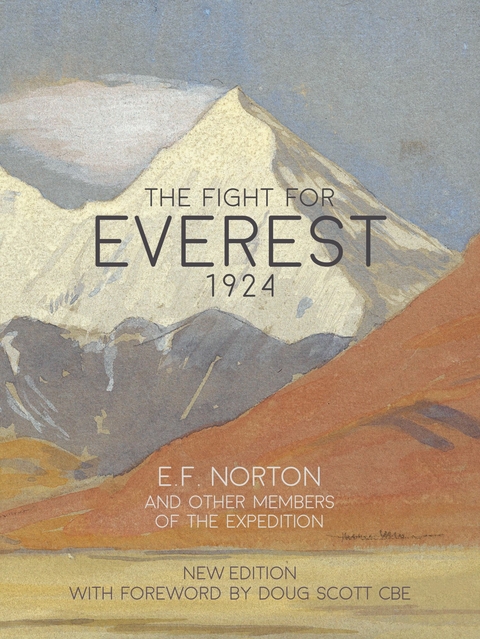
Fight for Everest 1924 (eBook)
Vertebrate Publishing (Verlag)
978-1-910240-40-3 (ISBN)
In 1924 Mount Everest remained unclimbed. Two British expeditions had already tackled what was known to be the highest mountain on Earth. The first, in 1921, found a route to the base. The second, in 1922, attempted the summit, reaching a record height of 27,320 feet before retreating. Two years later, a team that included Colonel E.F. Norton, George Mallory and Andrew Irvine returned to the Himalaya. Armed with greater knowledge and experience, confidence was high. But they were still climbing into the unknown. How high could they climb without supplementary oxygen? Would the cumbersome oxygen equipment help them climb higher? Could they succeed where others had failed, and make the first ascent of the highest mountain on earth? Before they could find out, tragedy struck - George Mallory and Andrew Irvine, climbing high on the mountain, vanished into the clouds. First published in 1925, and reissued now for only the second time, The Fight for Everest 1924 is the official record of this third expedition to Everest. The compelling narrative by Norton and other expedition members, and Mallory's vivid letters home, present a gripping picture of life in the Himalaya. Notes and observations from the entire team show how far knowledge of the mountain and of high-altitude climbing had advanced by 1924, and make recommendations for future Everest attempts. As well as the full original text and illustrations, this edition reproduces some of Norton's superb pencil sketches and watercolours along with previously unpublished materials from his private archive. These include original planning documents from the expedition, Mallory's last note to Norton, and a moving letter to Norton from Mallory's widow. Together, they add up to complete one of the most fascinating mountaineering books ever written.
– Introduction to the 1925 edition –
by Sir Francis Younghusband, KCSI, KCIE
This book is the record of a repulse. Mallory and Irvine may possibly have reached the summit; but they have not lived to tell us. And besides these two English lives, one Scottish and nine Indian lives have also been lost in assaulting Mount Everest. The repulse has been cruel. Yet the pain has not diminished the determination of man to conquer the mountain: it has increased it. And the men who are most determined are not we who stay at home and watch the struggle from afar; they are the assailants themselves: they are the men who have reached nearest the summit and have stood the hardest buffetings and faced the gravest dangers. Long before they knew what was in the minds of people at home, Colonel Norton had recorded in a dispatch in The Times the unanimous wish of the whole Expedition that the attempt should be renewed. And among the public generally there is a distinctly firmer determination to prosecute the project than there was when the idea was first mooted. At that time the public took very little interest in it. Douglas Freshfield, Bruce, Collie, Longstaff, and a few others who had actually climbed in the Himalaya, had for long dreamed of climbing Everest whenever political conditions made it possible to get at the mountain. But beyond the Alpine Club, and in a lesser degree the Royal Geographical Society, little interest was taken in the project, and a combined appeal from the Presidents of the two bodies to the general public produced only £10.
Very different is the feeling now. There are of course still many – very many – who do not care a rap whether Everest is climbed or not. There are others who think the expenditure of thousands of pounds on these expeditions is a great waste of money. And there are a few who think it positively wicked to throw away human life on so useless an enterprise. Still, the number of those who do see some value in these efforts has greatly increased. And in the hope that it may still further increase we may once more review what we expect to get from these efforts.
And first we must sum up what we have already gained.
When these expeditions to Mount Everest were first started it was still very problematical whether man could sustain himself at extreme altitudes, and, if he could just sustain himself, whether he could survive the exertion of climbing. With great difficulty man had attained a height of 24,600 feet in another part of the Himalaya, a few years previously; but between that and the summit of Everest there was a difference of 4,400 feet. Could man over-come that great difference in height? To do this he would have to sleep at a height of approximately 27,000 feet, for it would not do to leave more than 2,000 feet to climb on the final day. Would he be able to sleep at 27,000 feet? And could even the lightest camp be carried for him to that height? Many thought that both these questions would be answered in the negative – that it would be impossible to get a camp carried to so great a height, and that even if it were man could not sleep there and would therefore be dead beat before he started for the final effort.
The present Expedition has proved, however, that a camp can be carried to 27,000 feet, that man can sleep even at that tremendous altitude, and that without any artificial aid he can reach 28,000 feet. Colonel Norton and Dr Somervell accomplished this last feat in an exceptionally bad year and when they were in a thoroughly exhausted state. For a whole month previously they had been severely strained in establishing the high camps on the glacier, and on the North Col, battling with blizzards and experiencing extreme cold. Yet in spite of these drawbacks Colonel Norton reached a point only 900 feet below the summit. And it cannot be doubted that, if climbers could be put on the mountain in a less exhausted condition than Norton and Somervell were in, the summit could be reached. Norton was able to see enough of the last portion to be sure that there were no physical obstacles to prevent this; and if he in his condition could have reached so near we may be certain that at his best he could have attained the summit. The problem is now merely a matter of putting men on the mountain in a fit condition. What was before a mere probability is now anyhow a possibility, and some consider a certainty. Where originally all was doubt and speculation there is now conviction. We feel convinced that sooner or later man will stand on the summit of the highest mountain. And these climbs to higher heights have added to man’s knowledge of himself. Once again he has found that by exercising his capacity he increases it. By forcing himself to live at higher and higher altitudes, he finds that his body adjusts itself to the new conditions. The amount of oxygen in the air near the summit of Mount Everest is only a third of the amount in the air at sea-level, and unless the body made some adjustment to these altered conditions man could not survive them. And this last Expedition has shown that the human body does make this adjustment if it has the requisite time for the purpose. Major Hingston, in part 3, gives full details. Ascending suddenly in a balloon to a height of 28,000 feet in 1875, one man fainted and two men died. But on Mount Everest last year the same altitude was attained by Norton and Somervell and because the ascent had been gradual their bodies had been able to adjust themselves; they showed no signs of fainting and were able to make the effort of climbing.
The experience gained on last year’s Expedition further showed that men who have once experienced high altitudes will acclimatise very much more rapidly than those ascending to them for the first time. Climbers who had been on two expeditions suffered less on the second than they did on the first; and the new members of last year’s Expedition were distinctly more affected than the members who had been on a previous Expedition.
Thus it has been found that not only does man’s body adapt itself to high altitude conditions, but adapts itself more rapidly on successive occasions. And the members of this expedition are of opinion that climbers can be so acclimatised to altitudes of between 24,000 and 26,000 feet that they would be able to climb to 29,000 feet without the use of oxygen. The summit of Mount Everest will not be attained without the climbers, somewhere or other on the seven stages between the base camp and the summit, suffering from hardships of extreme cold, furious winds, uncomfortable accommodation, and the poor food and indifferent cooking incidental to life in such regions. And these sufferings and discomforts must sap into the vitality. But this much we now do know which we did not know before, that the body does find better means than the normal of taking in what little oxygen there remains in the air, and that therefore the climbing of the highest mountain on the earth is a feasible proposition.
So much for the body; and with the spirit also it has once more been found that as it exerts itself so does it grow in capacity. And it not merely adapts itself to new conditions: it masters them. When man first started out to assault the mountain he was full of doubt and hesitation and not a little fear. Everest was formidable enough in herself, but she had with her terrible allies in the wind and the cold and the snow; and man might well have quailed before her. But he faced her squarely, and now he knows the worst about her, and knows that he himself has further resources within him which he can bring up against the mountain and he is confident of victory. He knows the limit of what Everest can do. She may have frost and snow and wind on her side, but she cannot loose off poison-gas or belch forth volcanic fire or shake man off in an earthquake. Whereas man can use his intelligence and profit by the experience he has gained; can equip himself better against the weather; and having once nearly reached the summit the way is known to him and he can march forward with confidence.
His increasing confidence is indeed very remarkable. The members of the 1924 Expedition, marching across Tibet, took it as a certainty that they would reach the summit; and that they got so near as they did after their terrible experiences during the months on the glacier before they could even make the attempt, must have been due to this confidence that was in them; they would never have reached so high if they had not had confidence born of their experiences in 1922. And Colonel Norton speaks of the stimulating effect there was in passing the highest point they had reached in 1922. Anything then seemed possible. And the want of success on this occasion did not diminish the feeling of confidence. They were as confident on the way back as they were on the way out, that the summit would be reached.
Everest cannot add to her height; but the spirit of man heightens even under repulse.
And what is the value of this heightened spirit is well exemplified in the contrast between Mallory and the Sherpas. These men are born and bred in the mountains below Everest, and as Captain Geoffrey Bruce tells us, they are sure-footed and owing to the rigorous climate of their homes can withstand more than average exposure and fatigue. In ordinary life they are quite accustomed to carrying loads across a 19,000-foot pass. And on this expedition they actually carried small loads to a height of 27,000 feet. So there, right on the spot, must be dozens of men who could, as far as bodily fitness goes, reach the summit of Everest any year they liked. Yet the fact remains that they don’t. They have not even the desire to. They have not the spirit.
Compare these people with Mallory. He undoubtedly was fine in body. But...
| Erscheint lt. Verlag | 8.10.2015 |
|---|---|
| Verlagsort | London |
| Sprache | englisch |
| Themenwelt | Sachbuch/Ratgeber ► Sport |
| Schlagworte | climb everest • facts about mount everest • George Mallory • mallory everest • Mount Everest • mount everest facts • Mt Everest |
| ISBN-10 | 1-910240-40-0 / 1910240400 |
| ISBN-13 | 978-1-910240-40-3 / 9781910240403 |
| Informationen gemäß Produktsicherheitsverordnung (GPSR) | |
| Haben Sie eine Frage zum Produkt? |
 EPUB (Adobe DRM)
Kopierschutz: Adobe-DRM
Adobe-DRM ist ein Kopierschutz, der das eBook vor Mißbrauch schützen soll. Dabei wird das eBook bereits beim Download auf Ihre persönliche Adobe-ID autorisiert. Lesen können Sie das eBook dann nur auf den Geräten, welche ebenfalls auf Ihre Adobe-ID registriert sind.
Details zum Adobe-DRM
Dateiformat: EPUB (Electronic Publication)
EPUB ist ein offener Standard für eBooks und eignet sich besonders zur Darstellung von Belletristik und Sachbüchern. Der Fließtext wird dynamisch an die Display- und Schriftgröße angepasst. Auch für mobile Lesegeräte ist EPUB daher gut geeignet.
Systemvoraussetzungen:
PC/Mac: Mit einem PC oder Mac können Sie dieses eBook lesen. Sie benötigen eine
eReader: Dieses eBook kann mit (fast) allen eBook-Readern gelesen werden. Mit dem amazon-Kindle ist es aber nicht kompatibel.
Smartphone/Tablet: Egal ob Apple oder Android, dieses eBook können Sie lesen. Sie benötigen eine
Geräteliste und zusätzliche Hinweise
Buying eBooks from abroad
For tax law reasons we can sell eBooks just within Germany and Switzerland. Regrettably we cannot fulfill eBook-orders from other countries.
aus dem Bereich