GIS Methodologies for Developing Conservation Strategies (eBook)
Columbia University Press (Verlag)
978-0-231-50501-7 (ISBN)
Basil G. Savitsky is assistant professor in the Graduate School of Geography and coordinator of the M.A. program in GIS and International Development at Clark University.Thomas E. Lacher Jr. is professor and Caesar Kleberg Chair in Wildlife Ecology in the Department of Wildlife and Fisheries Sciences at Texas A & M University. Formerly the director of the Archbold Tropical Research Center at Clemson University (1989-1996), he is the coauthor, with R. J. Kendall, of Wildlife Toxicology and Population Modeling: Integrated Studies of Agroecosystems.
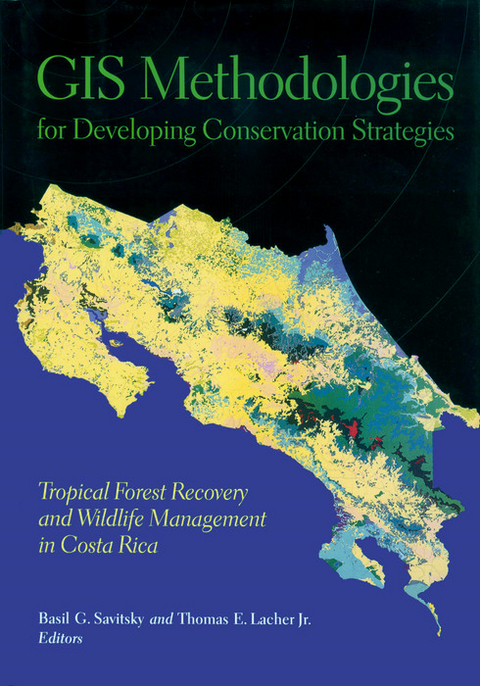
Tropical habitats may contain more than a third of the world's plant and animal species; Costa Rica alone is home to one of the highest levels of biodiversity per unit area in the world, and stands at center stage in worldwide conservation efforts. Within such regions, the use of state-of-the-art digital mapping technologies-sophisticated techniques that are relatively inexpensive and accessible-represents the future of conservation planning and policy. These methods, which employ satellites to obtain visual data on landscapes, allow environmental scientists to monitor encroachment on indigenous territories, trace park boundaries through unmarked wilderness, and identify wildlife habitats in regions where humans have limited access.Focusing on the rich biodiversity of Costa Rica, the contributors demonstrate the use of geographic information systems (GIS) to enhance conservation efforts. They give an overview of the spatial nature of conservation and management and the current status of digital mapping in Costa Rica; a review of the basic principles behind digital mapping technologies; a series of case studies using these technologies at a variety of scales and for a range of conservation and management activities; and the results of the Costa Rican gap analysis project. GIS Methodologies for Developing Conservation Strategies provides powerful tools for those involved in decision-making about the natural environment, particularly in developing nations like Costa Rica where such technologies have not yet been widely adopted. For specialists in such areas as geography, conservation biology, and wildlife and natural resource management, the combination of conceptual background and case examples make the book a crucial addition to the literature.
Basil G. Savitsky is assistant professor in the Graduate School of Geography and coordinator of the M.A. program in GIS and International Development at Clark University.Thomas E. Lacher Jr. is professor and Caesar Kleberg Chair in Wildlife Ecology in the Department of Wildlife and Fisheries Sciences at Texas A & M University. Formerly the director of the Archbold Tropical Research Center at Clemson University (1989-1996), he is the coauthor, with R. J. Kendall, of Wildlife Toxicology and Population Modeling: Integrated Studies of Agroecosystems.
Foreword, by James D. NationsPrefaceAbbreviationsPart I. Overview1. The Spatial Nature of Conservation and Development, by Thomas Lacher Jr.2. Conservation Mapping in Costa Rica, by Christopher Vaughan, Jorge Fallas, and Michael McCoyPart II. Digital Mapping Technologies3. Digital Mapping Technologies, by Basil Savitsky4. GIS, by Basil Savitsky5. Image Analysis, by Basil Savitsky6. GPS, by Jeffery AllenPart III. Uses of GIS—Examples in Costa Rica7. GIS Design and Implementation at La Selva Biological Station, by Elizabeth Wentz and Joseph Bishop8. Use of Digital Elevation Models in Tropical Rain Forest Basins to Extract Basic Hydrologic and Land Use Information, by G. Arturo Sanchez-Azifeifa9. Using a GIS to Determine Critical Areas in the Central Volcanic Cordillera Conservation Area, by Gregoire Leclerc and Johnny Rodriguez Chacon10. Application of the HEP Methodology and Use of GIS to Improve Continental-Scale Conservation Planning, by J. David Lambert and Margaret H. Carr11. The Paseo Pantera Project: A Case Study Using GIS to Improve Continental-Scale Conservation Planning. by J. David Lambert and Margaret H. CarrPart IV. The USAID Case Study in Gap Analysis12. Overview of Gap Analysis, by Basil Savitsky13. Wildlife and Habitat Data Collection and Analysis, by Basil Savitsky, Jorge Fallas Christopher Vaughan, and Thomas Lacher Jr.14. Error and the Gap Analysis Model, by Jennifer N. Morgan and Basil Savitsky15. A GIS Method for Conservation Decision Making, by Basil Savitsky and Thomas Lacher Jr.16. Using the Gap Analysis Model for Sustainable Development and Natural Resources Management in Developing Countries, by Thomas Lacher Jr.17. Application of the Gap Analysis Model in Regional and International Programs in the Tropics, by Thomas Lacher Jr., G. Wesley Burnett, Basil Savitsky, and Christopher VaughanAppendixesContributorsIndex
| Erscheint lt. Verlag | 28.4.1998 |
|---|---|
| Reihe/Serie | Biology and Resource Management Series | Biology and Resource Management Series |
| Zusatzinfo | 73 illus, 28 photos |
| Verlagsort | New York |
| Sprache | englisch |
| Themenwelt | Sachbuch/Ratgeber ► Natur / Technik |
| Naturwissenschaften ► Biologie ► Ökologie / Naturschutz | |
| Naturwissenschaften ► Geowissenschaften ► Geografie / Kartografie | |
| ISBN-10 | 0-231-50501-9 / 0231505019 |
| ISBN-13 | 978-0-231-50501-7 / 9780231505017 |
| Informationen gemäß Produktsicherheitsverordnung (GPSR) | |
| Haben Sie eine Frage zum Produkt? |
 PDF (Wasserzeichen)
Größe: 3,6 MB
DRM: Digitales Wasserzeichen
Dieses eBook enthält ein digitales Wasserzeichen und ist damit für Sie personalisiert. Bei einer missbräuchlichen Weitergabe des eBooks an Dritte ist eine Rückverfolgung an die Quelle möglich.
Dateiformat: PDF (Portable Document Format)
Mit einem festen Seitenlayout eignet sich die PDF besonders für Fachbücher mit Spalten, Tabellen und Abbildungen. Eine PDF kann auf fast allen Geräten angezeigt werden, ist aber für kleine Displays (Smartphone, eReader) nur eingeschränkt geeignet.
Systemvoraussetzungen:
PC/Mac: Mit einem PC oder Mac können Sie dieses eBook lesen. Sie benötigen dafür einen PDF-Viewer - z.B. den Adobe Reader oder Adobe Digital Editions.
eReader: Dieses eBook kann mit (fast) allen eBook-Readern gelesen werden. Mit dem amazon-Kindle ist es aber nicht kompatibel.
Smartphone/Tablet: Egal ob Apple oder Android, dieses eBook können Sie lesen. Sie benötigen dafür einen PDF-Viewer - z.B. die kostenlose Adobe Digital Editions-App.
Buying eBooks from abroad
For tax law reasons we can sell eBooks just within Germany and Switzerland. Regrettably we cannot fulfill eBook-orders from other countries.
aus dem Bereich