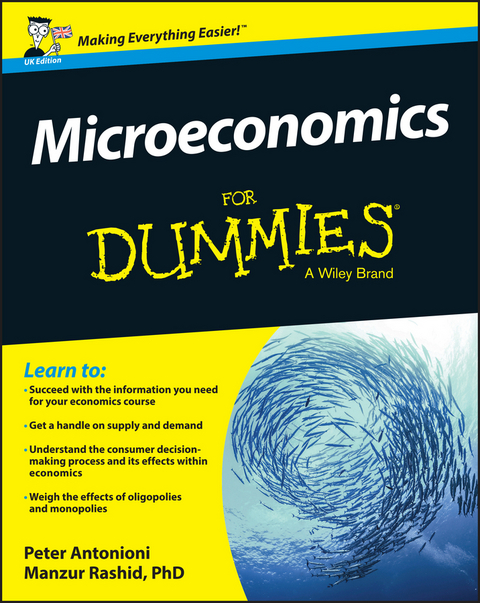
Microeconomics For Dummies, UK Edition (eBook)
John Wiley & Sons (Verlag)
978-1-119-02671-6 (ISBN)
Microeconomics For Dummies (with content specific to the UK reader) is designed to help you understand the economics of individuals. Using concise explanations and accessible content that tracks directly to an undergraduate course, this book provides a student-focused course supplement with an in-depth examination of each topic. This invaluable companion provides clear information and real-world examples that bring microeconomics to life and introduces you to all the key concepts. From supply and demand to market competition, you'll understand how the economy works on an individual level, and how it affects you every day. Before long, you'll be conversant in consumers, costs, and competition.
Microeconomics is all about the behaviour of individual people and individual firms. It sounds pretty straightforward, but it gets complicated early on. You may not be an economist, but if you're a business student at university, the odds are you need to come to grips with microeconomics. That's where Microeconomics For Dummies comes in, walking you through the fundamental concepts and giving you the understanding you need to master the material.
- Understand supply, demand, and equilibrium
- Examine the consumer decision making process
- Delve into elasticity and costs of production
- Learn why competition is healthy and monopolies are not
Even the brightest business students can find economics intimidating, but the material is essential to a solid grasp of how the business world works. The good news is that you've come to the right place.
Peter Antonioni is a senior teaching fellow at the Department of Management Science and Innovation, University College, London, and coauthor of Economics For Dummies, 2nd UK Edition. Manzur Rashid, PhD, is a lecturer at New College of the Humanities, where he covers second year micro- and macroeconomics.
Your one-stop guide to understanding Microeconomics Microeconomics For Dummies (with content specific to the UK reader) is designed to help you understand the economics of individuals. Using concise explanations and accessible content that tracks directly to an undergraduate course, this book provides a student-focused course supplement with an in-depth examination of each topic. This invaluable companion provides clear information and real-world examples that bring microeconomics to life and introduces you to all the key concepts. From supply and demand to market competition, you'll understand how the economy works on an individual level, and how it affects you every day. Before long, you'll be conversant in consumers, costs, and competition. Microeconomics is all about the behaviour of individual people and individual firms. It sounds pretty straightforward, but it gets complicated early on. You may not be an economist, but if you're a business student at university, the odds are you need to come to grips with microeconomics. That's where Microeconomics For Dummies comes in, walking you through the fundamental concepts and giving you the understanding you need to master the material. Understand supply, demand, and equilibrium Examine the consumer decision making process Delve into elasticity and costs of production Learn why competition is healthy and monopolies are not Even the brightest business students can find economics intimidating, but the material is essential to a solid grasp of how the business world works. The good news is that you've come to the right place.
Peter Antonioni is a senior teaching fellow at the Department of Management Science and Innovation, University College, London, and coauthor of Economics For Dummies, 2nd UK Edition. Manzur Rashid, PhD, is a lecturer at New College of the Humanities, where he covers second year micro- and macroeconomics.
Introduction 1
Part I: Getting Started with Microeconomics 5
Chapter 1: Discovering Why Microeconomics Is a Big Deal 7
Chapter 2: Considering Consumer Choice: Why Economists Find You Fascinating! 17
Chapter 3: Looking at Firm Behaviour: What They Are and What They Do 31
Part II: Doing the Best You Can: Consumer Theory 43
Chapter 4: Living a Life without Limits 45
Chapter 5: Considering the Art of the Possible: The Budget Constraint 55
Chapter 6: Achieving the Optimum in Spite of Constraints 67
Part III: Uncovering the Alchemy of Firms' Inputs and Outputs 85
Chapter 7: Working with Different Costs and Cost Curves 87
Chapter 8: Squeezing Out Every Last Drop of Profit 105
Chapter 9: Supplying the Demanded Information on Supply and Demand 117
Chapter 10: Dreaming of the Consumer's Delight: Perfect Competition 137
Part IV: Delving into Markets, Market Failure and Welfare Economics 149
Chapter 11: Stepping into the Real World: Oligopoly and Imperfect Competition 151
Chapter 12: Appreciating the Fundamental Theorems of Welfare Economics 167
Chapter 13: Controlling Markets with a Monopoly 179
Chapter 14: Examining Market Failure: Pollution and Parks 197
Chapter 15: Understanding the Dangers of Asymmetric Information 209
Part V: Thinking Strategically: Life Is Just a Game! 219
Chapter 16: Playing Games with Economic Theory 221
Chapter 17: Keeping Things Stable: The Nash Equilibrium 239
Chapter 18: Knowing How to Win at Auctions 249
Chapter 19: Deciphering the Signals: Threats and Benefits 261
Part VI: The Part of Tens 271
Chapter 20: Meeting Ten Great Microeconomists 273
Chapter 21: Ten Top Tips to Take Away 281
Glossary 289
Index 295
Chapter 1
Discovering Why Microeconomics Is a Big Deal
In This Chapter
Introducing the areas that interest microeconomists
Considering the central roles of decision-making, competition and co-operation
Seeing that markets don’t always work
As we’re sure you know, micro as a prefix often indicates something very small, such as a microchip (a tiny French fry) or a microbrain (your arch enemy’s intellect). Micro can also mean something that isn’t small itself but is used to examine small things, such as a microscope (necessary to see your nemesis’s minuscule brain).
Well, microeconomics is the area of economics that studies the decisions of consumers and producers and how they come together to make markets. It asks how people decide to do what they do and what happens when interests conflict. It also considers how people can improve markets through their actions, the effects of laws and other outside interventions. However you look at it, and despite the name, microeconomics is a huge subject!
Traditionally, people contrasted microeconomics with macroeconomics – the study of national economies and big phenomena such as growth, debt or investments. But over the years, the scope of microeconomics has grown; today economists analyse some parts of what used to be macroeconomics – for instance, negotiations on loans – using microeconomic tools.
Microeconomists employ those tools to look at things that form from the bottom up, because markets build on the actions of individual firms and consumers. This approach involves starting with an account of how firms and consumers make decisions and building on that to investigate more complex things that ‘emerge’ from those decisions – such as how a market is structured.
In general, microeconomics works by building models of these situations. Models are mathematical – or graphical – pictures of how the world works given some basic assumptions. Models aren’t reality; they’re a description of something that resembles it. Like an architect’s model of a house, they don’t have to stand up to reality; they just have to provide a feeling for what the world looks like. Microeconomists use additional data to refine the models until they provide a more accurate picture. They also test models against real data to see how well the models work – the answer is usually ‘variably’!
In this chapter we introduce you to microeconomics and its core areas of interest, and we touch on the fact that markets don’t always work.
Peering into the Economics of Smaller Units
Microeconomics is fundamentally about what happens when individuals and firms make decisions. The idea is to think through those decisions and explore their consequences.
What happens – for example – when prices, say of ice cream, go up? Well, on the one hand, people are likely to buy less ice cream. On the other hand, firms may want to make more of it so that they can get more revenue. The result is a lot of unsold ice cream! Then people want to get rid of those stocks to avoid holding onto them, and they probably do that by cutting the price.
When does that process stop? At the limit, the only logical place to stop cutting the price is when exactly as much is sold as is made. This point is an equilibrium in the market for ice cream – a place where supply and demand are equal. We discuss equilibria more fully in Chapter 9.
When people talk about market forces, they’re talking about the sum of all these decisions. No vast impersonal power called ‘market forces’ exists, just a lot of smaller entities – consumers and firms – making a lot of simple decisions based on signals that come from prices. That’s really all market forces means.
The way markets work seems so impersonal because every one of the smallest units – small firms and individuals– makes up just a tiny fraction of all the decisions taken. Even the biggest companies or most powerful governments have limitations on their ability to influence the world. Microeconomists take this fact for granted and explore cases where it looks like they’re less limited as exceptions, not the rule!
All these smaller units do the best they can, given that ultimately they’re acting with imperfect knowledge of a complicated world. People and firms can’t know exactly how much they’ll be earning next year or exactly how much they’ll sell. They just look for ways of making decisions that give them the best chance of doing the best that they can – which is about all anyone can ask for in an uncertain world!
Making Decisions, Decisions and More Decisions!
One word that’s central to microeconomics is ‘decision’. Microeconomics is ultimately about making decisions – whether to buy a house, how much ice cream to make, at what price to sell a bicycle, whether to offer a product to this or that market and so on.
This is one reason why economists centre their models on choice. After all, when you don’t have options to choose from, you can’t take a decision! Deciding to make something or to buy something is the starting point for microeconomics.
To a microeconomist, decisions aren’t right or wrong; instead they’re one of the following:
-
Optimal: Getting the best of what you want, given what’s available (check out Chapter 6).
- Sub-optimal: Getting less than the best.
Of course, a model of decisions needs two sides:
- Consumers: Base their decisions on the value from choosing one option as opposed to another.
- Firms: Base their decisions on a measure of benefit – revenue – against costs (see Chapter 7).
This book presents a few ways that microeconomists look at these decisions. In Chapters 2–8, we use a framework for making the best decision given some kind of constraint – budget, time or whatever else constrains you – to show you how microeconomists look at individuals and firms separately. In Chapters 9–15, the famous supply and demand model shows you how different types of market lead to different results. And in Chapters 16–19, we introduce you to the set of techniques known collectively as game theory, which look at how individuals or firms (or even other entities, such as governments) interact with each other.
Addressing how individuals and firms make decisions
Economists look at decisions in a slightly different way from how you might expect. They don’t have a model of all the things that you as a consumer use to inform your decisions. They don’t know, for a start, who you are, or what all your values are. They make no assumptions about gender, ethnicity, sexuality or anything else (though applied economists may test what they know about one population’s decisions against a more general model). They just know that you need to make choices, and explore how you may do so.
Starting simply
Economists make the least possible number of assumptions about the decision-making process and ask what you’d do if you only wanted the best possible outcome. Here are the two basic assumptions:
- The consumer is utility-maximising: She seeks to maximise her utility – that is, the value of her choice (see Chapters 2 and 4 for more details).
- The firm is profit-maximising: It wants to maximise its profit – see Chapters 3 and 8.
These choices don’t necessarily involve selfishness – a utility-maximising consumer can get benefit from helping other people and a profit-maximising firm may want to redistribute surplus profits to charitable causes.
Growing more complex
To begin with, these models are quite simple. If Billy Bob has £10 in his pocket and he wants to decide between having a burrito or a pizza, he’ll get the meal that gives him most utility given that it costs less than £10. Simple!
But later on, the models start to incorporate all kinds of other things, such as budget constraints (which we discuss in Chapter 5): if Billy Bob’s income goes up, will he buy more or less pizza? Or what about the utility gained by other people: if Billy Bob’s friends won’t eat pizza with him (perhaps he chews with his mouth open and makes an unappetising noise), he may get less utility from the pizza. Eventually, even with simple assumptions, models can end up incorporating some pretty complicated reasoning!
When you look at this example from the perspective of the pizza restaurant, things also start off simple: the restaurant just wants to make as much profit as possible, working to reduce its costs to do so. But what if you build in competitors? What about if the shareholders of the pizza company – the firm has grown, adding layer on tasty layer! – have different interests from the managers? What if the managers don’t just want to get costs down, but to keep competitors out? Again, the key is to start from the fewest justifiable assumptions and then build up as you get more familiar with models.
Even at the simplest level, models tell...
| Erscheint lt. Verlag | 13.10.2015 |
|---|---|
| Sprache | englisch |
| Themenwelt | Sachbuch/Ratgeber ► Beruf / Finanzen / Recht / Wirtschaft ► Wirtschaft |
| Wirtschaft ► Volkswirtschaftslehre ► Mikroökonomie | |
| Schlagworte | Economics • learning microeconomics • Manzur Rashid • Microeconomics • microeconomics alternative text • Microeconomics Concepts • microeconomics course companion • microeconomics examples • microeconomics exercises • microeconomics explained • Microeconomics For Dummies UK Edition • microeconomics guide • microeconomics lessons • microeconomics no jargon • microeconomics study guide • microeconomics supplemental text • Microeconomics topics • microeconomics tutorial • microeconomics tutoring aid • Mikroökonomie • Mikroökonomie • New College of Humanities • passing microeconomics • Peter Antonini • plain English microeconomics • teaching yourself microeconomics • undergraduate microeconomics • University College London • Volkswirtschaftslehre |
| ISBN-10 | 1-119-02671-7 / 1119026717 |
| ISBN-13 | 978-1-119-02671-6 / 9781119026716 |
| Informationen gemäß Produktsicherheitsverordnung (GPSR) | |
| Haben Sie eine Frage zum Produkt? |
 EPUB (Adobe DRM)
Kopierschutz: Adobe-DRM
Adobe-DRM ist ein Kopierschutz, der das eBook vor Mißbrauch schützen soll. Dabei wird das eBook bereits beim Download auf Ihre persönliche Adobe-ID autorisiert. Lesen können Sie das eBook dann nur auf den Geräten, welche ebenfalls auf Ihre Adobe-ID registriert sind.
Details zum Adobe-DRM
Dateiformat: EPUB (Electronic Publication)
EPUB ist ein offener Standard für eBooks und eignet sich besonders zur Darstellung von Belletristik und Sachbüchern. Der Fließtext wird dynamisch an die Display- und Schriftgröße angepasst. Auch für mobile Lesegeräte ist EPUB daher gut geeignet.
Systemvoraussetzungen:
PC/Mac: Mit einem PC oder Mac können Sie dieses eBook lesen. Sie benötigen eine
eReader: Dieses eBook kann mit (fast) allen eBook-Readern gelesen werden. Mit dem amazon-Kindle ist es aber nicht kompatibel.
Smartphone/Tablet: Egal ob Apple oder Android, dieses eBook können Sie lesen. Sie benötigen eine
Geräteliste und zusätzliche Hinweise
Buying eBooks from abroad
For tax law reasons we can sell eBooks just within Germany and Switzerland. Regrettably we cannot fulfill eBook-orders from other countries.
aus dem Bereich