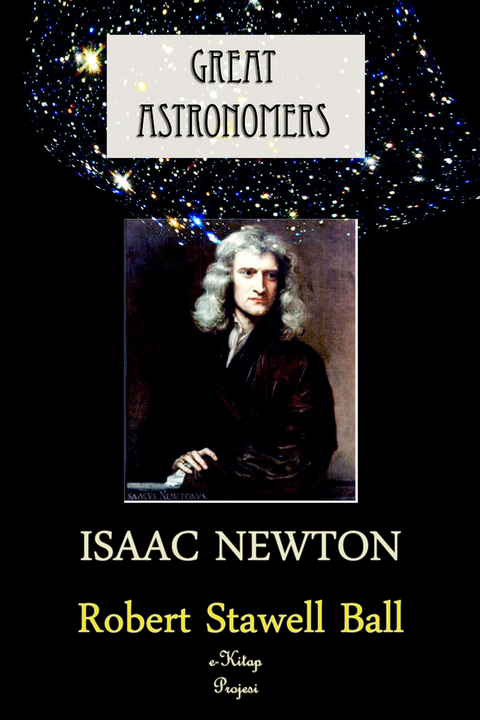
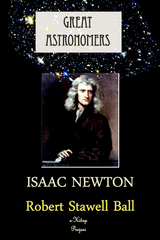
Great Astronomers (eBook)
31 Seiten
eKitap Projesi (Verlag)
978-615-5565-98-4 (ISBN)
For three years they continued to live at Woolsthorpe, the widow's means of livelihood being supplemented by the income from another small estate at Sewstern, in a neighbouring part of Leicestershire. In 1645, Mrs. Newton took as a second husband the Rev. Barnabas Smith, and on moving to her new home, about a mile from Woolsthorpe, she entrusted little Isaac to her mother, Mrs. Ayscough. In due time we find that the boy was sent to the public school at Grantham, the name of the master being Stokes. For the purpose of being near his work, the embryo philosopher was boarded at the house of Mr. Clark, an apothecary at Grantham. We learn from Newton himself that at first he had a very low place in the class lists of the school, and was by no means one of those model school-boys who find favour in the eyes of the school-master by attention to Latin grammar. Isaac's first incentive to diligent study seems to have been derived from the circumstance that he was severely kicked by one of the boys who was above him in the class. This indignity had the effect of stimulating young Newton's activity to such an extent that he not only attained the desired object of passing over the head of the boy who had maltreated him, but continued to rise until he became the head of the school.
The play-hours of the great philosopher were devoted to pursuits very different from those of most school-boys. His chief amusement was found in making mechanical toys and various ingenious contrivances. He watched day by day with great interest the workmen engaged in constructing a windmill in the neighbourhood of the school, the result of which was that the boy made a working model of the windmill and of its machinery, which seems to have been much admired, as indicating his aptitude for mechanics. We are told that Isaac also indulged in somewhat higher flights of mechanical enterprise. He constructed a carriage, the wheels of which were to be driven by the hands of the occupant, while the first philosophical instrument he made was a clock, which was actuated by water. He also devoted much attention to the construction of paper kites, and his skill in this respect was highly appreciated by his schoolfellows. Like a true philosopher, even at this stage he experimented on the best methods of attaching the string, and on the proportions which the tail ought to have. He also made lanthorns of paper to provide himself with light as he walked to school in the dark winter mornings.
IT was just a year after the death of Galileo, that an infant came into the world who was christened Isaac Newton. Even the great fame of Galileo himself must be relegated to a second place in comparison with that of the philosopher who first expounded the true theory of the universe. Isaac Newton was born on the 25th of December (old style), 1642, at Woolsthorpe, in Lincolnshire, about a half-mile from Colsterworth, and eight miles south of Grantham. His father, Mr. Isaac Newton, had died a few months after his marriage to Harriet Ayscough, the daughter of Mr. James Ayscough, of Market Overton, in Rutlandshire. The little Isaac was at first so excessively frail and weakly that his life was despaired of. The watchful mother, however, tended her delicate child with such success that he seems to have thriven better than might have been expected from the circumstances of his infancy, and he ultimately acquired a frame strong enough to outlast the ordinary span of human life. For three years they continued to live at Woolsthorpe, the widow's means of livelihood being supplemented by the income from another small estate at Sewstern, in a neighbouring part of Leicestershire. In 1645, Mrs. Newton took as a second husband the Rev. Barnabas Smith, and on moving to her new home, about a mile from Woolsthorpe, she entrusted little Isaac to her mother, Mrs. Ayscough. In due time we find that the boy was sent to the public school at Grantham, the name of the master being Stokes. For the purpose of being near his work, the embryo philosopher was boarded at the house of Mr. Clark, an apothecary at Grantham. We learn from Newton himself that at first he had a very low place in the class lists of the school, and was by no means one of those model school-boys who find favour in the eyes of the school-master by attention to Latin grammar. Isaac's first incentive to diligent study seems to have been derived from the circumstance that he was severely kicked by one of the boys who was above him in the class. This indignity had the effect of stimulating young Newton's activity to such an extent that he not only attained the desired object of passing over the head of the boy who had maltreated him, but continued to rise until he became the head of the school. The play-hours of the great philosopher were devoted to pursuits very different from those of most school-boys. His chief amusement was found in making mechanical toys and various ingenious contrivances. He watched day by day with great interest the workmen engaged in constructing a windmill in the neighbourhood of the school, the result of which was that the boy made a working model of the windmill and of its machinery, which seems to have been much admired, as indicating his aptitude for mechanics. We are told that Isaac also indulged in somewhat higher flights of mechanical enterprise. He constructed a carriage, the wheels of which were to be driven by the hands of the occupant, while the first philosophical instrument he made was a clock, which was actuated by water. He also devoted much attention to the construction of paper kites, and his skill in this respect was highly appreciated by his schoolfellows. Like a true philosopher, even at this stage he experimented on the best methods of attaching the string, and on the proportions which the tail ought to have. He also made lanthorns of paper to provide himself with light as he walked to school in the dark winter mornings.
| Erscheint lt. Verlag | 24.11.2024 |
|---|---|
| Sprache | englisch |
| Themenwelt | Literatur ► Biografien / Erfahrungsberichte |
| Sachbuch/Ratgeber ► Geschichte / Politik | |
| Sachbuch/Ratgeber ► Natur / Technik | |
| Naturwissenschaften ► Physik / Astronomie ► Astronomie / Astrophysik | |
| Technik | |
| Schlagworte | Astronomy • Great Astronomers • Great Scientists • Isaac Newton • Kepler • Newton |
| ISBN-10 | 615-5565-98-8 / 6155565988 |
| ISBN-13 | 978-615-5565-98-4 / 9786155565984 |
| Informationen gemäß Produktsicherheitsverordnung (GPSR) | |
| Haben Sie eine Frage zum Produkt? |
 EPUB (Ohne DRM)
Digital Rights Management: ohne DRM
Dieses eBook enthält kein DRM oder Kopierschutz. Eine Weitergabe an Dritte ist jedoch rechtlich nicht zulässig, weil Sie beim Kauf nur die Rechte an der persönlichen Nutzung erwerben.
Dateiformat: EPUB (Electronic Publication)
EPUB ist ein offener Standard für eBooks und eignet sich besonders zur Darstellung von Belletristik und Sachbüchern. Der Fließtext wird dynamisch an die Display- und Schriftgröße angepasst. Auch für mobile Lesegeräte ist EPUB daher gut geeignet.
Systemvoraussetzungen:
PC/Mac: Mit einem PC oder Mac können Sie dieses eBook lesen. Sie benötigen dafür die kostenlose Software Adobe Digital Editions.
eReader: Dieses eBook kann mit (fast) allen eBook-Readern gelesen werden. Mit dem amazon-Kindle ist es aber nicht kompatibel.
Smartphone/Tablet: Egal ob Apple oder Android, dieses eBook können Sie lesen. Sie benötigen dafür eine kostenlose App.
Geräteliste und zusätzliche Hinweise
Buying eBooks from abroad
For tax law reasons we can sell eBooks just within Germany and Switzerland. Regrettably we cannot fulfill eBook-orders from other countries.
aus dem Bereich