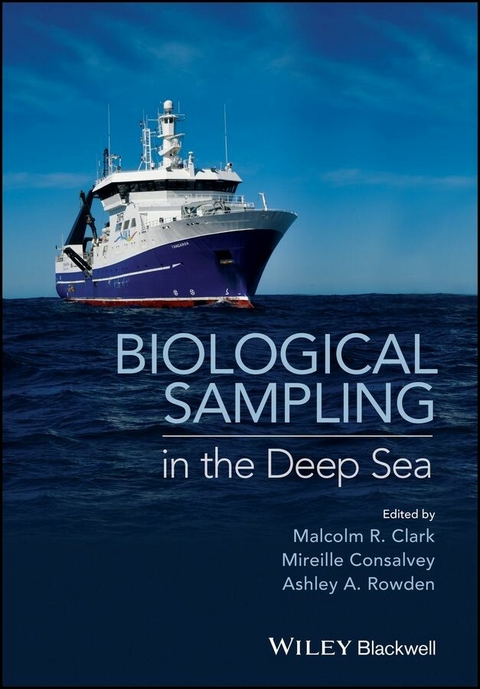
Biological Sampling in the Deep Sea (eBook)
John Wiley & Sons (Verlag)
978-1-118-33248-1 (ISBN)
Dr Malcolm R. Clark, scientist at the National Institute of Water and Atmospheric Research, Wellington, New Zealand. Dr Mireille Consalvey, scientist at the National Institute of Water and Atmospheric Research, Wellington, New Zealand. Dr Ashley A. Rowden, scientist at the National Institute of Water and Atmospheric Research, Wellington, New Zealand.
Contributors vii
Preface x
Chapter 1 Deep-Sea Benthic Habitats 1
Paul Tyler, Maria Baker and Eva Ramirez-Llodra
Chapter 2 Deep-Sea Fauna 16
Stefano Schiaparelli, Ashley Rowden and Malcolm R. Clark
Chapter 3 Survey and Sampling Design 36
Malcolm R. Clark, Thomas A. Schlacher, Gui Menezes, Tina Molodtsova and Ian J. Doonan
Chapter 4 Environmental Sampling 57
Martin White, Christian Mohn and Kostas Kiriakoulakis
Chapter 5 Benthic Habitat Mapping 80
Geoffroy Lamarche, Alan Orpin, John Mitchell and Arne Pallentin
Chapter 6 Deep-Sea Zooplankton Sampling 103
Bernd Christiansen
Chapter 7 Trawls 126
Malcolm R. Clark, Neil W. Bagley and Brian Harley
Chapter 8 Longlines 159
Gui Menezes and Michael Sigler
Chapter 9 Epibenthic Sledges 184
Stefanie Kaiser and Nils Brenke
Chapter 10 Corers and Grabs 207
Bhavani E. Narayanaswamy, Brian J. Bett, Peter Lamont, Ashley A. Rowden, Elanor M. Bell and Lenaick Menot
Chapter 11 Landers: Baited Cameras and Traps 228
Alan J. Jamieson
Chapter 12 Towed Cameras 260
David A. Bowden and Daniel O.B. Jones
Chapter 13 Submersibles and Remotely Operated Vehicles 285
Christopher Kelley, Terrence Kerby, Pierre-Marie Sarradin, Jozee Sarrazin and Dhugal Lindsay
Chapter 14 Seafloor Observatories 306
Marjolaine Matabos, Mairi Best, Jérome Blandin, Maia Hoeberechts, S. Kim Juniper, Benoît Pirenne, Katleen Robert, Henry Ruhl, Jozée Sarrazin and Michael Vardaro
Chapter 15 Sorting, Recording, Preservation and Storage of Biological Samples 338
Stefano Schiaparelli, Kareen E. Schnabel, Bertrand Richer de Forges and Tin-Yam Chan
Chapter 16 Information Management Strategies for Deep-Sea Biology 368
Karen Stocks, Nancy Jacobsen Stout and Timothy M. Shank
Chapter 17 Data Analysis Considerations 386
Timothy D. O'Hara, Thomas A. Schlacher, Ashley A. Rowden and Derek P. Tittensor
Chapter 18 Application of Biological Studies to Governance and Management of the Deep Sea 404
Cindy Lee Van Dover, Sophie Arnaud-Haond, Malcolm R. Clark, Samantha Smith, Andrew Thaler and Sybille van den Hove
Chapter 19 The Future of Biological Sampling in the Deep Sea 431
Mireille Consalvey, Malcolm R. Clark and Ashley A. Rowden
Glossary 437
Index 000
"I approached Clark et al.'s book, then, probably not as a member of its main target audience.
I had no intention of putting any of the detailed protocols for different sampling gears into practice2, but read it rather as someone hoping to get a feel for the labour that has gone into the data I analyse, and thus of its potential and limitations for macroecological research. Even viewed from this somewhat oblique angle, the book stands up very well"
--Thomas J. Webb, Department of Animal and Plant Sciences, The University of Sheffield on behalf of Frontiers of Biogeography, Summer 2017
"The editors are to be congratulated on producing a most helpful synthesis, with well-illustrated and extensively referenced chapters, that show the range of methods now available to explore this vast frontier"
--David L. Hawksworth, Biodiversity and Conservation, Summer 2019
Preface
The ocean covers 71% of the surface of the earth and the deep sea (considered here to be at depths greater than the continental shelf at 200–300 m) comprises the vast majority of this area. Seafloor habitats in the deep sea are many and varied, and include extensive areas of lower continental slope incised with canyons, beyond which there are large numbers of seamounts among plateaux, ridges, rises, plains and trenches, as well as hydrothermal vents and cold seeps. Until the late nineteenth century the depths beyond the photic zone were thought to be largely devoid of life. However, this concept has been disproven as scientific expeditions have discovered, and continue to find, a specialist deep-sea fauna that is among the most diverse on the planet.
Scientific knowledge of the deep sea has increased rapidly, but there exist large gaps in sampling coverage. As researchers have collectively worked towards increasing spatial coverage, inconsistencies have become apparent in how different habitats and regions have been sampled. Ultimately the extent to which data can be integrated will constrain how much our understanding of deep-sea ecosystems can develop. Furthermore, the pace of human impacts and changes in the deep sea are outstripping knowledge growth. There is growing pressure on deep-sea researchers to obtain data to understand the effects of fisheries and other human impacts that is vital for effective management and conservation.
In the wider scientific literature and online there already exist a number of publications and ‘grey literature’ reports discussing deep-sea sampling. In particular there are several methodological books (e.g. Eleftheriou & McIntyre, 2005; Eleftheriou, 2013; Danavaro, 2010) and general deep-sea texts (e.g. Gage & Tyler, 1991; Tyler, 2003). However, this book represents the first comprehensive compilation of deep-sea sampling methodologies for a range of habitats, and by dedicating a book specifically to deep-sea methods we are recognizing that the field of deep-sea research now warrants its own volume. The book fills a niche in the scientific and management communities, reviewing the real-life applications of current (and in some instances developing) deep-sea sampling tools and techniques across a range of deep-sea habitats and under a variety of conditions. In creating this book we have been able to draw upon the experiences of those at the ‘coal face’ of deep-sea sampling, expanding on the existing methodological texts while encompassing a level of detail often omitted from journal publications.
Ultimately we hope that the book will promote international consistency in sampling approaches and data collection, advance the integration of information into global databases, and facilitate improved data analyses and consequently uptake of science results for management and conservation of the deep sea.
Origin and scope of the book
The concept of this book was initially discussed by a small group of researchers comprising a ‘Standardization Working Group’ of the Census of Marine Life field project on seamounts (CenSeam). However, it rapidly became apparent that we could not, and should not, sample seamounts in isolation and the scope of the book was widened to encompass all deep-sea habitats.
The majority of sampling methods covered in the book target the mega- and macrofaunal assemblages associated with the deep seafloor. However, any study of the deep sea cannot exclude the wider influence of the entire water column and we also consider pelagic and environmental sampling. The main focus of the book by its very nature is biological sampling, but deep-sea research is a truly multidisciplinary venture. However, to encompass oceanographic and geological sampling in any detail would call for additional volumes that were beyond the realistic scope of our efforts. Nevertheless we hope all biologists can engage with other disciplines and encourage ongoing collaboration to obtain a wider understanding of deep-sea ecosystems.
In gathering authors to contribute to this book we have tried to cover as wide a range habitats and sampling equipment as possible. However, the content reflects personal experience and inevitably there will be omissions, but hopefully the book manages to build a solid foundation for future discussions of how to develop and progress biological sampling in the deep sea.
We hope that this book will appeal to a range of readers. Early career researchers can benefit from the experiences shared by those who have been on the trawl deck for many years, wisdom that is often not recorded in scientific papers and is often learnt the hard way. We also hope that the book will provide a scholarly platform and a solid foundation for students, as well as a valuable resource for environmental and science managers and policy-makers in detailing not only what tools are available to address issues in deep-sea management and conservation, but also in explaining some of the inherent challenges. The content of this book is based on the collective experiences of many deep-sea scientists, but we anticipate that even the most seasoned researcher will find this book of use. By documenting even the seemingly simplest of steps we might better identify where differences in approach occur, thereby providing opportunities for discussion and standardization across the research community to facilitate more robust data comparisons and analyses. Finally, the role of every research ship’s complement in making deep-sea research happen cannot be understated, and we hope that the book may find a place on board research vessels around the world as a reference to crews for the rationale behind some of the deployment strategies, and subsequent use of data.
The book cannot deal with every situation or gear type. Hence the chapters are cross-referenced and contain an extensive list of citations. The references included in the book are intended to give readers access to the main papers that can facilitate more detailed investigation of particular issues.
The book has been 5 years in the making, as the authors involved have tried to juggle the demands of their scientific work with the preparation of the various chapters. Research never stands still, and hence technological and sampling advances have occurred over that time period. We have tried to incorporate such changes wherever possible, and trust there are no major omissions that affect current ‘best practice’ advice or information.
Structure of Biological Sampling in the Deep Sea
The first part of the book sets the background scene with Chapters 1 and 2 considering general characteristics of deep-sea habitat and fauna, in the context of their influence on sampling methodologies. Chapter 3 moves towards the details of deep-sea sampling and discusses survey and sampling design. Recognizing that the motivations behind research surveys will vary, this book does not aim to be prescriptive, but rather to provide a toolbox of experience for users to utilize; with this in mind Chapter 3 draws heavily on case studies which bring to bear experiences from several research institutes.
Chapters 4–14 cover the major deep-sea sampling methods and equipment that are employed today. A ‘hands on’ description of the sampling operations includes information that is largely overlooked in the published literature. Each chapter encompasses a detailed description of the method, including information on gear specifications, modifications as well as notes on gear maintenance and handling; and also specific advice for application to different habitats and fauna. Treating sampling on the basis of gear type means there is some duplication and repetition, but this approach enables researchers to learn quickly about a particular gear type available to them, and keeps all relevant information together in concise sections. This structure emphasizes the need for consistency and comparability in the set-up and use of particular equipment, which is one of the priority objectives of the book. Chapter authors also detail what information must be captured for future cross-comparisons and analyses, as well as offering guidance on quality assurance. Sample sorting and processing is considered in the context of each method, and Chapter 15 includes a detailed discussion on the preservation and curation of biological samples.
However, important as ocean-going research and shipboard sampling are, ultimately they are only the beginning of the sequence of scientific research. Chapter 16 tackles what happens when ashore, and outlines best practices for developing and implementing deep-sea data management. Chapter 17 builds on this discussion to consider the peculiarities of deep-sea data analysis, with the authors drawing heavily on their own experiences and lessons learnt about data-poor situations and what to do and what not to do.
Scientific curiosity drove much of the early exploratory deep-sea research, but the current-day motivation to better understand this environment is now driven by an increasing need to manage and conserve deep-sea habitats and communities given a wide suite of anthropogenic threats. The knowledge base needed to effectively manage and conserve the deep sea is underpinned by good sampling design and practice, as well as effective transfer of information. Chapter 18 considers management approaches and outlines a process for developing biological...
| Erscheint lt. Verlag | 16.3.2016 |
|---|---|
| Sprache | englisch |
| Themenwelt | Sachbuch/Ratgeber ► Natur / Technik ► Naturführer |
| Naturwissenschaften ► Biologie ► Limnologie / Meeresbiologie | |
| Naturwissenschaften ► Biologie ► Ökologie / Naturschutz | |
| Technik | |
| Schlagworte | Ãkologie • Ãkologie / Aquatische Lebensräume • Ãkologie / Methoden, Statistik • Ãkologie / Salzwasser • aquatic ecology • Biowissenschaften • Data Analysis • Deep sea • Deep-sea • Information Management • Life Sciences • Marine Ecology • Meeresbiologie • Methods • Methods & Statistics in Ecology • Ökologie • Ökologie / Aquatische Lebensräume • Ökologie / Methoden, Statistik • Ökologie / Salzwasser • Probenahme • Research • Sampling Techniques • sampling tools • scientific sampling • Survey Design • Tiefsee |
| ISBN-10 | 1-118-33248-2 / 1118332482 |
| ISBN-13 | 978-1-118-33248-1 / 9781118332481 |
| Informationen gemäß Produktsicherheitsverordnung (GPSR) | |
| Haben Sie eine Frage zum Produkt? |
 EPUB (Adobe DRM)
Kopierschutz: Adobe-DRM
Adobe-DRM ist ein Kopierschutz, der das eBook vor Mißbrauch schützen soll. Dabei wird das eBook bereits beim Download auf Ihre persönliche Adobe-ID autorisiert. Lesen können Sie das eBook dann nur auf den Geräten, welche ebenfalls auf Ihre Adobe-ID registriert sind.
Details zum Adobe-DRM
Dateiformat: EPUB (Electronic Publication)
EPUB ist ein offener Standard für eBooks und eignet sich besonders zur Darstellung von Belletristik und Sachbüchern. Der Fließtext wird dynamisch an die Display- und Schriftgröße angepasst. Auch für mobile Lesegeräte ist EPUB daher gut geeignet.
Systemvoraussetzungen:
PC/Mac: Mit einem PC oder Mac können Sie dieses eBook lesen. Sie benötigen eine
eReader: Dieses eBook kann mit (fast) allen eBook-Readern gelesen werden. Mit dem amazon-Kindle ist es aber nicht kompatibel.
Smartphone/Tablet: Egal ob Apple oder Android, dieses eBook können Sie lesen. Sie benötigen eine
Geräteliste und zusätzliche Hinweise
Buying eBooks from abroad
For tax law reasons we can sell eBooks just within Germany and Switzerland. Regrettably we cannot fulfill eBook-orders from other countries.
aus dem Bereich