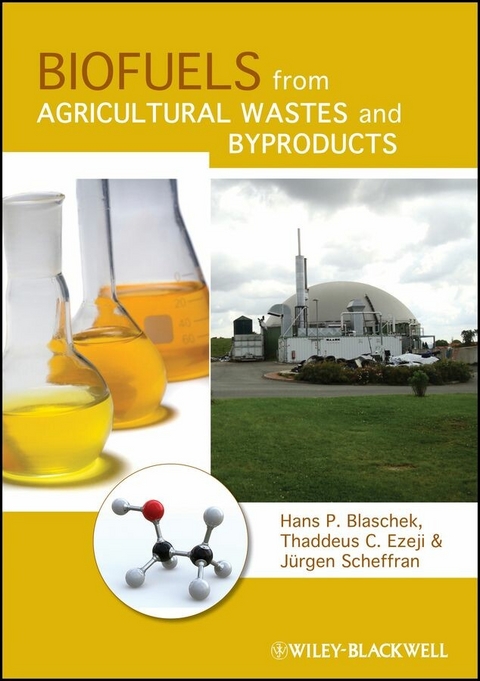
Biofuels from Agricultural Wastes and Byproducts (eBook)
John Wiley & Sons (Verlag)
978-0-470-96168-1 (ISBN)
Hans Blaschek is Professor of Food Microbiology and Assistant Dean at teh University of Illinois at Urbana-Champaign.
Thaddeus Ezeji is a Post-Doctoral Research Associate in the Biotechnology and Bioenergy Group at the University of Illinois at Urbana-Champaign.
Jürgen Scheffran is Professor at the Institute for Geography and at the KlimaCampus of Hamburg University in Germany.
Hans Blaschek is Professor of Food Microbiology and Assistant Dean at teh University of Illinois at Urbana-Champaign. Thaddeus Ezeji is a Post-Doctoral Research Associate in the Biotechnology and Bioenergy Group at the University of Illinois at Urbana-Champaign. Jürgen Scheffran is Professor at the Institute for Geography and at the KlimaCampus of Hamburg University in Germany.
Preface.
About the Editors.
Contributors.
1 Biofuels from Agricultural Wastes and Byproducts: An
Introduction (Hans P. Blaschek, Thaddeus C. Ezeji, and
Jürgen Scheffran).
2 Production of Liquid Biofuels from Biomass: Emerging
Technologies (Nasib Qureshi, Stephen Hughes, and Thaddeus C.
Ezeji).
3 Butanol Production from Lignocellulosic Biomass (Thaddeus
C. Ezeji and Hans P. Blaschek).
4 Practical Aspects of Methane Production from Agricultural
Wastes (Largus T. Angenent and Norman R. Scott).
5 Conversion of Agricultural Residues to Bioethanol: The Roles
of Cellulases and Cellulosomes (Edward A. Bayer, Raphael Lamed,
Bryan A. White, Shi-You Ding, and Michael E. Himmel).
6 Fuel and Chemical Production from Glycerol, a Biodiesel Waste
Product (Syed Shams Yazdani, Anu Jose Mattam, and Ramon
Gonzalez).
7 Farm-Gate to Plant-Gate Delivery of Lignocellulosic Feedstocks
from Plant Biomass for Biofuel Production (Klein E. Ileleji,
Shahab Sokhansanj, and John S. Cundiff).
8 Conversion of Existing Dry-Mill Ethanol Operations to
Biorefineries (Timothy C. Lindsey).
9 Cellulosic Ethanol from Agricultural Residues (Bin Yang,
Yanpin Lu, and Charles E. Wyman).
10 Hydrothermal Liquefaction to Convert Biomass into Crude Oil
(Yuanhui Zhang).
11 Detoxification of Lignocellulosic Hydrolysates (Bin Wang
and Hao Feng).
Index.
Chapter 1
Biofuels from Agricultural Wastes and Byproducts: An Introduction
Hans P. Blaschek, Thaddeus C. Ezeji, and Jürgen Scheffran
Around one-tenth of global primary energy use is based on bioenergy sources, of which about 10% are produced from modern bioenergy in the form of power, heat, and fuel. Biofuels for transportation account for 2.2% of all bioenergy, with a strong increase over the last decade. The total sustainable technical potential of bioenergy is estimated to be around a quarter of current global energy use.
Different from biomass specifically cultivated for energy purposes, residues and wastes are available as a byproduct of other processes. A significant amount of renewable energy is being generated from biogenic wastes and residues that do not require additional land and/or greenhouse gas emissions. Using their energy content would avoid methane emissions from slurry or landfills. Wastes and residues are quite heterogeneous: They arise in different sectors (agriculture and forestry, manufacturing, municipal enterprises, and private households) and at different stages of the value chain (biomass production and harvesting, processing, consumption, and disposal).
The technical potential of biogenic wastes and residues worldwide is estimated to be around 80 exajoules (EJ) per year. Research is needed in order to determine how much of this technical potential can be utilized in a sustainable and cost-effective way. A Department of Energy study has calculated in 2006 that over 1.3 billion dry tons per year of biomass from forestland and agricultural land alone are potentially available in the United States, a large fraction of which is from wastes and residues. This amount is sufficient to meet more than one-third of the current demand for transportation fuels while still meeting food, feed, and export demands. This biomass resource potential can be produced with relatively modest changes in land use, or agricultural and forestry practices.
Global production of biofuels in 2007 amounted to 16.4 billion gallons per year. Ethanol is currently the most important renewable liquid biofuel in the United States, which produces about half of the world’ s ethanol, compared with 38% in Brazil and 4.3% in the European Union. As the worldwide demand for fuels and chemicals surges and petroleum deposits are depleted, producers of ethanol fuel are increasingly looking beyond corn, potatoes, and other starchy crops as substrates for ethanol fuel production. Especially promising is cellulosic ethanol that can capitalize on microbial engineering and biotechnology to reduce costs. Derived from low-cost and plentiful feedstocks, it can achieve high yields, has high octane, and other desirable fuel properties. Lignocellulosic feedstocks, such as switchgrass, woody plants, mixture of prairie grass, agricultural residues, and municipal waste, have been proposed to offer environmental and economic benefits. Compared to current biofuel sources, these biomass feedstocks require fewer agricultural inputs than annual crops and can be grown on agriculturally marginal lands.
After crop harvesting, the residues usually represent relatively large amounts of cellulosic material that could be returned to the soil for its future enrichment in carbon and nutrients or could be made available for further conversion to biofuels. Similarly, animal wastes are high in cellulose content and can also be converted to liquid biofuels. Such agricultural byproducts can play an important role in triggering the transition to sustainable biofuels.
Increasing demand for bioenergy has generated a strong interest in the bioconversion of agricultural wastes and coproducts into fuels and chemical feedstocks. To reduce the impact on land resources available for the production of food crops, a further increase in ethanol production will require the use of agricultural materials not directly tied to food, especially lignocellulosic biomass such as corn stover and corn fiber, wheat straw and rice straw, paper and wood processing waste, landscape waste and sugarcane waste. Some of the technologies to be utilized also generate coproducts such as electricity, hydrogen, ammonia, and methanol.
The chapters in this book cover a wide range of topics and demonstrate the potential for production of biofuels and chemicals from agricultural wastes and byproducts.
The chapter by Nasib Qureshi, Stephen Hughes, and Thaddeus Ezeji describes recent progress in emerging technologies to produce ethanol from lignocellulosic substrates, over-coming inhibitors generated during pretreatment, development of genetically improved cultures, simultaneous product recovery, and process integration. It addresses problems associated with inhibitor generation and detoxification, fermentation of both hexose and pentose sugars to ethanol, and the development of efficient microbial strains. Simultaneous product recovery, process consolidation, and integration will further improve the economics of production of biofuels from biomass. Coproducts serve as additional sources for generating revenue.
Fermentation of lignocellulosic biomass to ethanol requires additional processing steps for hydrolysis of biomass to simple sugars before these sugars can be fermented. These extra processing steps add to the overall cost of the substrate. Generally, the chemicals that are used to pretreat lignocellulosic substrates include dilute acid or alkali, and their use results in higher sugar yields when compared to pretreatments such as hot water or ammonia. These pretreatments generate products that inhibit cell growth and/or the fermentation process or both. Another challenging problem with respect to fermentation of biomass involves the inability of some fermentation microorganisms to use pentose sugars for growth and production of biofuels. Lignocellulosic biomass contains up to 30% pentose sugars, which are not utilized by the traditional ethanol-producing cultures such as Saccharomyces cerevisiae. Although recombinant cultures of S. cerevisiae have been developed, the overall productivity and ethanol concentration that can be achieved by these strains are not optimal.
Next-generation alternative renewable liquid biofuels are under development. Butanol can be used in internal combustion engines. It has higher energy content, is more miscible with diesel, is less corrosive, and has a lower vapor pressure and flash point than ethanol. Butanol can also be used at higher blend levels with gasoline or even at 100% concentration in car engines with little or no engine modification. Because of the solubility characteristics of butanol, it can be transported in existing fuel pipelines and tanks. Butanol can be produced by the fermentation route using renewable biomass. The low vapor pressure of butanol facilitates its use in existing gasoline supply lines. As opposed to ethanol-producing cultures, butanol-producing cultures (e.g., C lostridium acetobutylicum or Clostridium beijerinckii) can use both hexose and pentose sugars released during hydrolysis of lignocellulosic biomass. During World War I and World War II, butanol plants existed worldwide, including those in the United States, the former Soviet Union (Russia), Canada, China, Japan, Australia, India, Brazil, Egypt, and Taiwan. As a result of various technological developments, attempts are being made to revive commercial production of butanol from agricultural residues for both chemical and biofuel use.
One of the major problems associated with bioproduction of butanol is the cost of substrate, which has led to recent interest in the production of butanol from alternative, inexpensive materials. However, much of the proposed alternative substrates, such as corn stover and fiber, wheat and rice straw, or dedicated energy crops such as switchgrass and Miscanthus, present challenges that need to be overcome before they can be used as commercial substrates for butanol production. The chapter by Thaddeus Ezeji and Hans Blaschek details the butanol pathway, including pretreatment and hydrolysis; generation of lignocellulosic degradation products; effects of degradation products on growth and butanol production by fermenting microorganisms; and strategies for improved utilization of lignocellulosic hydrolysates.
Most bacteria use glucose as a preferred carbon source for growth, and only when glucose is limiting are the pentose sugars utilized, making fermentation of complex mixture of sugars in lignocellulosic hydrolysates challenging. The solventogenic acetone-butanol-ethanol (ABE)-producing clostridia have an added advantage over many other cultures in that they can utilize both hexose and pentose sugars, which are released from wood and agricultural residues upon hydrolysis in order to produce ABE. Pretreatment can result in the formation of a complex mixture of microbial inhibitors that are detrimental to growth of fermenting microorganisms. Options for the reduction or elimination of lignocellulosic degradation products during pretreatment include the removal of inhibitors prior to fermentation, development of inhibitor-tolerant mutants, or a combination of the above approaches. The development of inhibitor-tolerant mutants via culture adaptation appears to be the most viable approach from an economic standpoint, a research area in which the authors are currently involved.
Largus T. Angenent and Norman R. Scott discuss practical aspects and future directions for methane production from agricultural wastes. Anaerobic digestion is a proven technology for bioconversion of agricultural waste that is high in organic material to gaseous biofuel. It provides an efficient energy...
| Erscheint lt. Verlag | 14.6.2016 |
|---|---|
| Sprache | englisch |
| Themenwelt | Kunst / Musik / Theater ► Theater / Ballett |
| Sachbuch/Ratgeber ► Sport ► Tanzen / Tanzsport | |
| Naturwissenschaften ► Biologie ► Ökologie / Naturschutz | |
| Naturwissenschaften ► Geowissenschaften | |
| Technik | |
| Weitere Fachgebiete ► Land- / Forstwirtschaft / Fischerei | |
| Schlagworte | Additional • Agricultural • Agriculture • Basis • bioenergy • Biofuels • Biokraftstoff • Biorenewable Resources • Book • byproducts • corn • Environmental Management, Policy & Planning • Environmental Studies • fiber • First • focus • Landwirtschaft • liquid • manure • Nachwachsende Rohstoffe • Nachwachsender Rohstoff • Natürliche Ressourcen • natural resources • Natürliche Ressourcen • Number • Potential • primarily • Produce • Production • Sources • Technology • Traditional • two sections • Umweltforschung • Umweltmanagement, Politik u. -Planung |
| ISBN-10 | 0-470-96168-6 / 0470961686 |
| ISBN-13 | 978-0-470-96168-1 / 9780470961681 |
| Informationen gemäß Produktsicherheitsverordnung (GPSR) | |
| Haben Sie eine Frage zum Produkt? |
 EPUB (Adobe DRM)
Kopierschutz: Adobe-DRM
Adobe-DRM ist ein Kopierschutz, der das eBook vor Mißbrauch schützen soll. Dabei wird das eBook bereits beim Download auf Ihre persönliche Adobe-ID autorisiert. Lesen können Sie das eBook dann nur auf den Geräten, welche ebenfalls auf Ihre Adobe-ID registriert sind.
Details zum Adobe-DRM
Dateiformat: EPUB (Electronic Publication)
EPUB ist ein offener Standard für eBooks und eignet sich besonders zur Darstellung von Belletristik und Sachbüchern. Der Fließtext wird dynamisch an die Display- und Schriftgröße angepasst. Auch für mobile Lesegeräte ist EPUB daher gut geeignet.
Systemvoraussetzungen:
PC/Mac: Mit einem PC oder Mac können Sie dieses eBook lesen. Sie benötigen eine
eReader: Dieses eBook kann mit (fast) allen eBook-Readern gelesen werden. Mit dem amazon-Kindle ist es aber nicht kompatibel.
Smartphone/Tablet: Egal ob Apple oder Android, dieses eBook können Sie lesen. Sie benötigen eine
Geräteliste und zusätzliche Hinweise
Buying eBooks from abroad
For tax law reasons we can sell eBooks just within Germany and Switzerland. Regrettably we cannot fulfill eBook-orders from other countries.
aus dem Bereich