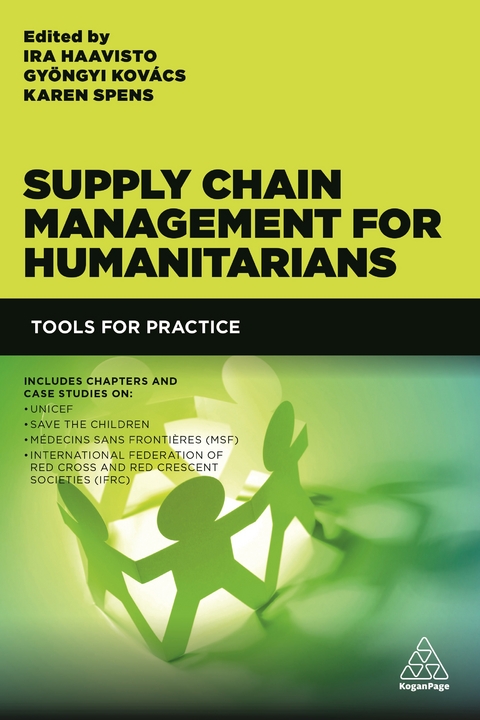
Supply Chain Management for Humanitarians
Kogan Page Ltd (Verlag)
978-0-7494-7468-3 (ISBN)
Supply Chain Management for Humanitarians provides an in-depth insight into the management of supply chains in the context of humanitarian logistics. This accessible and practical book considers humanitarian logistics from a strategic and operational perspective.
The overarching theme is collaboration and coordination, one of the biggest challenges in the humanitarian community. Supply Chain Management for Humanitarians takes a problem-based learning approach, featuring real cases and examples from leading organizations including Oxfam, Unicef, and The Red Cross.
Each chapter is self-standing, relating the content in each chapter to the supply chain as a whole. This enables the reader to easily dip into different sections. At the end of each chapter, there is a case study written by a leading practitioner currently working in the humanitarian field.
Supply Chain Management for Humanitarians fills a much needed gap in the market and is essential reading for humanitarians worldwide.
Dr Ira Haavisto is the Director of the HUMLOG Institute. She teaches Supply Chain Management and Social Responsibility at Hanken School of Economics in Finland. Professor Karen Spens is the Dean of Education at Hanken School of Economics, and a professor in Supply Chain Management and Social Responsibility. She is widely published in the logistics and supply chain industry. Dr Gyöngyi Kovács is the Erkko Professor in Humanitarian Logistics at the Hanken School of Economics, and the Director of the HUMLOG Institute. She also lectures in supply chain management and corporate geography. She is widely published in the logistics and supply chain industry.
Section - 01: Logistics and supply chain management in the humanitarian context;
Chapter - 1.1: Introduction;
Chapter - 1.2: Exploring logistics competences and capabilities in not-for-profit environments: the case of Médecins Sans Frontières;
Section - 02: Setting up a supply chain network;
Chapter - 2.1: Setting up a humanitarian supply network;
Chapter - 2.2: Service triad case study;
Chapter - 2.3: Setting up a supply chain network in the Kenyan nutrition sector;
Section - 03: Supply chain strategy;
Chapter - 3.1: Supply chain strategy;
Chapter - 3.2: Case study: partnerships – supply chain strategy;
Section - 04: Decision making in the supply chain;
Chapter - 4.1: Decision making in humanitarian logistics;
Chapter - 4.2: Forecasts, financing and acceleration of humanitarian logistics: from supply chain to value chain;
Section - 05: Procurement ;
Chapter - 5.1: Procurement in humanitarian supply chains;
Chapter - 5.2: Joint tender for freight-forwarding services: promises and pitfalls;
Chapter - 5.3: A procurement project in the Philippines;
Chapter - 5.4: Partnerships and innovative procurement as enablers for sustainable development goals;
Section - 06: Transportation, fleet management, delivery and distribution;
Chapter - 6.1: Transport in humanitarian supply chains;
Chapter - 6.2: Humanitarian aid supply corridors: Europe–Iraq;
Section - 07: Warehouse and inventory management;
Chapter - 7.1: Warehousing in humanitarian logistics;
Chapter - 7.2: The ABC analysis;
Section - 08: Information technology;
Chapter - 8.1: Information systems for humanitarian logistics: concepts and design principles;
Chapter - 8.2: GDACSmobile: an IT tool supporting assessments for humanitarian logistics;
Section - 09: Sustainability, performance measurement, monitoring/evaluation and exit strategy;
Chapter - 9.1: Logistics competency for humanitarian relief: the case of Médecins Sans Frontières;
Chapter - 9.2: Community-managed rural water supply in Ethiopia;
Chapter - 9.3: Managing supply chain sustainability risks;
Chapter - 9.4: Using three-dimensional printing in a humanitarian context: challenges and solutions;
Chapter - 9.5: Making performance measurement work in humanitarian logistics: the case of an IT-supported balanced scorecard;
Chapter - 9.6: Boko Haram: the security and supply chain management challenges of providing relief;
Chapter - 9.7: Measuring the supply chain performance of humanitarian organizations: the case of Thai Red Cross in Chiangmai
| Erscheinungsdatum | 16.08.2016 |
|---|---|
| Verlagsort | London |
| Sprache | englisch |
| Maße | 157 x 234 mm |
| Gewicht | 628 g |
| Themenwelt | Sachbuch/Ratgeber ► Beruf / Finanzen / Recht / Wirtschaft ► Wirtschaft |
| Wirtschaft ► Betriebswirtschaft / Management ► Logistik / Produktion | |
| Wirtschaft ► Betriebswirtschaft / Management ► Marketing / Vertrieb | |
| ISBN-10 | 0-7494-7468-8 / 0749474688 |
| ISBN-13 | 978-0-7494-7468-3 / 9780749474683 |
| Zustand | Neuware |
| Informationen gemäß Produktsicherheitsverordnung (GPSR) | |
| Haben Sie eine Frage zum Produkt? |
aus dem Bereich