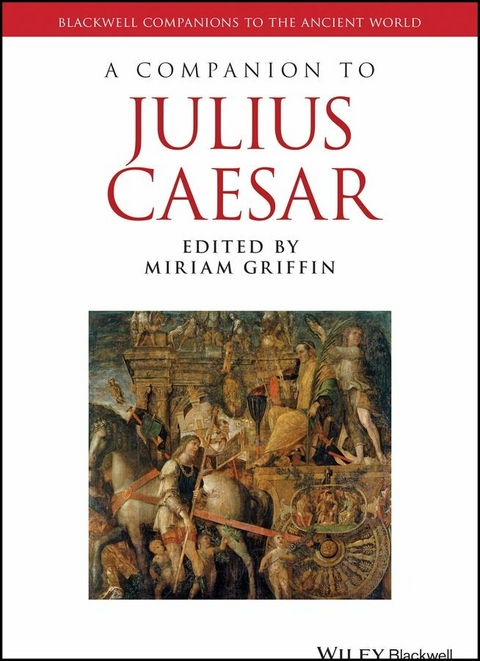
A Companion to Julius Caesar (eBook)
John Wiley & Sons (Verlag)
978-1-119-06235-6 (ISBN)
- Explores Caesar from a variety of perspectives: military genius, ruthless tyrant, brilliant politician, first class orator, sophisticated man of letters, and more
- Utilizes Caesar's own extant writings
- Examines the viewpoints of Caesar's contemporaries and explores Caesar's portrayals by artists and writers through the ages
Miriam Griffin is Emeritus Fellow of Classics at Oxford University. She is the author of numerous books and articles on Roman history and philosophy, including Nero (1987), Seneca: A Philosopher in Politics (1992), and Philosophia togata I & II (with Jonathan Barnes, 1991 & 1997). She was until recently editor of the Classical Quarterly.
A Companion to Julius Caesar comprises 30 essays from leading scholars examining the life and after life of this great polarizing figure. Explores Caesar from a variety of perspectives: military genius, ruthless tyrant, brilliant politician, first class orator, sophisticated man of letters, and more Utilizes Caesar s own extant writings Examines the viewpoints of Caesar s contemporaries and explores Caesar s portrayals by artists and writers through the ages
Miriam Griffin is Emeritus Fellow of Classics at Oxford University. She is the author of numerous books and articles on Roman history and philosophy, including Nero (1987), Seneca: A Philosopher in Politics (1992), and Philosophia togata I & II (with Jonathan Barnes, 1991 & 1997). She was until recently editor of the Classical Quarterly.
List of Figures viii
Notes on Contributors x
Preface xvi
Reference Works: Abbreviated Titles xviii
1 Introduction 1
Part I Biography: Narrative 9
2 From the Iulii to Caesar 11
Ernst Badian
3 Caesar as a Politician 23
Erich S. Gruen
4 The Proconsular Years: Politics at a Distance 37
John T. Ramsey
5 The Dictator 57
Jane F. Gardner
6 The Assassination 72
Andrew Lintott
Part II Biography: Themes 83
7 General and Imperialist 85
Nathan Rosenstein
8 Caesar and Religion 100
David Wardle
9 Friends, Associates, and Wives 112
Catherine Steel
10 Caesar the Man 126
Jeremy Paterson
11 Caesar as an Intellectual 141
Elaine Fantham
Part III Caesar's Extant Writings 157
12 Bellum Gallicum 159
Christina S. Kraus
13 Bellum Civile 175
Kurt Raaflaub
14 The Continuators: Soldiering On 192
Ronald Cluett
Part IV Caesar's Reputation at Rome 207
15 Caesar's Political and Military Legacy to the Roman Emperors 209
Barbara Levick
16 Augustan and Tiberian Literature 224
Mark Toher
17 Neronian Literature: Seneca and Lucan 239
Matthew Leigh
18 The First Biographers: Plutarch and Suetonius 252
Christopher Pelling
19 The Roman Historians after Livy 267
Luke Pitcher
20 The First Emperor: The View of Late Antiquity 277
Timothy Barnes
21 The Irritating Statues and Contradictory Portraits of Julius Caesar 288
Paul Zanker
Part V Caesar's Place in History 315
22 The Middle Ages 317
Almut Suerbaum
23 Empire, Eloquence, and Military Genius: Renaissance Italy 335
Martin McLaughlin
24 Some Renaissance Caesars 356
Carol Clark
25 Shakespeare's Julius Caesar and the Dramatic Tradition 371
Julia Griffin
26 The Enlightenment 399
Thomas Biskup
27 Caesar and the Two Napoleons 410
Claude Nicolet
28 Republicanism, Caesarism, and Political Change 418
Nicholas Cole
29 Caesar for Communists and Fascists 431
Luciano Canfora
30 A Twenty-First-Century Caesar 441
Maria Wyke
Bibliography 456
Index 492
"Those seeking answers to [Caesar's] place in the world as hero or villain will not find the answer in these pages. Instead, they will find this book adds illumination toward that decision, which must be made by the reader, not the writers. It is precisely this rational impartiality that makes A Companion to Julius Caesar an aid to study, and a good one at that ... Enlightening." UNRV History (1 September 2015)
Notes on Contributors
Ernst Badian, FBA, John Moors Cabot Professor of History, Emeritus, Harvard, was born in Vienna and educated in New Zealand and at University College, Oxford. He was a Professor at Leeds and at Buffalo, before his appointment to Harvard (1971–98). His publications include Foreign Clientelae (264–70BC), 1958; Studies in Greek and Roman History, 1964; Roman Imperialism in the Late Republic, 1967 (revised and enlarged as Römischer Imperialismus in der Späten Republik, 1980); Publicans and Sinners, 1972 (translated into German and augmented as Zöllner und Sünder, 1997); From Plataea to Potidaea, 1993; and numerous contributions to the Oxford Classical Dictionary and to journals.
Timothy Barnes was educated at Balliol College, Oxford and held a Junior Research Fellowship at the Queen’s College. He taught in the Department of Classics at the University of Toronto from 1970 to 2007, and was elected a Fellow of the Royal Society of Canada in 1985. He won the Conington Prize at Oxford for his first book, Tertullian: A Historical and Literary Study (1971) (2nd edition, with postscript, 1985). His major publications since then have been The Sources of the Historia Augusta (1978), Constantine and Eusebius (1981), The New Empire of Diocletian and Constantine (1982), Athanasius and Constantius: Theology and Politics in the Constantinian Empire (1993) and Ammianus Marcellinus and the Representation of Historical Reality (1998). He now lives in Edinburgh and is attached to the University of Edinburgh.
Thomas Biskup is Research Councils UK Fellow and Lecturer in Enlightenment History at the University of Hull. He gained his PhD at the University of Cambridge in 2001, and was Mary Somerville Research Fellow at the University of Oxford from 2001 to 2004. His main research interests are the cultural history of European monarchy and courts in the early modern and modern eras and natural history in eighteenth-century England and Germany. Recent publications include: ‘German court and French Revolution: Émigrés in Brunswick around 1800’, in Francia, 33 (2007); ‘A University for Empire? The University of Göttingen and the Personal Union, 1737–1837’, in Brendan Simms and Torsten Riotte (eds.), The Hanoverian Dimension in British History, 1714–1837 (Cambridge, 2007); ‘Napoleon’s second Sacre? Iéna and the ceremonial translation of Frederick the Great’s insignia in 1807’, in Alan Forrest and Peter H. Wilson (eds.), The Bee and the Eagle: Napoleonic France and the End of the Holy Roman Empire (Basingstoke, 2008); and (coedited with Marc Schalenberg), Selling Berlin: Imagebildung und Stadtmarketing von der preußischen Residenz bis zur Bundeshauptstadt (Stuttgart, 2008).
Luciano Canfora studied at the University of Bari and at the Scuola Normale of Pisa. He is currently Professor of Classical Philology at the University of Bari. He is chief editor of the journal Quaderni di Storia (1975–) and of the series “La città antica” (published by Sellerio, Palermo). In 2000 he was awarded the Gold Medal of the President of the Italian Republic for cultural merits, and in 2005 he received the Golden Honour Cross of the Hellenic Republic. Among his publications are: Conservazione e perdita dei classici (Padua: Antenore 1974); Cultura classica e crisi tedesca. Gli scritti politici di Wilamowitz 1914–31 (Bari: De Donato 1977); Ideologie del classicismo (Turin: Einaudi, 1980); Studi di storia della storiografia romana (Bari: Edipuglia, 1993; Il copista come autore (Palermo: Sellerio, 2002); Il papiro di Dongo (Milan: Adelphi, 2005); Democracy in Europe: A History of an Ideology (Oxford: Blackwell 2006); Julius Caesar: The People’s Dictator (Edinburgh: Edinburgh University Press, 2007); Filologia e libertà (Milan, Mondadori, 2008); and Exporter la liberté. Échec d’un mythe (Paris: Desjonquères, 2008).
Carol Clark studied at Somerville College, Oxford and Westfield College, London. She then taught in London, in West Africa and at Glasgow University before being elected to Balliol College, Oxford, where she remained for many years as Fellow and Tutor in Modern Languages. She has published books and articles on Rabelais and Montaigne and translations from Baudelaire, Rostand and Proust.
Ronald Cluett holds a Ph.D. in Classics from Princeton University. From 1992 until 2004 he held a joint position in Classics and History at Pomona College in Claremont, California. He has published on ancient numismatics and Roman women as well as on the Continuators. He is currently completing his J.D. at the Georgetown University Law Center, where he has been surprised to discover numerous structural and stylistic similarities between the Iliad and the United States Internal Revenue Code.
Nicholas Cole is currently a Junior Research Fellow in History at St. Peter’s College, Oxford. He read Ancient and Modern History at University College, Oxford, where he also completed his MPhil in Greek and Roman History and his doctorate. His particular interests are the influence of classical political thought on America’s first politicians, and the search for a new ‘science of politics’ in post-Independence America. He has been a Visiting Fellow at the International Center for Jefferson Studies at Monticello. His book, The Ancient World in Jefferson’s America, will be published by Oxford University Press.
Elaine Fantham took her degrees at Oxford and Liverpool and taught at St. Andrews University before emigrating in 1966. She has taught at the University of Toronto (1968–86) and Princeton University (1986–2000) and is now Giger Professor of Latin Emeritus. She has published commentaries on Seneca’s Troades, Lucan BC II and Ovid Fasti IV, and monographs including Roman Literary Culture (1996) and The Roman World of Cicero’s De Oratore (2004). She is editor and contributor to the conference volume Caesar against Liberty? (Proceedings of the Langford Seminar, 2005), reviewing Roman perspectives on Caesar’s autocracy.
Jane F. Gardner is Emeritus Professor of Ancient History, School of Humanities, University of Reading, UK. Her publications include two in the Penguin Classics series, Caesar: The Civil War (1967) and a revision of S. A. Handford’s Caesar: The Gallic War (1951, rev. 1982), and three monographs on Roman legal and social history, Women in Roman Law and Society (1986), Being a Roman Citizen (1993) and Family and Familia in Roman Law and Life (1998).
Julia Griffin studied Classics and then English at Oxford and Cambridge Universities and is Associate Professor of English at Georgia Southern University. She has published on various Renaissance authors, and is particularly interested in later uses of the classical writers. Among her publications is Selected Poems of Abraham Cowley, Edmund Waller and John Oldham (London: Penguin Classics, 1998).
Miriam Griffin is Emeritus Fellow in Ancient History of Somerville College, Oxford. She is the author of Seneca: a Philosopher in Politics (Oxford: Clarendon Press, 1976; reissued with Postscript, 1992), of Nero: the End of a Dynasty (London: Batsford, and New Haven, CT: Yale University Press, 1984), and (with E. M. Atkins) of Cicero: On Duties (Cambridge: Cambridge University Press, 1991). She is currently working on a study of Seneca’s De Beneficiis.
Erich S. Gruen is Gladys Rehard Wood Professor of History and Classics Emeritus at the University of California, Berkeley. His research has been primarily in the Roman Republic, Hellenistic history, and the Jews in the Greco-Roman world. His books include The Last Generation of the Roman Republic (1974), The Hellenistic World and the Coming of Rome (1984), Culture and Identity in Republican Rome (1992), Heritage and Hellenism (1998), and Diaspora: Jews Amidst Greeks and Romans (2002). His current project is a study of Greek and Roman perceptions and representations of the “Other.”
Christina S. Kraus taught at New York University, University College London, and Oxford before moving to Yale. She works on Roman historiographical narrative, and has published studies on Caesar, Sallust, Livy, and Tacitus. She is currently writing a commentary, with A. J. Woodman, on Tacitus, Agricola.
Matthew Leigh is Professor of Classical Languages and Literature at Oxford University and a Tutorial Fellow of St. Anne’s College, Oxford. He is the author of Lucan: Spectacle and Engagement (Oxford, 1997) and Comedy and the Rise of Rome (Oxford, 2004).
Barbara Levick, Emeritus Fellow and Tutor in Literae Humaniores at St. Hilda’s College, Oxford, is the author of Tiberius the Politician (1976), Claudius (1990), Vespasian (1999), and Julia Domna: Syrian Empress (2007), and is co-editor with Richard Hawley of Women in Antiquity: New Assessments (1995). She is working on a book about Augustus.
Andrew Lintott is now retired, after teaching first Classics, then Ancient History, successively at King’s College London, Aberdeen University, and Worcester College,...
| Erscheint lt. Verlag | 21.7.2015 |
|---|---|
| Reihe/Serie | Blackwell Companions to the Ancient World |
| Blackwell Companions to the Ancient World | Blackwell Companions to the Ancient World |
| Sprache | englisch |
| Themenwelt | Literatur ► Biografien / Erfahrungsberichte |
| Literatur ► Romane / Erzählungen | |
| Sachbuch/Ratgeber ► Geschichte / Politik | |
| Geschichte ► Allgemeine Geschichte ► Vor- und Frühgeschichte | |
| Geschichte ► Allgemeine Geschichte ► Altertum / Antike | |
| Sozialwissenschaften ► Soziologie ► Gender Studies | |
| Schlagworte | Ancient Rome • Andrew W. Lintott • Cäsar • Caesar • Cäsar • Classical Studies • Humanistische Studien • Julius Caesar • Kurt A. Raaflaub • Luciano Canfora • Nathan Rosenstein • Römische Geschichte • Roman emperor • Roman History • Römische Geschichte |
| ISBN-10 | 1-119-06235-7 / 1119062357 |
| ISBN-13 | 978-1-119-06235-6 / 9781119062356 |
| Informationen gemäß Produktsicherheitsverordnung (GPSR) | |
| Haben Sie eine Frage zum Produkt? |
 EPUB (Adobe DRM)
Kopierschutz: Adobe-DRM
Adobe-DRM ist ein Kopierschutz, der das eBook vor Mißbrauch schützen soll. Dabei wird das eBook bereits beim Download auf Ihre persönliche Adobe-ID autorisiert. Lesen können Sie das eBook dann nur auf den Geräten, welche ebenfalls auf Ihre Adobe-ID registriert sind.
Details zum Adobe-DRM
Dateiformat: EPUB (Electronic Publication)
EPUB ist ein offener Standard für eBooks und eignet sich besonders zur Darstellung von Belletristik und Sachbüchern. Der Fließtext wird dynamisch an die Display- und Schriftgröße angepasst. Auch für mobile Lesegeräte ist EPUB daher gut geeignet.
Systemvoraussetzungen:
PC/Mac: Mit einem PC oder Mac können Sie dieses eBook lesen. Sie benötigen eine
eReader: Dieses eBook kann mit (fast) allen eBook-Readern gelesen werden. Mit dem amazon-Kindle ist es aber nicht kompatibel.
Smartphone/Tablet: Egal ob Apple oder Android, dieses eBook können Sie lesen. Sie benötigen eine
Geräteliste und zusätzliche Hinweise
Buying eBooks from abroad
For tax law reasons we can sell eBooks just within Germany and Switzerland. Regrettably we cannot fulfill eBook-orders from other countries.
aus dem Bereich