


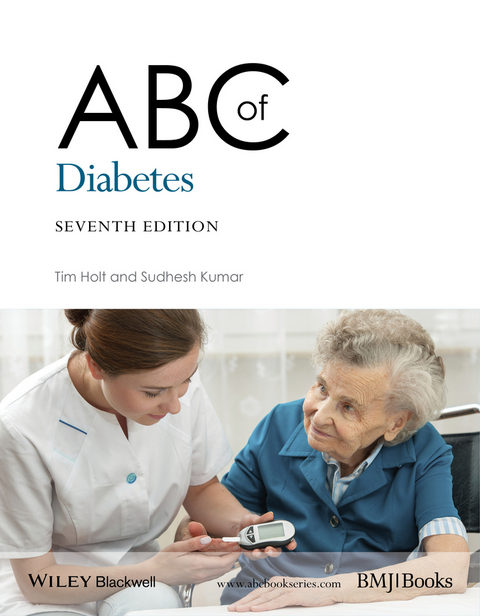
ABC of Diabetes (eBook)
John Wiley & Sons (Verlag)
978-1-118-85054-1 (ISBN)

ABC of Diabetes provides primary care practitioners with a practical guide to all aspects of diabetes including the aetiology, diagnosis and management of Types 1 and 2 diabetes, detection and prevention, and the organization of care and support.
Advances in diabetes care take place at a rapid rate and this new edition is updated throughout to cover the latest evidence-based information for contemporary practice. A new chapter describes the management of severe and complex obesity complicated by diabetes and the management of patients through bariatric surgery.
It also covers the growing number of devices and digital technology, including health informatics, that can assist in diabetes care and provides evidence of their benefit. With more links to useful websites and resources online, it is now easier than ever to keep up-to-date with changes.
Drawing on the professional and teaching experience of an expert author team, ABC of Diabetes is an essential guide for general practice, primary care practitioners, diabetes specialist nurses, as well as for medical students and those training in diabetes as a specialty.
Tim A. Holt is Senior Clinical Research Fellow, Nuffield Department of Primary Care Health Sciences, Oxford University, Oxford and General Practitioner, Oxfordshire
Sudhesh Kumar is Dean, Warwick Medical School, University of Warwick, & Honorary Consultant Physician, University Hospital Coventry, Coventry
ABC of Diabetes provides primary care practitioners with a practical guide to all aspects of diabetes including the aetiology, diagnosis and management of Types 1 and 2 diabetes, detection and prevention, and the organization of care and support. Advances in diabetes care take place at a rapid rate and this new edition is updated throughout to cover the latest evidence-based information for contemporary practice. A new chapter describes the management of severe and complex obesity complicated by diabetes and the management of patients through bariatric surgery. It also covers the growing number of devices and digital technology, including health informatics, that can assist in diabetes care and provides evidence of their benefit. With more links to useful websites and resources online, it is now easier than ever to keep up-to-date with changes. Drawing on the professional and teaching experience of an expert author team, ABC of Diabetes is an essential guide for general practice, primary care practitioners, diabetes specialist nurses, as well as for medical students and those training in diabetes as a specialty.
Tim A. Holt is Senior Clinical Research Fellow, Nuffield Department of Primary Care Health Sciences, Oxford University, Oxford and General Practitioner, Oxfordshire Sudhesh Kumar is Dean, Warwick Medical School, University of Warwick, & Honorary Consultant Physician, University Hospital Coventry, Coventry
Contributors to this Book vii
Foreword ix
Preface xi
Acknowledgements xiii
Diagnosing Diabetes 1
Tim Holt and Sudhesh Kumar
Types of Diabetes 7
Tim Holt and Sudhesh Kumar
Helping People Live with Diabetes 11
Tim Holt and Sudhesh Kumar
Early Detection and Prevention of Diabetes 15
Tim Holt and Sudhesh Kumar
Obesity 23
Tim Holt and Sudhesh Kumar
Cardiovascular Disease 27
Ponnusamy Saravanan, Vinod Patel, Tim Holt and Sudhesh Kumar
Management of Blood Glucose in Type 2 Diabetes 35
Tim Holt and Sudhesh Kumar
Hyperglycaemic Emergencies and Management of Diabetes in Hospital 41
Sailesh Sankar, Sudhesh Kumar and Tim Holt
Insulin Therapy 47
Tim Holt and Sudhesh Kumar
Hypoglycaemia 51
Tim Holt, Sudhesh Kumar and Noreen Kumar
Self?]Management of Diabetes 55
Tim Holt and Sudhesh Kumar
Surveillance for Complications 63
Tim Holt and Sudhesh Kumar
Kidney Disease in Diabetes 67
Tim Holt and Sudhesh Kumar
Eye Disease in Diabetes 75
Tim Holt and Sudhesh Kumar
The Diabetic Foot 81
Tim Holt, Gurdev Deogon and Sudhesh Kumar
Diabetic Neuropathy 91
Tim Holt and Sudhesh Kumar
Psychological Issues Related to Diabetes Care 95
Tim Holt and Sudhesh Kumar
Diabetes and Pregnancy 99
Sudhesh Kumar, Aresh Anwar and Tim Holt
Organisation of Diabetes Care in General Practice 107
Tim Holt and Sudhesh Kumar
New and Emerging Therapies for Diabetes 111
Tim Holt and Sudhesh Kumar
Support for People Living with Diabetes 115
Tim Holt and Sudhesh Kumar
Index 000
CHAPTER 1
Diagnosing Diabetes
Tim Holt1 and Sudhesh Kumar2
1Nuffield Department of Primary Care Health Sciences, Oxford University, UK
2Warwick Medical School, University of Warwick; and WISDEM, University Hospital, Coventry, UK
OVERVIEW
- Diabetes produces a variety of clinical presentations, from acute to gradual onset.
- The diagnosis should be based on two separate tests, unless the patient is clearly symptomatic, in which case only one positive test is required.
- A combination of genetic and environmental factors contribute to the risk of diabetes.
- Impaired glucose regulation is an important risk factor, both for future diabetes and cardiovascular disease.
- Distinction between random and fasting samples is essential in interpreting the significance of borderline blood glucose levels.
Introduction
Diabetes mellitus is a common metabolic disorder that is defined by chronic hyperglycaemia. There are myriad underlying causes for the hyperglycaemia but, currently, much of our approach to treatment is empirical. Besides symptoms related to hyperglycaemia itself, such as thirst, polyuria and weight loss, it may also cause potentially life-threatening acute hyperglycaemic emergencies. It is a major cause of morbidity and premature mortality from long-term complications such as cardiovascular disease, blindness, renal failure, amputations and stroke. With good control of hyperglycaemia established early on, and continued life-long, an individual with diabetes can enjoy a good quality of life and reduce the risk of these long-term complications that are so detrimental to their life and wellbeing.
Prevalence of diabetes
In the United Kingdom, we have an estimated 2.9 million people with diabetes. The prevalence of both type 1 and type 2 diabetes is increasing. Type 2 diabetes is increasing far more rapidly, driven by increasing life expectancy and the epidemic of obesity. It is believed that there will be as many as 300 million people with diabetes worldwide by the year 2025. Most of this increase will occur in developing countries. The majority of children have insulin-requiring type 1 diabetes, while the vast majority of those aged over 25 years will have type 2 diabetes (Figure 1.1).
Figure 1.1 Projected prevalence of diabetes in 2025.
Source: World Health Organisation (1998). Reproduced with permission of World Health Organisation.
Types of diabetes
The types of diabetes have been classified by the WHO. Type 1 diabetes (previously referred to as insulin-dependent diabetes mellitus or IDDM) is due to absolute insulin deficiency and is usually an autoimmune disease, leading to the destruction of the insulin-secreting beta cells in the pancreas. In some cases, the cause of destruction of the beta cells is not known.
Type 2 (previously known as non-insulin dependent diabetes mellitus or NIDDM) results from relative insulin deficiency that may be associated with varying degrees of insulin action defects, known collectively as insulin resistance.
For a practising clinician, the implication of this diagnosis is that patients with type 1 diabetes require insulin straight away and insulin should not be stopped, as it is life-preserving. Type 2 patients can progress through several stages, and may require insulin later on in their disease.
Risk factors for diabetes
Genetics
Genetic susceptibility is important for both types of diabetes. Family history of type 1 diabetes, or other autoimmune diseases such as autoimmune thyroid disease, is associated with a higher risk of developing type 1 diabetes in the family. Inheritance in type 2 diabetes is far more complex, as there are many underlying causes. Furthermore, the risk varies according to the particular sub-type of type 2 diabetes. A family history of type 2 diabetes in a first degree relative is a strong risk factor for diabetes in that individual.
Obesity
Apart from family history, obesity is a very important risk factor for diabetes. For a given degree of obesity, central or ‘apple-shaped’ obesity is associated with a much higher risk of progression to type 2 diabetes than for those who have lower body obesity or are ‘pear-shaped’. Those with a body mass index (BMI) of more than 25 kg/m2 or high waist circumference (Table 1.1) are at a higher risk of developing diabetes, and they should be encouraged to take regular exercise and eat healthily (Figure 1.2).
Table 1.1 The International Classification of adult underweight, overweight and obesity according to BMI (adapted from WHO guidelines, http://apps.who.int/bmi/index.jsp?introPage=intro_3.html).
Source: Adapted from World Health Organisation 1995, 2000, 2004.
| BMI(kg/m2) |
| Classification | Principal cut-off points | Additional cut-off points |
| Underweight | <18.50 | <18.50 |
| Normal range | 18.50–24.99 | 18.50–22.99 |
| 23.00–24.99 |
| Overweight | ≥25.00 | ≥25.00 |
| Pre-obese | 25.00–29.99 | 25.00–27.49 |
| 27.50–29.99 |
| Obese | ≥30.00 | ≥30.00 |
| Obese class I | 30.00–34.99 | 30.00–32.49 |
| 32.50–34.99 |
| Obese class II | 35.00–39.99 | 35.00–37.49 |
| 37.50–39.99 |
| Obese class III | ≥40.00 | ≥40.00 |
Figure 1.2 ‘Apple’-shaped fat distribution (central obesity with intra-abdominal adiposity) carries a higher cardiovascular and diabetes risk than ‘pear’-shaped fat distribution.
Age
Beta cell function declines with age. Indeed, if we live long enough, all of us have the potential to develop diabetes at some stage. With an aging population, an increase in prevalence of diabetes can be expected.
Ethnicity
People of South Asian or Afro-Caribbean origin are at higher risk of developing diabetes. They are also more likely to have type 2 diabetes presenting at a young age, and usually have poorer risk factor control. South Asian patients have a high risk of developing diabetic renal disease and also coronary artery disease. Afro-Caribbean patients are more likely to have strokes, and have a higher risk of gestational diabetes. South Asian and Hispanic children may develop type 2 diabetes.
Initial presentation and diagnosis
The commonest presentation is tiredness, thirst, polyuria, weight loss, pruritus vulvae or balanitis. It is not uncommon for this diagnosis to be missed for years, and a significant proportion of those with type 2 diabetes remain undiagnosed. Insidious symptoms mean that the patients generally tend to ignore them. This is one reason why complications are often seen at diagnosis in patients with type 2 diabetes. A number of cases with type 2 diabetes are now diagnosed at insurance examinations, or through opportunistic testing, when the patient has presented for some other problem to the general practice or hospital.
The diagnosis of diabetes must not be taken lightly by a clinician, as the consequences for the individual are significant and life-long. For those presenting with severe symptoms, evidence of long-term complications or severe hyperglycaemia at presentation, the diagnosis is quite straightforward and can be made using only one diagnostic blood glucose or HbA1c measurement. In asymptomatic individuals presenting with mild hyperglycaemia, the diagnosis should only be established on the basis of at least two abnormal test results. One may use either glucose or HbA1c testing for diagnosis of diabetes (Box 1.1).
Box 1.1 Recommendation of the International Expert Committee
For the diagnosis of diabetes:
- The HbA1c assay is an accurate, precise measure of chronic glycaemic levels and correlates well with the risk of diabetes complications.
- The HbA1c assay has several advantages over laboratory measures of glucose.
- Diabetes should be diagnosed when HbA1c is ≥ 48 mmol/mol. Diagnosis should be confirmed with a repeat HbA1c test. Confirmation is not required in symptomatic subjects with plasma glucose levels ≥ 11.1 mmol/l.
- If HbA1c testing is not possible, previously recommended diagnostic methods (e.g. FPG or two-hour OGTT, with confirmation) are acceptable.
- HbA1c should not be used to diagnose diabetes in certain circumstances, namely: pregnancy; children, young people or anyone following a type 1...
| Erscheint lt. Verlag | 15.7.2015 |
|---|---|
| Reihe/Serie | ABC Series | ABC Series |
| Sprache | englisch |
| Themenwelt | Sachbuch/Ratgeber ► Gesundheit / Leben / Psychologie |
| Medizinische Fachgebiete ► Innere Medizin ► Diabetologie | |
| Medizinische Fachgebiete ► Innere Medizin ► Endokrinologie | |
| Studium ► 1. Studienabschnitt (Vorklinik) ► Biochemie / Molekularbiologie | |
| Schlagworte | Allgemeine u. Innere Medizin • Diabetes • Diabetes, Prevention, Obesity, Cardiovascular, Disease, Glucose, Type 2, Blood, Hyperglycaemic, Hypoglycaemia, Insulin, Therapy, Self-Management, Surveillance, Complications, Diabetic Foot, Pregnancy, General Practice, Bariatric, surgery, digital, technology, health, informatics • General & Internal Medicine • Krankenpflege • Medical Science • Medizin • nursing |
| ISBN-10 | 1-118-85054-8 / 1118850548 |
| ISBN-13 | 978-1-118-85054-1 / 9781118850541 |
| Informationen gemäß Produktsicherheitsverordnung (GPSR) | |
| Haben Sie eine Frage zum Produkt? |
 PDF (Adobe DRM)
Kopierschutz: Adobe-DRM
Adobe-DRM ist ein Kopierschutz, der das eBook vor Mißbrauch schützen soll. Dabei wird das eBook bereits beim Download auf Ihre persönliche Adobe-ID autorisiert. Lesen können Sie das eBook dann nur auf den Geräten, welche ebenfalls auf Ihre Adobe-ID registriert sind.
Details zum Adobe-DRM
Dateiformat: PDF (Portable Document Format)
Mit einem festen Seitenlayout eignet sich die PDF besonders für Fachbücher mit Spalten, Tabellen und Abbildungen. Eine PDF kann auf fast allen Geräten angezeigt werden, ist aber für kleine Displays (Smartphone, eReader) nur eingeschränkt geeignet.
Systemvoraussetzungen:
PC/Mac: Mit einem PC oder Mac können Sie dieses eBook lesen. Sie benötigen eine
eReader: Dieses eBook kann mit (fast) allen eBook-Readern gelesen werden. Mit dem amazon-Kindle ist es aber nicht kompatibel.
Smartphone/Tablet: Egal ob Apple oder Android, dieses eBook können Sie lesen. Sie benötigen eine
Geräteliste und zusätzliche Hinweise
Buying eBooks from abroad
For tax law reasons we can sell eBooks just within Germany and Switzerland. Regrettably we cannot fulfill eBook-orders from other countries.
aus dem Bereich


