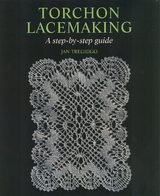
Torchon Lacemaking (eBook)
240 Seiten
Crowood (Verlag)
978-1-78500-067-6 (ISBN)
Jan Tregidgo has been making bobbin lace since 1980 when she attended a weekend course at Missenden Abbey. From that moment she was hooked and she has been passionate about bobbin lacemaking ever since. As a trained teacher, she has been teaching lacemaking since the late 1980's: locally for Portsmouth College Adult Education classes, at residential colleges and for the Lace Guild. Jan also teaches creative textiles and has combined her modern textile techniques with her traditional bobbin lace skills to produce 'LetExist' - her 21st century approach to contemporary bobbin lacemaking. Jan was awarded a medal of excellence by the Lace Guild in 2007 for her lacemaking skills in a piece of traditional Bedfordshire lace.
Torchon lacemaking is a textile art steeped in tradition - the skills required are often perceived to be beyond the reach of ordinary mortals. In this practical book, Jan Tregidgo describes those skills through a step-by-step guide and makes them accessible to all. She explains traditional techniques through a series of specially designed samplers, which can be worked in order by the beginner or in any order they choose by the more experienced. Although colour is not traditional in bobbin lace, it has been used here to great effect so the path of each thread can be clearly followed through the sampler.
1 Equipment and Materials
In order to make bobbin lace, the lacemaker will need basic equipment and materials such as a lace pillow, lace bobbins, pins, lace pricking and thread. To start with, these items will be new to the beginner, but their uses and a description of each will follow. For clarity these items are listed under two categories – equipment and materials.
Equipment refers to those items that can be used many times, such as lace pillows or bobbins. (Broken items may need replacing, such as broken bobbins or bent pins.)
Materials are consumables, which will run out and need to be replaced, such as thread, pricking card or beeswax.
Other items are very useful and will be described, but the beginner would be well advised to purchase items only as they become necessary. A teacher or a local lace group may have second-hand equipment available for sale. Contact the Lace Guild (see page 239) for addresses.
Equipment
Lace pillows
A lace pillow is the surface on which the pricking is placed. The lace stitches are then worked on it, and pins are positioned to secure the lace. Traditionally a lace pillow was made of hessian or canvas stuffed with chopped beaten straw. This created a very firm, solid surface for pins to stick into. It is still possible to purchase traditional barley straw stuffed lace pillows but these are naturally more expensive than those made of polystyrene.
Polystyrene pillows are generally made of high-density polystyrene and covered in fabric with an MDF base. EHD (extra-hard density) polystyrene, which is used in the aircraft industry, is also available.
It is always advisable to buy the largest pillow that you can afford, ensuring, however, that it is comfortable for you to use. You must be able to reach the centre of the pillow without strain. Pillows are made with a domed or flat surface, and can be round or square with rounded corners. They come in many different sizes.
Bobbin lace is made in many countries and there are many different types of pillows and lace bobbins. However, for the torchon bobbin lace described in this book, the following pillows are the most useful.
The basic polystyrene round pillow
This is ideal for a beginner, being inexpensive to purchase and light to carry. It is generally about 40 centimetres in diameter and has a domed top. It is necessary to cover the pillow with a removable washable cloth.
The shape of these pillows is suited to making short sample bookmarks or motifs. To make edgings or handkerchiefs it is advisable to use a block pillow (see below) or to constantly ‘move up’ the lace as you work (see page 234). The basic polystyrene round pillow is good for the beginner to have a go on, and see if bobbin lace is for them without spending too much.
Block pillows
A block pillow is very useful for making continuous lengths of lace and for turning corners. These pillows are made from polystyrene with an MDF or wooden base and are covered with fabric. The centre of the pillow has removable blocks (also covered) which can be moved as necessary. Block pillows are made in various sizes. The blocks are available as squares or as half blocks (rectangles) making them very versatile to use. Extra blocks can also be purchased allowing the lacemaker to use the same pillow for various different lace patterns. Some suppliers will supply a roller to fit in a block pillow, making it even more versatile (see roller pillows, below).
Roller pillows
A roller pillow can also be very useful for continuous lengths of lace. It has a roller around which the pricking is pinned (see page 24 for details on preparing the pricking for a roller pillow). As the lace is worked the roller is turned around and the lace is unpinned, thus freeing the pricking to be used again as the roller rotates.
(A) block pillow; (B) fan pillow; (C) basic round polystyrene pillow; (D) roller pillow.
Fan pillow
These pillows are particularly useful when making a large mat or motif. The central round flat pillow can revolve, bringing the pattern closer to the lacemaker and also allowing the bobbins to rest on the outer part of the pillow. The central round flat pillow is also removable and can be used on its own.
Travel pillow
These come in all shapes and sizes. Lace suppliers have devised ingenious ways to allow lacemakers to take their pillows on their travels. Some of these pillows have small ‘working’ areas and require the use of travel bobbins.
Cover cloths for lace pillows
Cover cloths are used to protect the pricking and also to cover the work when not in use. (see page 23 for their use.) They are generally made from dark blue or dark green closely woven cotton or linen. These colours are used to help reduce eye strain. It is useful for the beginner to have at least two cover cloths, approximately 45 centimetres square. Do ensure that they are hemmed and ironed before use. Larger ones will be needed with the different shaped pillows. A clean pressed tea towel can be used to cover and protect the pillow when not in use. It is sensible to wash and press your cover cloths before starting a new piece of lace.
(A) foreign bobbins; (B) Bucks Thumper; (C) Honiton; (D) modern ebony bobbin with pewter inlay; (E) modern ebony bobbin with silver wire decoration; (F) antique wooden bobbin with pitted decoration; (G) homemade dowelling bobbin stained with dark oak stain; (H) beginner’s-quality bobbin; (I) plastic bobbin; (J) plastic bobbins.
Parts of a bobbin: (A) head; (B) neck; (C) shank; (D) tail end and spangle.
Lace bobbins
Lace bobbins hold the thread when making the lace. They are wound in pairs (see Winding bobbins on page 20) and a pattern generally lists the number of pairs of bobbins required.
Lace bobbins come in all shapes and sizes and are made in a variety of materials. The English-style bobbins, known as East Midlands bobbins, are the most beautiful and attract a lot of attention. They have a spangle at the end (a ring of wire with beads). Continental bobbins vary in shape and size but generally have a bulbous end as a weight rather than a spangle. There is an English traditional bobbin known as a Bucks Thumper, which is similar to the continental type, as it is not spangled.
The purposes of the lace bobbin are to hold enough thread to work on a project, and to apply the correct tension to the thread.
The bobbins must therefore have:
- A smooth surface to ensure that the thread does not snag or get worn (rub with a little wire wool to smooth wooden bobbins if necessary).
- A long neck to hold the thread.
- A suitable head to hold the hitch knot which secures the thread on the bobbin.
- Enough weight to act as a tension for the thread when hanging from the work.
Materials used for making bobbins
Plastic and Nylon These bobbins are functional and cheap. Do ensure that you check each one carefully for any rough edges before you use them. Rough edges can be sanded down.
Wood In the past, the bobbin-maker would use locally available wood, mostly fruit. A wide variety of wood is now used for modern bobbins.
Bone These can be beautifully decorated or plain and are a delight to use.
Glass Modern glass bobbins are available in many colours and with interesting inserts.
Ivory It is possible to find beautiful antique bobbins made of ivory.
Other materials (silver, brass, aluminium, acrylic) These are more unusual materials and in some cases will be heavier and will therefore affect tension.
Commemoratives
These are particularly popular to remind lacemakers of special events. They are generally made from wood or bone. Commemorative bobbins can be purchased at lace fairs or lace days, commemorating that lace fair or national events such as a royal wedding or a new Government in power or a favourite football team winning the FA cup! Commemoratives can be ordered and specially made to remind lacemakers of lace weekends or classes they have attended, or special events in their lives such as births, marriages, anniversaries and other achievements.
For beginners it is best to buy ‘quantity’, not necessarily ‘quality’, and then later to purchase bobbins as required which are more beautifully crafted and naturally more expensive. The beginner would be well advised to purchase twenty pairs (forty bobbins) in plastic or plain wood to be used to work the early patterns in this book. Many bobbin-makers create a ‘beginner’ pack of this type of bobbin (see list of suppliers, page 239).
Commemorative bobbins in the author’s collection: (A, B and C) commemorating Portsmouth Football Club’s FA Cup win in 2008; (D) celebrating a wedding – note the wedding bell spangle; (E) celebrating a pearl wedding anniversary; (F) antique bone bobbin with ‘David’ marked on it; (G) antique bone bobbin with ‘Father’ marked on it; (H) celebrating family events; (I) attending a lace class – straight inscription; (J) attending a lace class – twisted inscription; (K) celebrating a special lace class taken by Margaret Tite; (L) Summer School bobbin.
Make your own bobbins
Dowelling bobbins can be turned on a home lathe or whittled into shape. (See Bibliography for books on turning bobbins.) Paper bobbins have been designed by various lacemakers, and can be a useful and very...
| Erscheint lt. Verlag | 31.5.2015 |
|---|---|
| Zusatzinfo | 400 colour photographs 280 line drawings |
| Verlagsort | London |
| Sprache | englisch |
| Themenwelt | Sachbuch/Ratgeber ► Freizeit / Hobby ► Handarbeit / Textiles |
| Sachbuch/Ratgeber ► Freizeit / Hobby ► Heimwerken / Do it yourself | |
| ISBN-10 | 1-78500-067-5 / 1785000675 |
| ISBN-13 | 978-1-78500-067-6 / 9781785000676 |
| Informationen gemäß Produktsicherheitsverordnung (GPSR) | |
| Haben Sie eine Frage zum Produkt? |
 EPUB (Wasserzeichen)
DRM: Digitales Wasserzeichen
Dieses eBook enthält ein digitales Wasserzeichen und ist damit für Sie personalisiert. Bei einer missbräuchlichen Weitergabe des eBooks an Dritte ist eine Rückverfolgung an die Quelle möglich.
Dateiformat: EPUB (Electronic Publication)
EPUB ist ein offener Standard für eBooks und eignet sich besonders zur Darstellung von Belletristik und Sachbüchern. Der Fließtext wird dynamisch an die Display- und Schriftgröße angepasst. Auch für mobile Lesegeräte ist EPUB daher gut geeignet.
Systemvoraussetzungen:
PC/Mac: Mit einem PC oder Mac können Sie dieses eBook lesen. Sie benötigen dafür die kostenlose Software Adobe Digital Editions.
eReader: Dieses eBook kann mit (fast) allen eBook-Readern gelesen werden. Mit dem amazon-Kindle ist es aber nicht kompatibel.
Smartphone/Tablet: Egal ob Apple oder Android, dieses eBook können Sie lesen. Sie benötigen dafür eine kostenlose App.
Geräteliste und zusätzliche Hinweise
Buying eBooks from abroad
For tax law reasons we can sell eBooks just within Germany and Switzerland. Regrettably we cannot fulfill eBook-orders from other countries.
aus dem Bereich