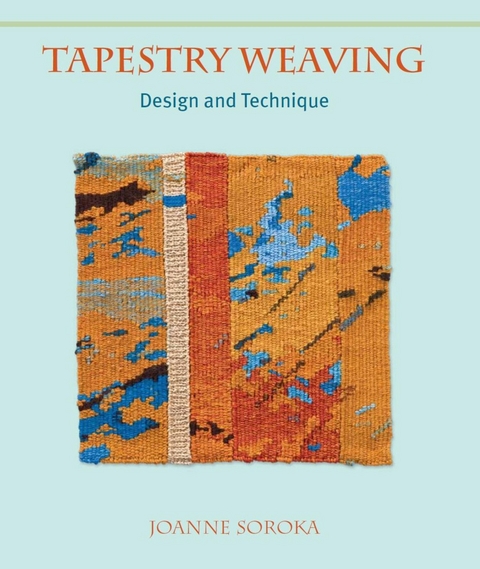

Tapestries were among the most prestigious of art forms, created for the mightiest in the land and valued for centuries. Despite its illustrious history, tapestry weaving is actually a simple technique that requires little equipment or expenditure, and can be done anywhere. Written by a prominent tapestry weaver, this lavishly illustrated book gently leads you through the whole process with detailed diagrams and exciting work by contemporary weavers. It will be useful to the absolute beginner, but experienced weavers will also find new ideas and techniques to tempt and inspire them.
2 THE ORIGINS AND HISTORY OF TAPESTRY WEAVING
While it is not possible to detail the entire history of tapestry weaving in a single chapter, this section will consider its high points to give an overview of its progress down the ages. Focusing on Europe and with the emphasis on more recent achievements, we will chart the development of the medium from its beginnings.
Tapestry weaving grew out of cloth weaving about 3,000 to 4,000 years ago. Textiles are robust, but they are also subject to damage from moisture and pests, not to mention grave robbers and vandals. Despite these hazards, fragments have been discovered in the tombs of two of the pharaohs who died in the fourteenth and fifteenth centuries BCE, Thutmose IV and Tutankhamun, preserved by the dry air of the Egyptian desert and the fact that the tombs were not opened until relatively recently. These are the oldest known surviving tapestries, but whether they were woven in Egypt or imported from Mesopotamia (present-day Iraq and Syria) is not known. Tapestries and their weaving are described by Homer in The Odyssey, which is thought to date from the eighth century BCE. Other fragments dating from the third or fourth century BCE to the first century CE have been found in regions as far apart as the Ukraine, Peru, Syria and China.
While we have these tantalizing remnants of early tapestry, little is known of its exact origins, or how it spread through the world. It is likely that it arose in different places that had no communication with each other. We do know that some early cultures practised tapestry with a high level of skill, so it is possible that tapestries were already being made for a long time before the fifteenth century BCE.
COPTIC TAPESTRY
The first real flowering of the medium, at least the one where we have many examples to document it, came in the early years of the first millennium, from the fourth to the twelfth century. The Copts were early Egyptian converts to Christianity, at first mostly Greeks and Jews who lived in Alexandria. But it is thought that by the end of the fourth century, about 80 per cent of the country’s population was Christian. They buried their dead rather than using the older practice of mummification and dressed them in garments decorated with bands of tapestry weaving. During the era in which they were weaving, a great variety of motifs was used, from decorative devices using vines, to birds, animals and human figures. Colours are often vivid, with the use of blues, reds, browns, purples, yellows and blacks.
Coptic tapestry portrait. Made in the fourth century in wool and linen, this is thought to represent the goddess Venus (Aphrodite). There is some shading in the hair and face, which stand out from the background, and the eyes are highlighted. Photograph © Victoria and Albert Museum, London.
The practice of tapestry expanded from garments to include cushions and curtains, and then to wall-hung tapestries, woven in the home, in workshops and in monasteries. Influences can be seen from the Greco-Roman tradition, from Egypt and from Syrian and Persian sources. Unexpectedly, specifically Christian motifs are rare.
These charming small tapestries often show Greek gods and goddesses with plants, birds and animals. A limited amount of modelling, or three-dimensional quality, was initially created through the use of gradations of colour, but later tapestries make use of areas of flat colour without any attempt at dimensionality and perspective. Heads are large; eyes are often also large and emphasized as though with eyeliner. Figures are also usually outlined.
MEDIEVAL EUROPEAN TAPESTRY
Among tapestry lovers and historians, the period around the late fourteenth and fifteenth centuries is considered the golden age of European tapestry, in particular in what are now France, Flanders and Germany. Tapestries were numerous, at least for the wealthy, decorating the walls of castles, but they also served more mundane functions as saddles and cushions.
Workshops had been established in Paris, Arras, Tournai and Brussels, and there are records of guilds of tapestry weavers at the end of the thirteenth century. Women were, of course, prohibited from membership of guilds, although tapestries were also made on a smaller scale by nuns, in what are now Switzerland and Germany. The workshops were able to employ teams of weavers to create large tapestries or even sets of tapestries on a grand scale. However, because of the lack of documentation, we sometimes don’t know which tapestries were woven in which workshop, or even in which country.
While weavers were not well paid, the time taken to weave large tapestries and the cost of materials meant that patronage was needed. Charles V of France (1338–80) was a great patron of tapestry from French and Flemish workshops. Two other important connoisseurs at the time were Philip the Bold, Duke of Burgundy, and Louis, Duke of Anjou, the brother of Charles V, and this patronage greatly helped to stimulate the development of tapestry.
The Apocalypse Tapestries
The most famous and most revered tapestries of this golden age are the set of Apocalypse tapestries, woven c.1373–80, now on display at the Château d’Angers in France. Commissioned by Louis, Duke of Anjou, and designed by the Flemish Hannequin de Bruges, who worked in Paris, it eventually consisted of seven enormous panels, each about 15ft (4.6m) high and up to 80ft (24.4m) long. They depict in gory detail the events recounted by St John in Revelation, the last book of the New Testament, in about 105 scenes, of which only sixty-seven survive in whole or in part.
Each scene illustrates an episode in the story of the last days of the world, as detailed by St John. In a limited range of twenty-four colours, they include dragons and seven-headed beasts, angels and grasshoppers. It is wonderfully and completely literal in its interpretation. For example, the panel depicting ‘the sleep of the just’ shows seven bearded men sharing two beds.
In this thirty-eighth scene from the Apocalypse tapestries, the seven-headed serpent tries to drown the woman in a flood, which pours from its mouth, but the earth opens to save her, as St John the Divine looks on. The water is rendered in a stylized manner. Hatching can be seen at the bottom of the tapestry, which was woven on its side. Photograph © Caroline Rose, Centre des Monuments Nationaux, Paris.
Backgrounds alternate between red and blue, with later tapestries in the series including stylized plants and patterns. A limited number of main figures, whether angels, people or animals, may stand on islands of flower-strewn meadow or look down to Earth from a bank of clouds. In common with all European art of this period, there is only a minimum amount of perspective or modelling. Hatching is used in a limited way. This is a form of shading in which two colours are toothed together, allowing an intermediate colour to be created by the overlap. We can see the shape of the drapery of clothing, but there is nothing painterly about the interpretation. Hair, feathers and water are rendered in a stylized manner using few shades, but they are instantly recognizable for what they are. Each scene is packed with event, but, on the other hand, nothing is superfluous. Dreadful and marvellous events are shown. The Beast of the Sea and the Beast of the Earth are thrown into the pit of burning sulphur, or frogs emerge from the mouths of the seven-headed dragon. This is magnificent storytelling, a tale of good triumphing over evil, of punishment of sinners. We can only imagine how impressed the people of the time were, seeing in splendid detail what they had only heard from the pulpit.
The Lady and the Unicorn
The Lady and the Unicorn (La Dame à la Licorne) is another acclaimed set of tapestries, but its subject matter and intent are completely different from those of the Apocalypse. While still having some narrative quality, its emphasis is on sensuality and beauty, and it is secular rather than religious.
Made at the end of the fifteenth century in Flanders, this set of six tapestries, each about 12ft (3.7m) square, now hangs in the Musée National du Moyen Age (Cluny Museum) in Paris. The tapestries show a beautiful woman dressed fashionably and luxuriously, surrounded by flowers and friendly animals, most notably a lion and a unicorn. Five of the panels each depict one of the senses, with To My Only Desire (A Mon Seul Désir) a mystery. This is, however, the only one of the series whose title we can be sure of, since it is woven into the tent band above the lady’s head.
Tracy Chevalier, in her novel The Lady and the Unicorn, imagined how the tapestries might have been commissioned and woven, but few facts are known about the weaving or the meaning of the tapestries. They were certainly made for the family of Jean Le Viste, one of the noblemen in the court of Charles VII, since its heraldry appears in each tapestry. Much has been written about the possible meanings of the tapestries, and in particular To My Only Desire, but it is not even known whether this is the first or the last of the series. The most popular interpretations are that it is about a virgin seducing a unicorn, the Virgin Mary and Christ, or about the refusal to be ruled by one’s senses only and about resisting temptation. In To My Only Desire, is the lady taking off her necklace, which might support the last reading, or putting it on? In medieval times, every flower, tree and animal in a work such as this had a symbolic meaning.
The...
| Erscheint lt. Verlag | 31.5.2015 |
|---|---|
| Verlagsort | London |
| Sprache | englisch |
| Themenwelt | Sachbuch/Ratgeber ► Freizeit / Hobby ► Handarbeit / Textiles |
| Sachbuch/Ratgeber ► Freizeit / Hobby ► Heimwerken / Do it yourself | |
| ISBN-10 | 1-78500-065-9 / 1785000659 |
| ISBN-13 | 978-1-78500-065-2 / 9781785000652 |
| Informationen gemäß Produktsicherheitsverordnung (GPSR) | |
| Haben Sie eine Frage zum Produkt? |
 EPUB (Adobe DRM)
Kopierschutz: Adobe-DRM
Adobe-DRM ist ein Kopierschutz, der das eBook vor Mißbrauch schützen soll. Dabei wird das eBook bereits beim Download auf Ihre persönliche Adobe-ID autorisiert. Lesen können Sie das eBook dann nur auf den Geräten, welche ebenfalls auf Ihre Adobe-ID registriert sind.
Details zum Adobe-DRM
Dateiformat: EPUB (Electronic Publication)
EPUB ist ein offener Standard für eBooks und eignet sich besonders zur Darstellung von Belletristik und Sachbüchern. Der Fließtext wird dynamisch an die Display- und Schriftgröße angepasst. Auch für mobile Lesegeräte ist EPUB daher gut geeignet.
Systemvoraussetzungen:
PC/Mac: Mit einem PC oder Mac können Sie dieses eBook lesen. Sie benötigen eine
eReader: Dieses eBook kann mit (fast) allen eBook-Readern gelesen werden. Mit dem amazon-Kindle ist es aber nicht kompatibel.
Smartphone/Tablet: Egal ob Apple oder Android, dieses eBook können Sie lesen. Sie benötigen eine
Geräteliste und zusätzliche Hinweise
Buying eBooks from abroad
For tax law reasons we can sell eBooks just within Germany and Switzerland. Regrettably we cannot fulfill eBook-orders from other countries.
aus dem Bereich